
Épisode · Wiki Storia
S1 - E3 | Life in the Trenches
How did soldiers live during the war?
On the road to knowledge with music for 3 to 6 year olds!
Today, we are going to learn about the lives of soldiers during the war.
Pictures of our little adventurers in action - can you come and play with them?
🎼 Ready to move, sing and dream?
This first melody will take you on a musical discovery of the world!
🎤 Move, sing, discover!
Let's get adventurous with this second soundtrack. 😀
🎙 Read the lyrics to our music:
The lyrics of the two songs are identical, only the melodies are different.
The adventure begins with a story and discoveries for 6 - 8 year olds!
📻 Listen to this article as a podcast
For an immersive experience, enjoy our article in podcast mode. Click the player below to start listening and let the article carry you away!
📝 Quick summary of key information
Trenches were very long and deep ditches dug in the ground. Soldiers used them to protect themselves from enemy attacks. It was like tunnels where they could hide and feel safe.
In the trenches, the soldiers spent their days watching for the enemy, fixing the defenses, and waiting. They had to be very alert and ready to react quickly. Sometimes, they played games or wrote letters to their families to pass the time.
Life in the trenches was very hard. It was often cold and wet, and there was lots of mud. The soldiers had to deal with the noise of bombs and constant fear. They often slept on the ground in very uncomfortable conditions.
Even though they were scared and things were hard, the soldiers helped each other. They shared moments of friendship, helped each other out, and cheered each other up. Sometimes, they sang songs or told stories to feel better. These moments of togetherness were very important to keep hope alive.
Life in the Trenches
How did soldiers live during the war?
The Trenches and Moments of Friendship
With the help of Papy Henri and Opa Friedrich, Louis and Karl started exchanging secret letters. These messages, carried by a little carrier pigeon named Pépin, talked about their families, their games, and their fears. Each letter was a fragile but precious bridge between their worlds, even though the war was raging (1). Louis, in his attic full of memories, always eagerly awaited letters from his cousin. One day, a letter arrived, different from the others. It contained a story that Karl had heard from Opa Friedrich.
Karl, with a shy smile, begins to tell:
« Karl, Opa Friedrich read me a story. »
Louis, curious, asks:
« What is this story? »
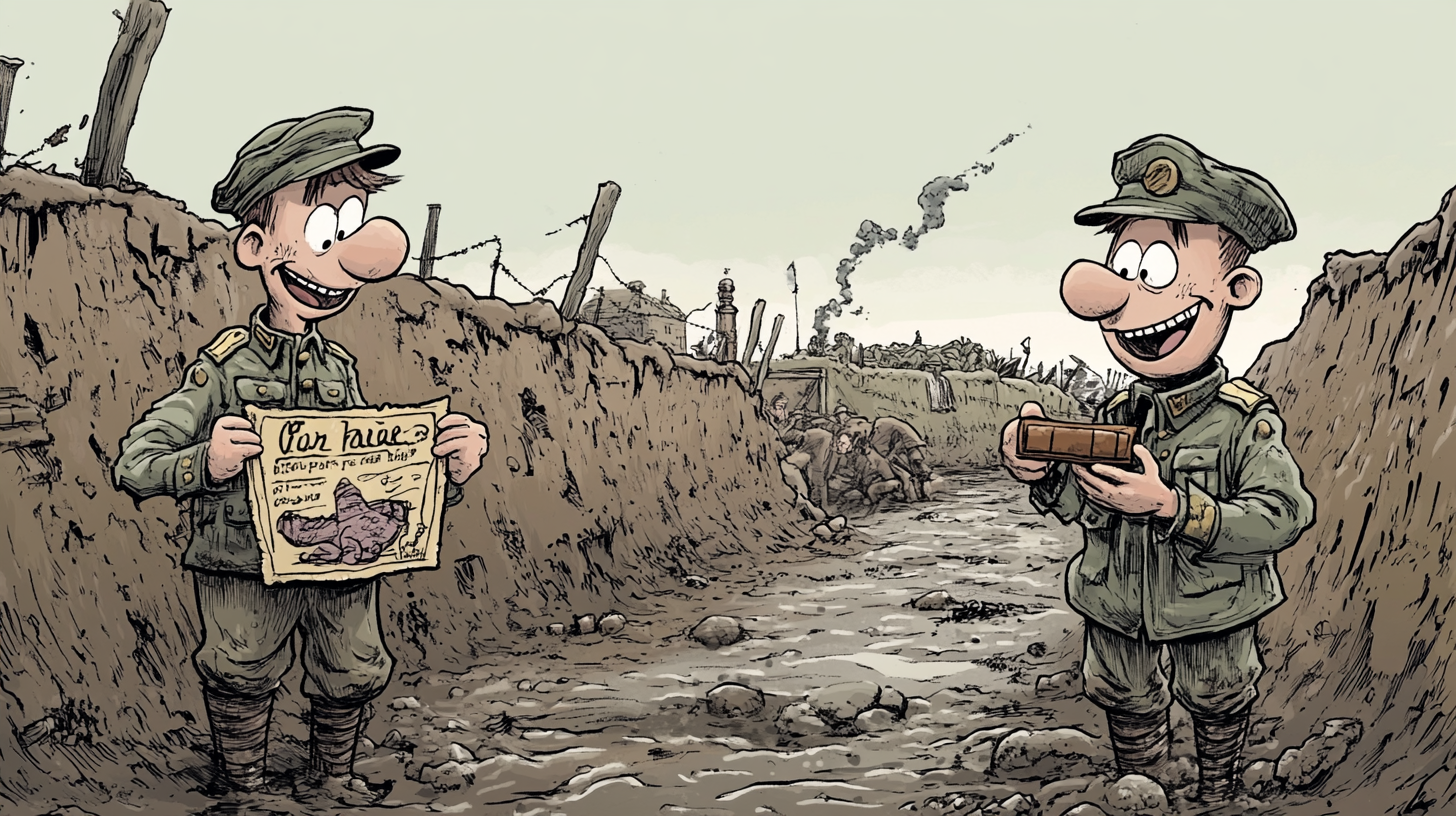
Karl, with sparkling eyes, then tells: « A German soldier shared chocolate with a French soldier during a truce (2). »
Louis, curious about his cousin's words, then asks:
« What is a truce? »
Karl, looking out the window, tells Louis:
« A break in the war. The soldiers are not fighting anymore. »
Louis, after listening carefully, says:
« It's nice, the truce. The soldiers eat chocolate together. »
After imagining the soldiers in their trenches (3), sharing moments of friendship (4) despite the war, Louis thought about the fear they must have felt. But also about the warmth that could be born in these brief moments of peace. Louis decided to write a letter to his cousin. He took a piece of paper and a pencil, then began to write.
Resilience and Hope
Louis finished his letter. He carefully folded it and slipped it into an envelope. He wondered how soldiers could find the strength to laugh in such conditions. He remembered Papy Henri's stories about the soldiers' resilience (5).
Louis, curious about his grandfather's stories, asks:
« Opa Friedrich, what is resilience? »
Papy Henri, with his white mustache and his mailbag, then explains to Louis:
« It is the strength to keep going despite the difficulties. The soldiers in the trenches help each other. »
Louis, curious about his grandfather's story, asks: « Do they share their food (6)? »
Papy Henri, with a soft smile, tells:
« Yes, and they warm up around a campfire. They play games to forget about the war. »
Louis, curious about his grandfather's stories, asks:
« Do they laugh together? »
Papy Henri, with a reassuring smile, explains to Louis:
« Yes, they find moments of joy. They show that even in war, there is hope. »
Days passed, and the letters kept coming from far away. A new letter arrived, written by Karl. Louis, curious, opened it and read a sad story. Karl told about how his neighbor's brother would not be coming back from Verdun. Louis, sitting in the attic, read the letter in silence, his heart heavy. He knew that Verdun was a place with lots of fighting. A little bird, perched on the windowsill, seemed sad too. Louis then thought about the next letter he would write. He wanted to talk about happy moments to keep in touch with his cousin, despite the war.
📺 Watch this article in video format
For an even more immersive experience, watch our video: