
Épisode · Wiki Storia
S1 - E5 | Women at Work
What did the women do while the men were at the front?
On the road to knowledge with music for 3 to 6 year olds!
Today, we are going to discover women during the war.
Pictures of our little adventurers in action - can you come and play with them?
🎼 Ready to move, sing and dream?
This first melody will take you on a musical discovery of the world!
🎤 Move, sing, discover!
Let's get adventurous with this second soundtrack. 😀
🎙 Read the lyrics to our music:
The lyrics of the two songs are identical, only the melodies are different.
The adventure begins with a story and discoveries for 6 - 8 year olds!
📻 Listen to this article as a podcast
For an immersive experience, enjoy our article in podcast mode. Click the player below to start listening and let the article carry you away!
📝 Quick summary of key information
During the war, men were at the front fighting. This meant they were not at home to work in factories, farms, schools, or hospitals.
Women then took their place. They worked hard in factories to make weapons and equipment needed for the war. They also grew food in the fields to feed everyone.
In schools, they taught the children, and in hospitals, they cared for the injured. Their work was very important so that the country could keep running normally.
With their bravery and determination, the women supported the families and the soldiers. They showed that they could face all the challenges.
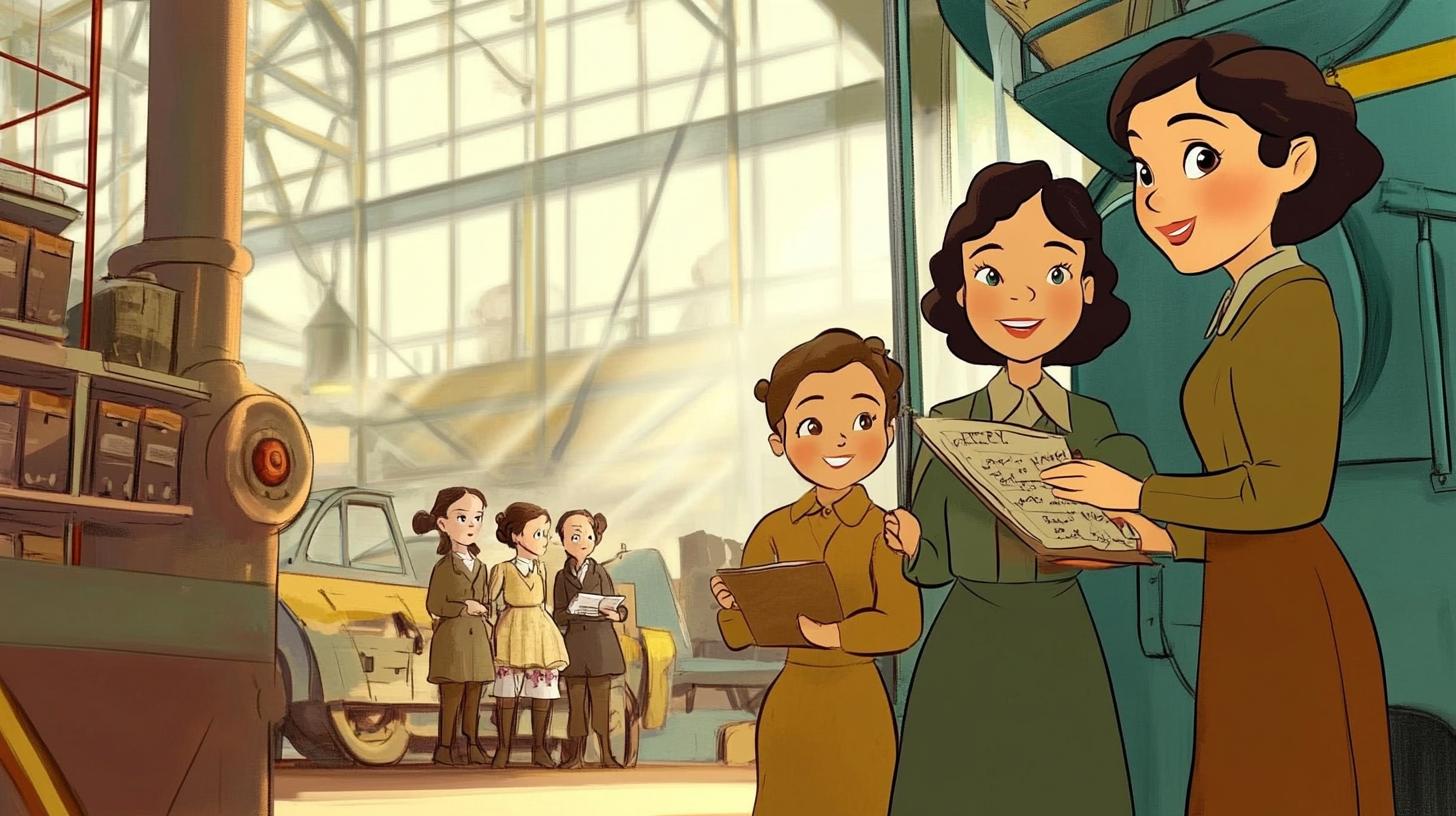
Women at Work
What did the women do while the men were at the front?
Women are taking the place of men
Louis folds the letter, his eyes still wet. He imagines the battlefields of Verdun, where thousands of soldiers, including war dogs like his cousin's German Shepherd, had lost their lives. He understands that even far from the front, the war affected everyone, including women and children. After putting the letter away in his attic, Louis goes downstairs to join Louis' Mother in the kitchen. Louis' Mother, always active and full of energy, is preparing dinner while telling him about her days at school. She talks about the children she teaches and the challenges she faces. Louis listens carefully, curious about the role of women during the war.
Louis, curious, asks:
« Mom, what are you doing at school? »
Louis' Mother, while stirring the soup, explains to Louis: « I teach the children. They learn their lessons and the importance of solidarity (1). »
Louis, curious, asks:
« And the women of the village? »
Louis' Mother, while stirring the soup, explains:
« They make uniforms and work in the fields. They are very brave. »
Louis, after thinking, says:
« That's good. I will write to Karl. He needs to know this. »
Not long after, Karl receives a letter from Louis. In his letter, Louis talks about his mother who keeps on teaching, and the women in the village who make uniforms or work in the fields. Karl sends a photo of his own mother in front of a military hospital. So, the two cousins understand that women are war heroes too.
Women, war heroes
Karl decides to visit Opa Friedrich. He wants to learn more about the women during the war.
Karl, curious, asks his grandfather:
« Opa Friedrich, what do women do during the war? »
Opa Friedrich, after thinking for a moment, explains to Karl: « They work in the factories. They make ammunition (2). »
Karl, curious, asks:
« What else do they do? »
Opa Friedrich, after thinking for a moment, explains to Karl:
« They grow the fields. They take care of the wounded. »
Karl, proud of his mother, says:
« My mom takes care of the soldiers. She is a nurse. »
Opa Friedrich, looking at the letters from his grandsons, says:
« That's good. Women are very brave. »
Louis and Karl's letters keep traveling across borders, bringing news from their homes. One day, Louis goes to the small country train station with Papy Henri. They see a train full of young soldiers leaving. Train stations, silent witnesses of departures and returns, have left a mark on people's memories during the war, becoming symbols (3) of separation and hope. As Louis watches the train disappear, he thinks of all the stories he has heard and the heroines he has discovered. He promises to keep writing to Karl, to share their discoveries and hopes. Soon after, Louis receives a new letter from Karl, who talks this time about the preparations for the armistice (4). The two cousins get ready to live a new adventure, that of found peace.
📺 Watch this article in video format
For an even more immersive experience, watch our video: