
Épisode · Wiki Storia
S1 - E6 | Farewells at the Quiet Station
Why did train stations stay in our memories during the war?
On the road to knowledge with music for 3 to 6 year olds!
Today, we are going on a journey to discover train stations during the war.
Pictures of our little adventurers in action - can you come and play with them?
🎼 Ready to move, sing and dream?
This first melody will take you on a musical discovery of the world!
🎤 Move, sing, discover!
Let's get adventurous with this second soundtrack. 😀
🎙 Read the lyrics to our music:
The lyrics of the two songs are identical, only the melodies are different.
The adventure begins with a story and discoveries for 6 - 8 year olds!
📻 Listen to this article as a podcast
For an immersive experience, enjoy our article in podcast mode. Click the player below to start listening and let the article carry you away!
📝 Quick summary of key information
Train stations were very important during the war. Soldiers left for the front from there. Many families said goodbye at this place, which made these moments very sad.
Train stations were often linked to the sadness of soldiers saying goodbye to their families. Goodbyes were hard because no one knew when the soldiers would come back.
But train stations were also places of hope. People went there to wait for soldiers to come back or to get news. It was a mix of sadness and hope that stayed in people's memories.
Families felt a big emptiness when the soldiers left. They always hoped to receive letters or telegrams with good news.
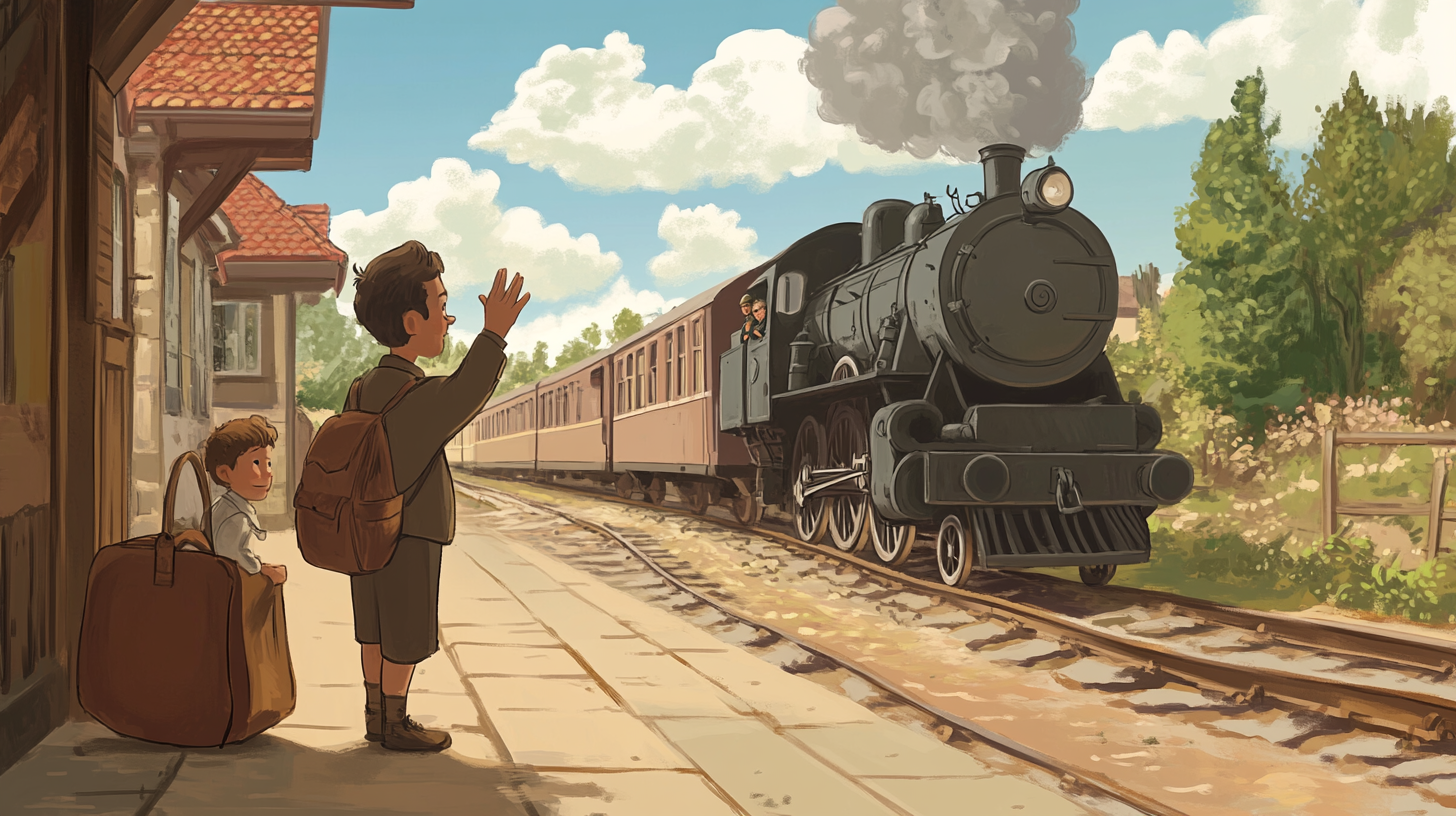
Farewells at the Quiet Station
Why did stations stay in our memories during the war?
Stations, Places of Departure and Hope
After learning that while the men were at the front, the women of his village were helping out, Louis goes to the small countryside train station with Grandpa Henry. His mom, a teacher (1), kept teaching, and the other women made uniforms or worked in the fields. Even the little dog, Marguerite, seemed to understand the importance of these efforts by staying close to the workers (2). It is with this image in mind that Louis goes to the small countryside train station with Grandpa Henry.
Louis, curious, asks:
« Grandpa, why do people come here? »
Grandpa Henry, with a soft and reassuring voice, explains to Louis:
« People are coming to say goodbye to their loved ones. They are going to war. »
Louis, with a heavy heart, whispers:
« Will they come back one day? »
After watching the train full of young soldiers, Grandpa Henry explains to Louis:
« Some will come back. Others, no. Train stations are places of leaving and hope. »
Louis sees families waving handkerchiefs. He hears the train whistles as it goes away. The young soldiers look out the window. Some smile. Others look serious. Louis watches everything. He sees the faces of the young men.
In his letter to Karl, Louis writes the words he heard: 'We'll be back.' And in his heart, he really hopes that everyone will one day find the way home.
Memories and Hopes
Louis carefully folds his letter. He puts it in an envelope. He thinks about Karl, far away in Europe. He hopes his letter will arrive soon.
Louis, after folding his letter, asks Grandpa Henry:
« Grandpa, do you think Karl gets my letters? »
To make Louis feel better, Grandpa Henry explains: « Yes, Louis. Letters travel on secret paths. They cross borders (3). »
Louis, curious, asks then:
« The secret paths? »
Grandpa Henry, with a reassuring smile, explains:
« Yes, friends like me help them travel. They help letters go on a journey. »
Louis imagines the letters traveling through the night. He thinks about the soldiers going to war. He says that the letters bring a little light in the darkness (4). Louis then goes to the little countryside train station with Grandpa Henry.
Days go by and Louis keeps writing to Karl, sharing his discoveries and thoughts. One afternoon, while helping Grandpa Henry clean the attic, Louis finds a dusty box. Curious, he opens it and finds treasures (5) from the past. In the attic, Louis discovers an old helmet, a yellowed journal, and a letter from an unknown soldier, found in a forgotten box. He then wonders why it is important to keep the memories (6) (7) of the war. Louis promises to keep exploring the attic, writing to Karl, and keeping alive the memories of those who fought. He knows that every letter, every memory, is a bridge between the past and the present, a hope for a peaceful future. And with this thought, Louis gets ready for a new adventure, eager to discover even more secrets hidden in the Memory Attic.
📺 Watch this article in video format
For an even more immersive experience, watch our video: