
Épisode · Wiki Storia
S1 - E8 | The Poppy Field, Symbol of Hope
Why did poppies become the symbol of remembrance?
On the road to knowledge with music for 3 to 6 year olds!
Today, we go on a journey to discover poppies.
Pictures of our little adventurers in action - can you come and play with them?
🎼 Ready to move, sing and dream?
This first melody will take you on a musical discovery of the world!
🎤 Move, sing, discover!
Let's get adventurous with this second soundtrack. 😀
🎙 Read the lyrics to our music:
The lyrics of the two songs are identical, only the melodies are different.
The adventure begins with a story and discoveries for 6 - 8 year olds!
📻 Listen to this article as a podcast
For an immersive experience, enjoy our article in podcast mode. Click the player below to start listening and let the article carry you away!
📝 Quick summary of key information
Poppies are pretty red flowers that often grow in fields. You can also see them in destroyed battlefields, where they symbolize life coming back after war and peace.
Poppies remind us of soldiers who fought and died in battles. They grow where battles took place.
In November, people wear poppies during ceremonies to honor soldiers who died in battle. It is an important time to remember and pay tribute to their bravery.
For families and communities, the poppy is a special symbol. It reminds us of the sacrifices made by soldiers and encourages us to promote peace.
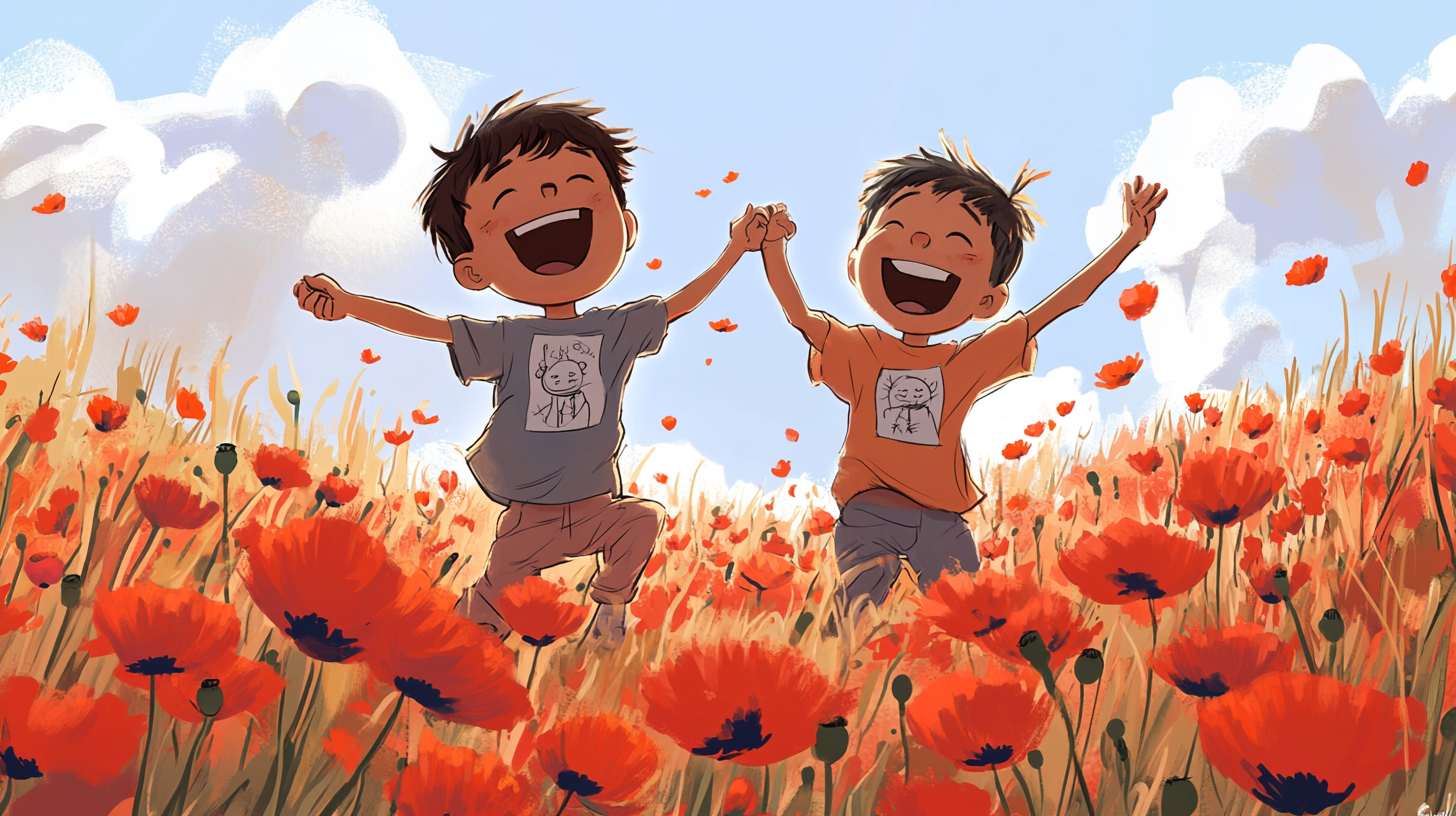
The Poppy Field, Symbol of Hope
Why did the poppies become the symbol of remembrance?
Letters of the Heart
After finding the soldier's helmet and letter, Louis realizes that war memories are precious. He thinks about his cousin Karl, in Germany, and their grandfathers, Papy Henri and Opa Friedrich, who were friends before the war. He decides to write to Karl to share these memories and keep their friendship alive despite the distance. Louis, a lively and sensitive (1) boy with black hair, wearing a beret and a knitted scarf, goes to the memory attic (2) of his house. He sits among the letters and cards and starts writing to his cousin Karl, a blond boy with round glasses, always in a long winter coat.
Louis, with shining eyes, starts by asking:
« Karl, do you know poppies? »
Karl, with a nostalgic smile, begins to speak:
« I remember the poppy fields near our house. They are so red and so beautiful. Do you remember when we ran in them last summer? »
Louis, thinking about his cousin, starts to talk:
« I remember that even in battlefields, poppies sometimes grow. It's strange, but it's beautiful. It's like they want to remind us that life goes on, even after the war. »
Louis, with a heart full of hope, writes to Karl:
« One day, we will run together in a field of poppies, freely, without helmets or guns. »
Louis writes to Karl: 'One day, we will run together in a field of poppies, freely, without helmets or guns.' Meanwhile, in Berlin, Karl receives the letter from Louis. He is touched by his cousin's words and decides to respond. He draws two cousins holding hands in a red field of poppies.
Karl answers with a drawing: two cousins holding hands in a red field. Friendship blooms where the war has ended. Karl sends his letter with the help of Opa Friedrich, who uses his old teacher knowledge to find the safest path. He hopes Louis will soon get his answer.
The Poppies of Remembrance
Not long after, Louis receives the letter from Karl. He opens the envelope and finds (3) the drawing. He is amazed by the two cousins holding hands in a field of red poppies. Louis runs to show the letter to Papy Henri.
Louis, eyes shining, says:
« Papy Henri, look! Karl drew a field of poppies. »
Papy Henri, after looking at the drawing, said:
« It's beautiful, Louis. Poppies are special flowers. »
Louis, curious, asks:
« Why are they special? »
Papy Henri, with a wise smile, explains: « Poppies grow on disturbed soil. They symbolize life reborn after destruction (4). »
Louis, after thinking for a moment, said:
« I want to plant poppies in my garden. »
Papy Henri, thoughtful, says:
« That's a good idea, Louis. The poppies honor the memories of the war and the friendship between you and Karl. »
The letters between Louis and Karl keep arriving, but this time, they bring news full of hope. The children have heard about the peace talks (5) and the efforts to end the fighting. One day, when a carrier pigeon brought a letter from Karl, Louis understood that the end of the war was near. Bells ring in Louis' village. He runs with his mom in the street. Everyone is singing, crying, and hugging. Louis thinks of Karl and imagines a day when they can finally meet in a field of poppies, free and happy. The war is fading away, and the hope for a better future is on the horizon.
📺 Watch this article in video format
For an even more immersive experience, watch our video: