
Épisode · Wiki Storia
S1 - E9 | The Armistice and the Promise of Friendship
How did the children experience the end of the war?
On the road to knowledge with music for 3 to 6 year olds!
Today, we are going to learn about the end of World War One.
Pictures of our little adventurers in action - can you come and play with them?
🎼 Ready to move, sing and dream?
This first melody will take you on a musical discovery of the world!
🎤 Move, sing, discover!
Let's get adventurous with this second soundtrack. 😀
🎙 Read the lyrics to our music:
The lyrics of the two songs are identical, only the melodies are different.
The adventure begins with a story and discoveries for 6 - 8 year olds!
📻 Listen to this article as a podcast
For an immersive experience, enjoy our article in podcast mode. Click the player below to start listening and let the article carry you away!
📝 Quick summary of key information
On November 11, 1918, an agreement called the Armistice ended the fighting of World War I. On that day, soldiers put down their weapons, and people started to hope for a better life. It is a very important day because it marks the end of four long years of war.
When the war ended, the children were very happy. They ran in the streets, sang, and danced to celebrate peace. They hoped they could play freely and go to school without fear. Their hearts were full of hope for a better future.
During the war, life was hard for children. They often didn't have enough food or toys. Schools were sometimes closed, and families had to stick together. Some children even helped their parents by working in the fields or making useful things.
With the end of the war, life for the children changed. Schools reopened and they could learn new things. Families started to rebuild their homes and plant gardens. The children could finally play and have fun without fear.
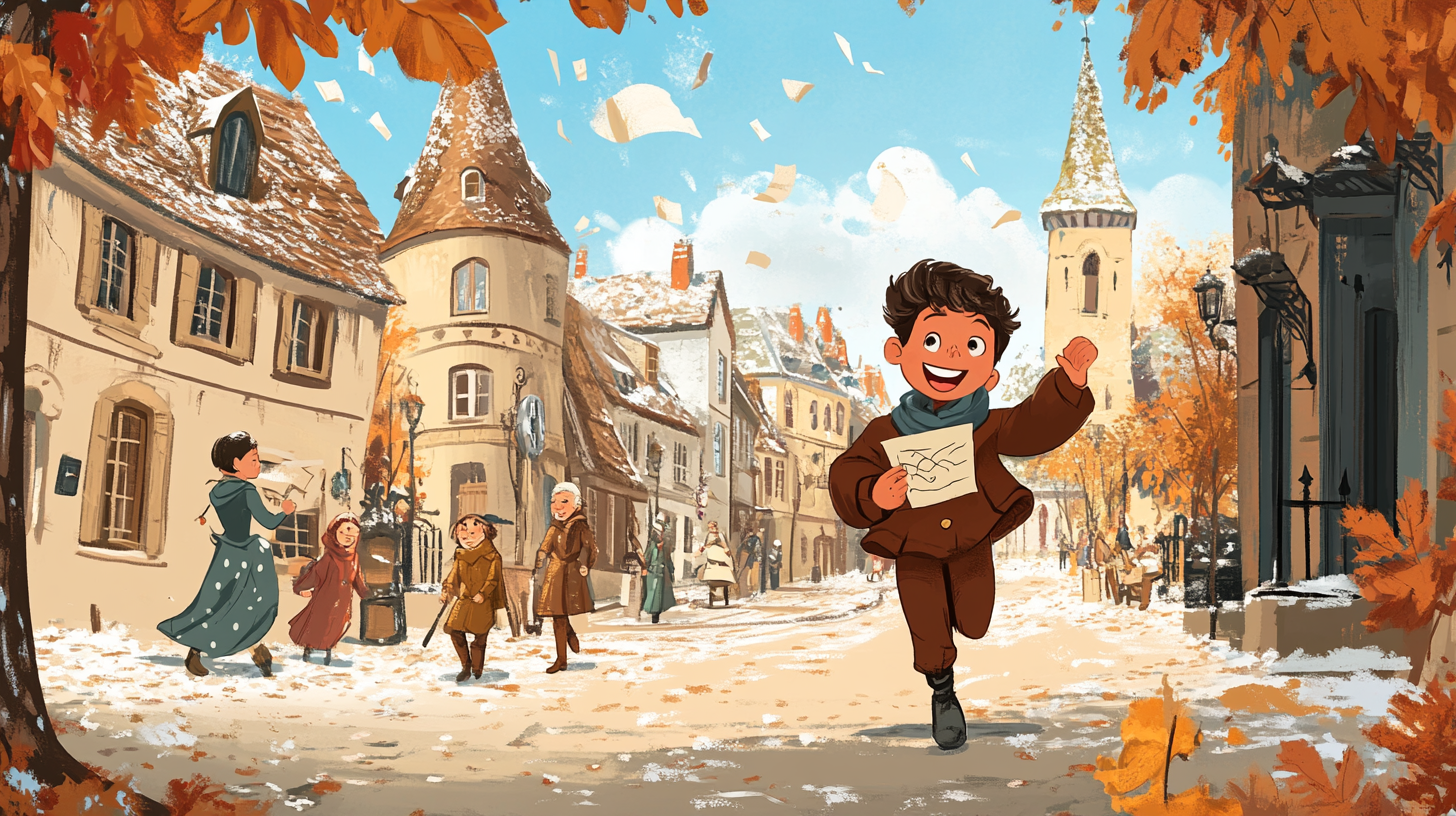
The Armistice and the Friendship Promise
How did the children experience the end of the war?
The Joy of Armistice
Louis taught Karl, his German cousin, that poppies (1), those red flowers that grow on battlefields (2), have become a symbol (3) of remembrance. They remind us of the soldiers who fell and the hope for peace. But one morning, a new sound of bells rang through the village. The sheepdogs barked happily, sensing the excitement in the air. Louis runs with Louis' Mom down the street. He sees Papy Henri, who is smiling from ear to ear. Papy Henri, the former postman (4), knows all the secret paths for delivering letters. He tells Louis that this ringing announces big news. Louis' Mom, always attentive, takes her son's hand and whispers in his ear that it is a special day, a day when the war ends.
Louis, his eyes sparkling with curiosity, asks:
« What is this news, Papy Henri? »
Papy Henri, with a big smile, then says:
« The war is over, Louis. The fighting is finished. »
Louis, with his eyes wide open, asks:
« Is it true? Is the war really over? »
Papy Henri, with a big smile, says:
« Yes, Louis. The bells are ringing to celebrate peace. »
Louis, eyes shining with hope, says:
« I am going to write to Karl. He will be happy to know that the war is over. »
After Louis wrote his letter, he is eager to know how Karl is spending this special day. Louis imagines his cousin reading the letter on a small street in Berlin. It is written in their last letter that they have survived the war and that their friendship must help build peace.
Hope and the Promise
Louis comes down from the attic. He runs to the kitchen. He wants to share the news with Louis' Mom.
Louis, with sparkling eyes, says:
« Mom, the war is over! »
Louis' Mom, smiling, says:
« That's right, Louis. We must celebrate. »
Louis, very excited, says:
« I am going to write to Karl. He will be happy. »
Louis' Mom, with a gentle smile, says:
« That's a good idea. Write to each other often. »
Louis writes a letter to Karl. In it, he talks about poppies, soldiers, and the hope for peace. Louis imagines Karl reading the letter. They promised each other to build peace together.
As the bells keep ringing, Louis and Karl make a promise (5) to keep writing. In their future letters, rebuilding (6), dreams of peace, and maybe even a dog named Max, a German Shepherd, could become a symbol of their friendship and unity (7). Louis, with his beret and scarf knitted by Louis' Mom, has a light heart. He thinks about Karl, his German cousin, and all the letters they have exchanged. He remembers the times when Papy Henri, with his white mustache and mailbag, explained the secret paths to send the letters. Louis' Mom, with her long, curly brown hair and sparkling green eyes, smiles at him and says it is a day of celebration. She tells him that poppies, those red flowers, symbolize hope and the memory of fallen soldiers. Louis imagines Karl, with his round glasses and long winter coat, reading the letter in a small street in Berlin. He wonders how Karl is experiencing this special day.
📺 Watch this article in video format
For an even more immersive experience, watch our video: