
Épisode · Wiki Storia
S1 - E1 | The Mystery of Nerve Cells
What is a nerve cell and how does it work?
On the road to knowledge with music for 3 to 6 year olds!
Today, we are going on a journey to discover the nerve cell.
Pictures of our little adventurers in action - can you come and play with them?
🎼 Ready to move, sing and dream?
This first melody will take you on a musical discovery of the world!
🎤 Move, sing, discover!
Let's get adventurous with this second soundtrack. 😀
🎙 Read the lyrics to our music:
The lyrics of the two songs are identical, only the melodies are different.
The adventure begins with a story and discoveries for 6 - 8 year olds!
📻 Listen to this article as a podcast
For an immersive experience, enjoy our article in podcast mode. Click the player below to start listening and let the article carry you away!
📝 Quick summary of key information
What is a nerve cell and how does it work?
Nerve cells are called neurons. They are like little messengers in our body, always ready to send information.
Neurons send messages as electrical and chemical signals. Imagine a network of tiny wires sending messages all over the body.
Neurons talk to each other using things called synapses. At the synapses, signals go from one neuron to another, like letters traveling from mailbox to mailbox.
Talking between brain cells is very important. It helps our body work properly, like when we move, think, and feel things.
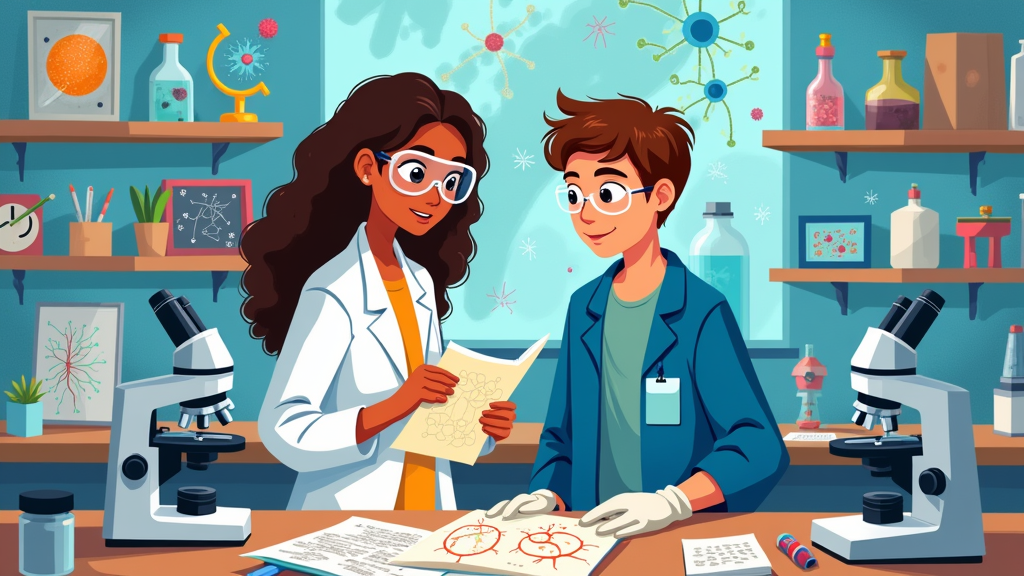
The Mystery of Nerve Cells
What is a nerve cell and how does it work?
The Cell Model Room
In a high-tech lab, Sonia, a passionate and meticulous technical manager, and Leo, a brilliant and curious scientist, spend the morning analyzing complex data. Their goal is to understand the mysteries of neurodegenerative (1) diseases. They are now headed to the Cellular Models Room, ready to dive into a microscopic world where every cell tells a story. Once they arrive, Sonia, wearing a white lab coat and protective glasses, adjusts her glasses and takes out her notepad full of notes, while Leo, wearing a blue lab coat, puts on gloves, ready to uncover the secrets of nerve cells.
Sonia, amazed, says:
« Leo, look at these nerve cells. They are wonderful. »
Leo, while looking carefully at the cells, says:
« Yes, they send messages. It's amazing. »
Sonia, curious, asks:
« How do they talk to each other? »
Leo, after carefully watching the nerve cells, explains: « With electrical and chemical signals (2). The neurons (3) send messages. »
Sonia, amazed, exclaims:
« Wow! We can better understand brain diseases. »
Not long after, Leo notices something unusual. There is a problem (4) with the electrical signals. Sonia, curious, leans in to take a closer look. After a few minutes of concentration, they realize it might be a promising clue to understand a specific disease. They will continue their research.
The Discovery of Synapses
Leo and Sonia get to work. They carefully watch the electrical and chemical signals. They write down notes in their notebooks. They look for clues to better understand the disease.
Sonia, curious, says:
« Leo, did you see that signal? It is very fast. »
Leo, after adjusting the microscope, says: « Yes, it travels through the nerve fibers (5) very fast. »
Sonia, amazed, says:
« Wow. The neurons talk to each other. »
Leo, after taking notes, says:
« Now that we know how neurons talk to each other, we need to test a new way to understand these signals better. This could help us find treatments for brain diseases. »
Sonia, after thinking for a moment, says:
« Okay, let's make some changes. We will succeed. »
After hours of intense concentration, Sonia and Leo leave the Cell Model Room, happy with the adjustments they made. They discovered how neurons communicate and can't wait to use their new knowledge. Their next stop is the Organ-on-a-Chip Lab, where they can explore how these tiny devices mimic the functions of human organs. This exploration opens new doors for medical research and might help them develop treatments for neurodegenerative diseases. Their adventure continues, full of challenges and fascinating discoveries.
📺 Watch this article in video format
For an even more immersive experience, watch our video: