
Épisode · Wiki Storia
S1 - E2 | Chip Organs: A Tiny Revolution
How do organ-on-a-chip devices copy human functions?
On the road to knowledge with music for 3 to 6 year olds!
Today, we are going on a journey to discover organs on chips.
Pictures of our little adventurers in action - can you come and play with them?
🎼 Ready to move, sing and dream?
This first melody will take you on a musical discovery of the world!
🎤 Move, sing, discover!
Let's get adventurous with this second soundtrack. 😀
🎙 Read the lyrics to our music:
The lyrics of the two songs are identical, only the melodies are different.
The adventure begins with a story and discoveries for 6 - 8 year olds!
📻 Listen to this article as a podcast
For an immersive experience, enjoy our article in podcast mode. Click the player below to start listening and let the article carry you away!
📝 Quick summary of key information
How do organ-on-a-chip devices copy human functions?
Organ-on-a-chip are tiny devices that copy the jobs of human organs. Imagine tiny hearts, tiny lungs, or tiny brains in a lab!
These tiny organs help test new medicines without needing humans. It's like having a magical lab where you can try treatments without hurting anyone.
With organ-on-a-chip, we can study diseases like neurodegenerative diseases. These diseases affect the brain and can make everyday life difficult.
Organ-on-a-chip copy how our organs work using cells that act like the ones in our bodies. They help us do fewer tests on animals and people, which is a big help.
Organs on Chips: A Tiny Revolution
How do organs on chips copy human functions?
Chip Organs: A Tiny Discovery
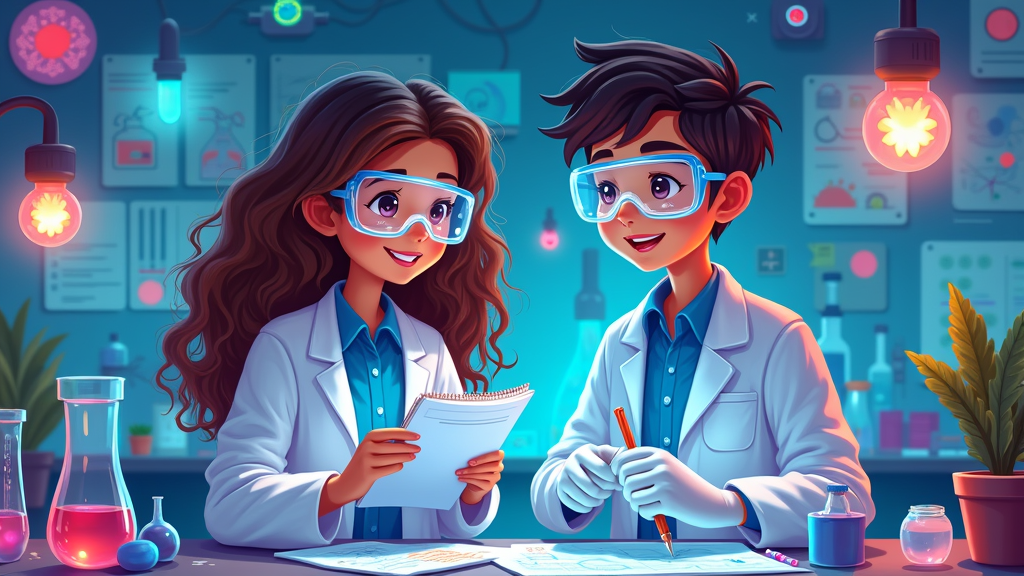
After exploring the mysteries of nerve cells and discovering how rat neurons (1) talk to each other, Sonia and Leo head to the Organ-on-a-Chip Lab. In this new room, they will use tiny devices to copy (2) (3) the functions of human organs and test new treatments (4). Sonia, the tech expert (5), wears a white lab coat, safety glasses, and always has a notepad full of notes. Leo, the smart scientist (6), wears a blue lab coat, gloves, and a name tag.
Sonia, with a determined smile, announces:
« We are going to test these mini-organs. »
Leo, after watching the devices, explains:
« Yes, they copy human functions. »
Sonia, pointing at the devices, says:
« Look, they are very small. »
Leo, amazed, says:
« But they do so many things. »
Sonia, amazed, says:
« Isn't this amazing? »
Leo, with an excited smile, adds:
« Yes, and we can use them to help people. »
Not long after, they find a problem with one of the devices. Sonia and Leo need to work together to fix it.
The Cool Tests
After many hours of work, the device is finally fixed. Sonia and Leo are ready to start their tests.
Sonia, after checking the devices one last time, says:
« Let's go, Leo. Let's start the tests. »
Leo, focused, says:
« Okay, Sonia. Let's watch the reactions. »
Sonia, focused, says:
« Pay close attention to the results. »
After a few minutes of watching, Leo says:
« The tiny organs are working well. »
Sonia, happy, says:
« It's perfect. Let's keep going. »
After a long day of experimenting, Sonia and Leo go to the Science Library, a place full of books and scientific publications. They are looking to learn more about neurodegenerative (7) diseases, drawing inspiration from past discoveries and the work of their colleagues. In this library, they find answers and innovative ideas that could speed up their research. A curious little squirrel watches them, jumping between the shelves, as if sharing their thirst for knowledge. Sonia and Leo know that every discovery brings them one step closer to innovative solutions to improve patients' lives. They are already getting ready for their next adventure, eager to explore new scientific horizons.
📺 Watch this article in video format
For an even more immersive experience, watch our video: