
Épisode · Wiki Storia
S1 - E3 | The Library of Discoveries
Why is it important to read and share science facts?
On the road to knowledge with music for 3 to 6 year olds!
Today, we are going on a Science Adventure.
Pictures of our little adventurers in action - can you come and play with them?
🎼 Ready to move, sing and dream?
This first melody will take you on a musical discovery of the world!
🎤 Move, sing, discover!
Let's get adventurous with this second soundtrack. 😀
🎙 Read the lyrics to our music:
The lyrics of the two songs are identical, only the melodies are different.
The adventure begins with a story and discoveries for 6 - 8 year olds!
📻 Listen to this article as a podcast
For an immersive experience, enjoy our article in podcast mode. Click the player below to start listening and let the article carry you away!
📝 Quick summary of key information
Why is it important to read and share science facts?
Science is the study of nature and things that happen. It helps us understand how the world around us works. It's like being a detective who solves mysteries.
Reading science books helps you find new ideas and learn amazing things. Imagine finding out why the sky is blue or how plants grow!
Sharing science knowledge can be done by talking with friends or doing experiments together. For example, looking at stars or doing simple experiments at home.
Working together, scientists make research better and find things faster. They can solve problems quicker and find new ideas.
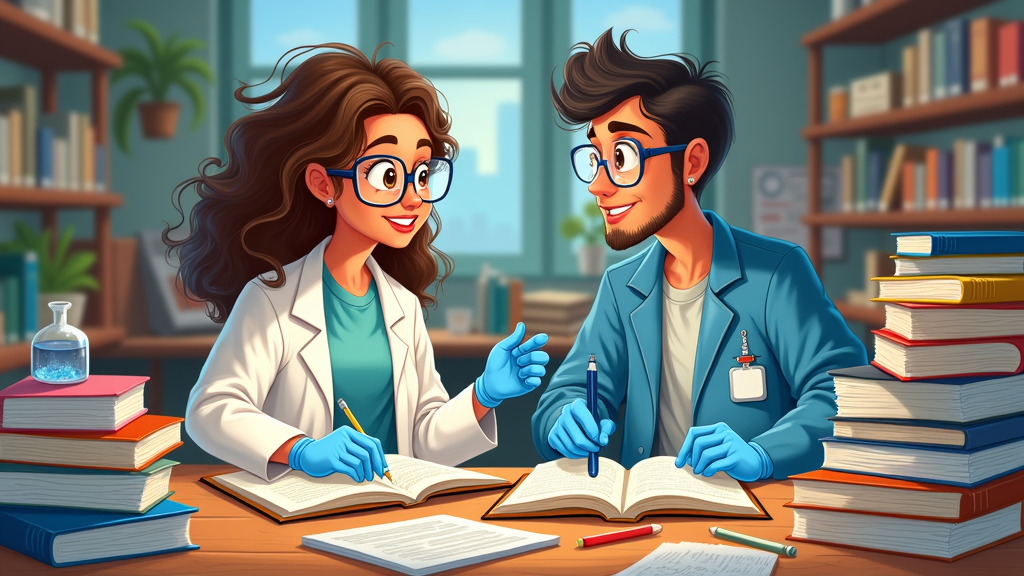
The Library of Discoveries
Why is it important to read and share scientific knowledge?
The Science Library: A Treasure of Knowledge
After a day of experimenting (1) with small devices in the lab, Sonia and Leo go to the Science Library. Their little rat, Einstein, often comes with them. They love to discover new things. Today, they want to learn how the tiny connections (2) in the brain work.
The Science Library is full of books and publications. Sonia and Leo love to read and talk. They often find important (3) information for their research. Today, they are looking for answers about synapses. They hope their discoveries will help them move forward in their experiments.
Sonia, after flipping through several books, says:
« Look at this book about synapses. »
Leo, curious, asks:
« What are synapses? »
Sonia, after turning a page, says: « These are tiny spaces between the neurons (4). They let information travel in the brain. »
Leo, curious, asks:
« Is it like invisible highways? »
Sonia, excited, explains:
« Yes, electrical signals travel very fast. These highways are important for communication between brain cells. »
While reading and talking, they find important information for their research, which helps them move forward in their experiments. After writing down all the useful (5) information, they decide to go back to the lab to use their new knowledge.
Teamwork: The Key to Discovery
After writing down all the important information, they decide to go back to the lab to use their new knowledge. They walk to the Cell (6) Model Room. They carefully prepare their experiment.
Leo, after thinking for a moment, says:
« We need to make a cell model. »
Sonia, as she adjusts her safety glasses, says:
« Yes, this will help us watch the synapses in action. »
Leo, after thinking for a moment, suggests: « Let's use fluorescent (7) dyes to see them under the microscope. »
Sonia, adjusting her safety glasses, says:
« Great idea. It will make the synapses visible. »
After a few adjustments, they manage to watch the synapses in real time. They write down every detail, knowing that these discoveries could change their research on brain diseases (8). They are amazed by what they see.
After spending hours watching synapses live, Sonia and Leo go to the Science Library to learn more. While flipping through special books, they find a fascinating chapter about synapses. It explains how these tiny spaces between neurons let information travel in the brain. Their teamwork and curiosity lead them to a new discovery that could change the lives of many patients. As they head home, they know they still have a lot to explore and learn, but they are ready to face all challenges. Their next adventure is already waiting, full of scientific mysteries to solve.
📺 Watch this article in video format
For an even more immersive experience, watch our video: