
Épisode · Wiki Storia
S1 - E4 | The Magic of Synapses
What is a synapse and what is its role in the brain?
On the road to knowledge with music for 3 to 6 year olds!
Today, we are going on a journey to Discover Synapses.
Pictures of our little adventurers in action - can you come and play with them?
🎼 Ready to move, sing and dream?
This first melody will take you on a musical discovery of the world!
🎤 Move, sing, discover!
Let's get adventurous with this second soundtrack. 😀
🎙 Read the lyrics to our music:
The lyrics of the two songs are identical, only the melodies are different.
The adventure begins with a story and discoveries for 6 - 8 year olds!
📻 Listen to this article as a podcast
For an immersive experience, enjoy our article in podcast mode. Click the player below to start listening and let the article carry you away!
📝 Quick summary of key information
What is a synapse and what is its role in the brain?
A synapse is a connection point between neurons, those little cells that are in our brain. Synapses let neurons talk to each other by sending signals.
Synapses are very important because they play a big role in how brain cells talk to each other. Thanks to them, our brain can work properly and help us think, move, and feel things.
Signals go from one neuron to another through the synapses. It's like neurons passing secret messages so our brain can work well.
If the synapses did not work properly, our brain would have a hard time talking and doing all the things it usually does. Luckily, they are there to help us work well every day.
The Magic of Synapses
What is a synapse and what is its role in the brain?
Discovering Synapses
After spending hours flipping through old and new books in the Science Library, Sonia and her little beagle dog, Pixie, found fascinating articles about synapses (1). Leo, captivated by their discoveries, joined them to talk about the implications of this research on neurodegenerative (2) diseases. They decided to put their new knowledge to practice in their lab. Soon after, Sonia and Leo went to the Cell Model Room. They observed neurons in action under the microscope.
Sonia, after looking at the neurons under the microscope, explains:
« Synapses are connection points between neurons. »
Leo, curious, asks:
« What does this mean? »
Sonia, with a smile lit up by discovery, explains: « These synapses allow electrical and chemical signals to be sent (3). »
Leo, curious, asks then:
« Why is this important? »
Sonia, after checking her notes, explains:
« These connections are important for the brain to work. »
They understand that synapses are very important for the brain to work and that studying them can help us understand diseases like Alzheimer's better. They decide to keep researching to learn more.
Experiments on Synapses
After understanding the importance of synapses, Sonia and Leo go to the Organ-on-a-Chip Lab. They use tiny devices to copy the functions of human organs.
Leo, excited, announces:
« We are going to observe the synapses with these neural chips. »
Sonia, while adjusting her safety goggles, says:
« Yes, these tools are very helpful for our experiments. »
Leo, concentrating, says:
« Now that we have these neuron chips, I am going to use them to play with the synapses and watch how they react. »
Sonia, focused, says:
« Now that you've started to play with the synapses using the neuron chips, I will watch how they react and record the data for our study. »
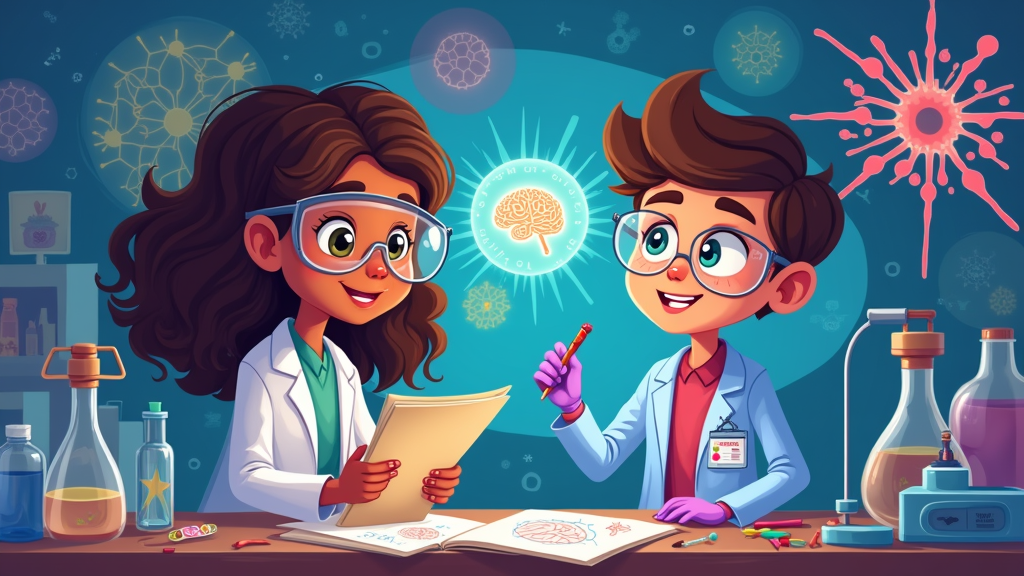
Leo carefully handles the organ-on-a-chip devices, wearing his blue lab coat, gloves, and badge. Sonia, attentive, in her white lab coat and protective glasses, watches the reactions of the synapses under the influence of different substances (4), with her notebook full of notes in her hand. It is then discovered that some molecules (5) can improve communication between neurons, while others can disrupt it.
With a new understanding of synapses, Sonia and Leo head to the Control Room. There, they analyze the results of their experiments on screens and computers, looking for patterns and trends to advance their research on neurodegenerative diseases. Their hard work and discoveries bring them closer to innovative solutions. They know there is still much to explore, but they are determined to continue their scientific quest. Their next adventure might lead them to discover new molecules that can protect synapses and improve the lives of patients.
📺 Watch this article in video format
For an even more immersive experience, watch our video: