
Épisode · Wiki Storia
S1 - E7 | The Magic of Microscopes
How do microscopes help scientists see the invisible?
On the road to knowledge with music for 3 to 6 year olds!
Today, we are going to explore microscopes.
Pictures of our little adventurers in action - can you come and play with them?
🎼 Ready to move, sing and dream?
This first melody will take you on a musical discovery of the world!
🎤 Move, sing, discover!
Let's get adventurous with this second soundtrack. 😀
🎙 Read the lyrics to our music:
The lyrics of the two songs are identical, only the melodies are different.
The adventure begins with a story and discoveries for 6 - 8 year olds!
📻 Listen to this article as a podcast
For an immersive experience, enjoy our article in podcast mode. Click the player below to start listening and let the article carry you away!
📝 Quick summary of key information
How do microscopes help scientists see the invisible?
A microscope is a very special tool that helps you see very small things. Scientists use it to look at things that are too tiny to see with just your eyes, like cells and molecules.
Microscopes help us see amazing details, like nerve cells. These cells are very important for understanding how our body works. They send messages between our brain and the rest of our body.
Scientists use microscopes to see how nerve cells talk to each other. This helps us learn how our bodies work and find cures for some illnesses.
With microscopes, scientists can see things that are too small to see with just our eyes. They can understand complicated processes. This is very important for medical research and for improving our health.
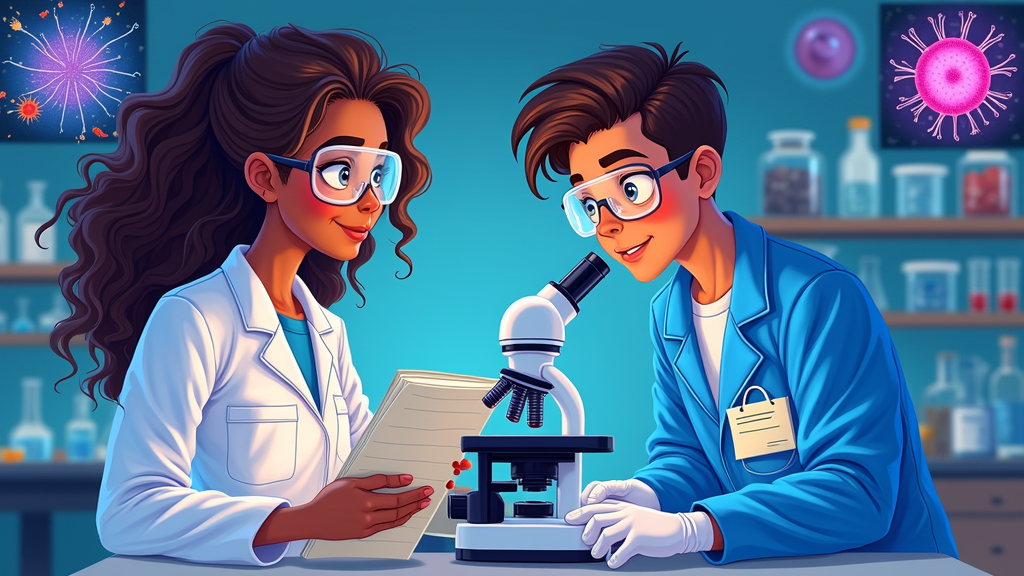
The Magic of Microscopes
How do microscopes help scientists see the invisible?
The Secrets of Nerve Cells
After learning more about neurodegenerative (1) diseases, Sonia and Leo, two explorers from the neurology lab (2), head to their advanced lab. Using an electron (3) microscope, they observe nerve cells (4) from mice and look for ways to treat them. Sonia, the technical expert, and Leo, the brilliant scientist, combine their skills to study neurodegenerative diseases. Together, they use cell models and organ-on-a-chip to conduct amazing experiments. Join them in their daily adventures where every technical challenge and scientific discovery brings them closer to innovative solutions to improve patients' lives.
Leo, fascinated by what he sees, says:
« Look at this nerve cell, it has interesting problems. It seems like it's not talking properly to its neighbors. Maybe this is a sign of what we're trying to understand about neurodegenerative diseases. »
Sonia, writing notes in her notebook, says:
« Yes, let's write down these strange things. They might give us clues about how nerve cells talk to each other. This could help us understand diseases that affect the brain and nerves better. »
After many hours of observing, they realize that this strange thing might be the key to understanding a specific neurodegenerative disease. They then go to the Science Library to find more information.
Leo, walking towards the shelves, says:
« Let's look for recent articles. »
Sonia, after reading many articles, says:
« Found it! These articles confirm our observations. »
Excited by this discovery, they go back to the Cell Model Room to do more research. However, they have a technical problem with the microscope. Sonia, with her expertise, manages to fix it quickly.
With microscopes (5), they can see tiny parts that are too small to see with just their eyes. This helps them understand diseases that affect the brain and nerves better. But to be sure, they need to do more experiments. They found a strange cell that reacts differently to treatments. This discovery could change how these diseases are treated forever.
The Rise of Tension
Sonia and Leo go to the Cell Model Room. They want to check if the reaction of abnormal nerve cells is the same with other types of cells. They prepare new samples.
Sonia, with clear determination, suggests:
« Let's look at the cells under the microscope. »
Leo, focused, suggests:
« Okay, let's adjust the light. »
Sonia, after adjusting the microscope, says:
« The cells are reacting well. »
Leo, amazed, shouts: « We can see the axons (6) and dendrites (7) connecting. It's amazing to see how nerve cells talk to each other. This could help us understand neurodegenerative diseases better. »
After several hours, they saw that the results were positive. They decided to write down all their observations. As they continued to explore the mysteries of nerve cells, Sonia and Leo realized that the true magic of science lies in collaboration. They knew that to go further, they needed to join forces with other researchers and experts. Their next adventure would take them to a world where innovation is born from teamwork and shared curiosity. They were already preparing to share their discoveries with the scientific community, hoping that their work would inspire other researchers to continue their studies. Together, they knew they could make a significant difference in the fight against neurodegenerative diseases.
📺 Watch this article in video format
For an even more immersive experience, watch our video: