
Épisode · Wiki Storia
S1 - E9 | The Journey to New Treatments
How can new science discoveries make patients' lives better?
On the road to knowledge with music for 3 to 6 year olds!
Today, we are going to explore new scientific discoveries.
Pictures of our little adventurers in action - can you come and play with them?
🎼 Ready to move, sing and dream?
This first melody will take you on a musical discovery of the world!
🎤 Move, sing, discover!
Let's get adventurous with this second soundtrack. 😀
🎙 Read the lyrics to our music:
The lyrics of the two songs are identical, only the melodies are different.
The adventure begins with a story and discoveries for 6 - 8 year olds!
📻 Listen to this article as a podcast
For an immersive experience, enjoy our article in podcast mode. Click the player below to start listening and let the article carry you away!
📝 Quick summary of key information
How can new science discoveries make patients' lives better?
Scientific discoveries are like hidden treasures that scientists find to help us live better. They are important because they help us cure diseases and make the world healthier.
Scientists find new treatments and medicines. For example, they make remedies that can cure or help with illnesses. These discoveries help treat illnesses better, which makes patients feel much better.
Brain diseases, like Alzheimer's, hurt the brain and make it work less well. New research gives hope for finding treatments for these diseases. For example, scientists have found vaccines that protect against diseases like polio.
Keeping on researching helps find new ways to treat illnesses and improve the lives of many people. Every new discovery can bring hope and solutions for health problems.
The Journey to New Treatments
How can new scientific discoveries improve the lives of patients?
Cell Models and Organs on Chips
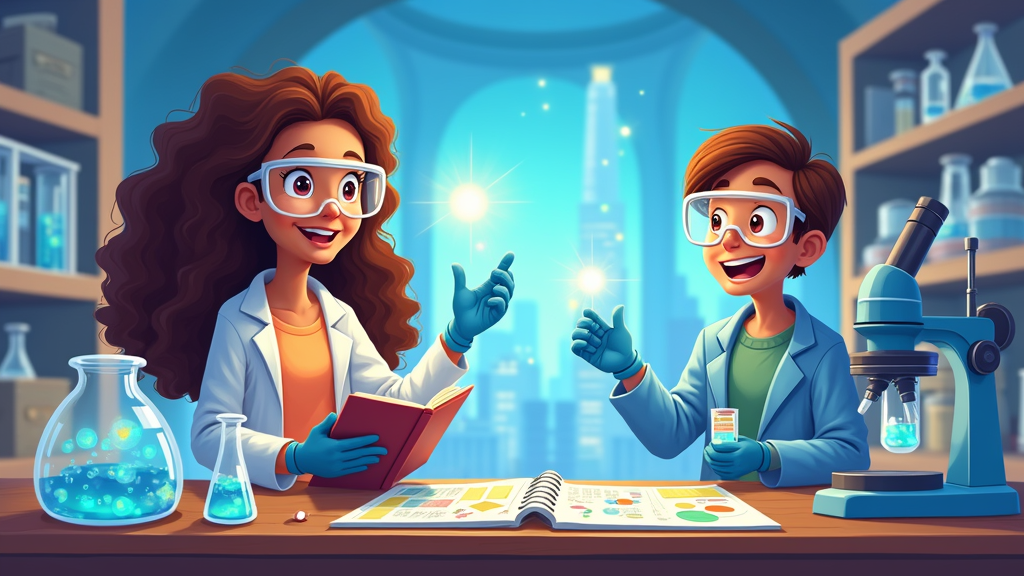
It was discovered that teamwork is very important in science, thanks to Sonia and Leo's lab. Their work with other scientists has led to big steps forward in finding new solutions for brain diseases (1). Each successful experiment brought them closer to their shared goal. After celebrating (2) their successes, Sonia and Leo went to the Cell (3) Model Room for another day of research. Sonia, with her white coat and safety goggles, and Leo, with his blue coat and gloves, were ready to take on new challenges.
In the Cell Model Room, Sonia and Leo watch nerve cells in action under the microscope. They study how these cells react to different treatments. Sonia carefully writes down each observation in her notebook, while Leo adjusts the experiment settings (4). Max watches them closely.
Sonia, focused, tells Leo:
« Leo, look closely at the cells. They are changing color. »
Leo, curious, observes the cells and says:
« Yes, they react to the treatment. It's interesting. »
Sonia, with a focused look, says:
« Let's write it all down. It can help with brain diseases. »
Not long after, they go to the Organ-on-a-Chip Lab. Tiny devices copy the work of human organs (5). They test new medicines there, hoping to make life better for patients.
Sonia and Leo understand that their research can improve the lives of patients and give them hope for the future. Suddenly, they hear a loud noise coming from another room.
The Challenges of Research
Sonia and Leo rush towards the source of the noise. They discover that the organ-on-a-chip show unexpected reactions. The treatments tested do not work as expected.
Leo, after looking at the data, says:
« Sonia, the results are not good. »
Sonia, after a moment of thought, says:
« We need to find a solution. Let's go to the science library. »
After walking through the lab's hallways, they reach the library. They start looking at old books and studies. Hours pass, but they stay focused.
Leo, after reading many articles, says:
« Sonia, I found something. A new study about brain diseases. »
Sonia, after looking at the results, says:
« Leo, this is a good lead. We need to change the settings of the experiment. »
After changing the experiment's settings, Sonia and Leo celebrate their discoveries and the progress made in finding new treatments for neurodegenerative diseases. They understand that their research can improve the lives of patients and give them hope for the future. As they enjoy their successes, a mysterious package is brought to the lab. Inside, a little hamster named Zéphyr seems to carry a coded (6) message. Curious and determined, our two scientists decide to solve this mystery, opening the door to new discoveries and scientific adventures. Who knows what the next challenge will bring?
📺 Watch this article in video format
For an even more immersive experience, watch our video: