
Épisode · Wiki Storia
S1 - E5 | The Secrets of Insects
What are the different types of insects and what role do they play in nature?
On the road to knowledge with music for 3 to 6 year olds!
Today, we are going on an Insect Discovery.
Pictures of our little adventurers in action - can you come and play with them?
🎼 Ready to move, sing and dream?
This first melody will take you on a musical discovery of the world!
🎤 Move, sing, discover!
Let's get adventurous with this second soundtrack. 😀
🎙 Read the lyrics to our music:
The lyrics of the two songs are identical, only the melodies are different.
The adventure begins with a story and discoveries for 6 - 8 year olds!
📻 Listen to this article as a podcast
For an immersive experience, enjoy our article in podcast mode. Click the player below to start listening and let the article carry you away!
📝 Quick summary of key information
What are the different types of insects and what role do they play in nature?
Insects are tiny animals without a backbone. They have six legs and often wings. You can find them everywhere on Earth, even in the most unexpected places!
Bugs are very important for nature. They help pollinate flowers, which lets plants make fruits and seeds. They also break down dead leaves and other organic matter.
There are many types of insects. For example, bees, butterflies, and ants. Each one has a special job in nature. Bees, for example, are real little garden workers.
Ants are decomposers. They eat dead leaves and animal scraps, helping to clean the forest. They also serve as food for other animals.
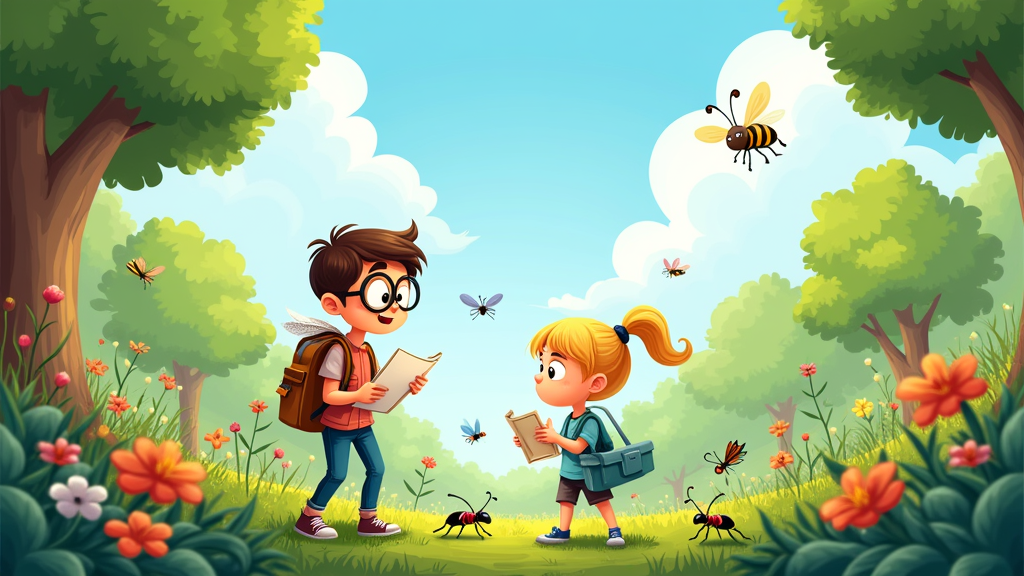
The Secrets of Insects
What are the different types of insects and what role do they play in nature?
The Discovery of Insects
After writing an article about colors, Lucas and Elodie decide to discover other wonders of nature. They go to the park with their chatty parrot, Pipo. On the way, they remember the color mixes that made their article so rich. Their curiosity leads them to explore the park in search of insects. They can't wait to discover the different types of insects and their role in nature.
Lucas, excited, points his finger:
« Look, Elodie, bees are buzzing around the flowers. »
Elodie, amazed, says: « You're right, Lucas. They pollinate (1) the flowers and help plants reproduce. It's amazing to see how they work so hard! »
Lucas, always curious, adds:
« Yes, they help make fruits and vegetables. »
After watching the bees, they continue their adventure. Soon after, they spot colorful butterflies. They move slowly to not scare them. The children take notes and pictures.
Elodie, amazed, says:
« The colors of the butterflies are beautiful. »
Lucas, curious, wonders out loud:
« I wonder why butterflies have such bright colors. The colors attract mates and keep enemies away. »
Elodie, amazed, says:
« It's amazing to see how the colors of butterflies play an important role in their survival. I wonder what other insects we will discover. Let's continue our exploration to learn more. »
After watching bees, butterflies, and ants, the children decide to write an article about how important insects are in nature. This article helps us understand the big role insects play in the ecosystem (2).
Writing the Article
Lucas and Elodie add photos of butterflies to the article. They explain that the colors of butterflies can show their role in communication, defense, and attracting partners, helping them to survive.
Lucas, looking at his notes, explains: « When we watch butterflies, we notice that they are often attracted to healthy flowers. These flowers give them the nectar they need to eat and survive. Besides that, butterflies play a very important role in pollination (3), helping plants to grow. It's amazing to see how every part of nature is connected! »
Elodie, always full of ideas, explains: « It's true, flowers and butterflies have a symbiotic (4) relationship. Flowers give nectar to butterflies, and in return, butterflies help them reproduce by carrying pollen from one flower to another. It's a perfect example of how insects and plants depend on each other in nature. »
Lucas, always ready to share his discoveries, adds: « Now that we have talked about butterflies and their important role in pollination, it is interesting to note that ants also play a crucial role in the ecosystem. They help break down organic matter and spread (5) seeds, helping to keep the forest balanced. »
Elodie, full of excitement, adds:
« You are right, Lucas! Ants are amazing. They carry leaves and bits of food to feed their larvae. By doing this, they help break down organic matter. They also spread seeds, helping plants to grow. This is another example of how insects play a important role in the ecosystem. »
Lucas, with his shiny glasses, exclaims: « Ants help plants grow. They are recyclers (6). »
After writing their exciting article about insects, Lucas and Elodie decide to explore another nature mystery. Joined by their faithful grey parrot, Pipo, and their red fox, Renard, they head to the garden. They will discover how plants reproduce and grow. Lucas and Elodie can't wait to share their new findings with their readers.
📺 Watch this article in video format
For an even more immersive experience, watch our video: