
Épisode · Wiki Storia
S1 - E7 | The Community Garden and Urban Farming
What are the benefits of urban farming?
On the road to knowledge with music for 3 to 6 year olds!
Today, we are exploring urban farming.
Pictures of our little adventurers in action - can you come and play with them?
🎼 Ready to move, sing and dream?
This first melody will take you on a musical discovery of the world!
🎤 Move, sing, discover!
Let's get adventurous with this second soundtrack. 😀
🎙 Read the lyrics to our music:
The lyrics of the two songs are identical, only the melodies are different.
The adventure begins with a story and discoveries for 6 - 8 year olds!
📻 Listen to this article as a podcast
For an immersive experience, enjoy our article in podcast mode. Click the player below to start listening and let the article carry you away!
📝 Quick summary of key information
What are the benefits of urban farming?
Urban farming is growing fruits and vegetables in the city. Imagine gardens on rooftops or vegetable patches in school yards!
Growing food in the city is great for the planet. Fewer trucks to carry vegetables, so less black smoke in the sky.
Also, eating fresh fruits and vegetables is good for your health. No need to travel far to find crunchy green vegetables!
Kids should learn about urban farming. This way, they will learn to take care of nature and eat healthily. A greener future starts with small seeds planted today.
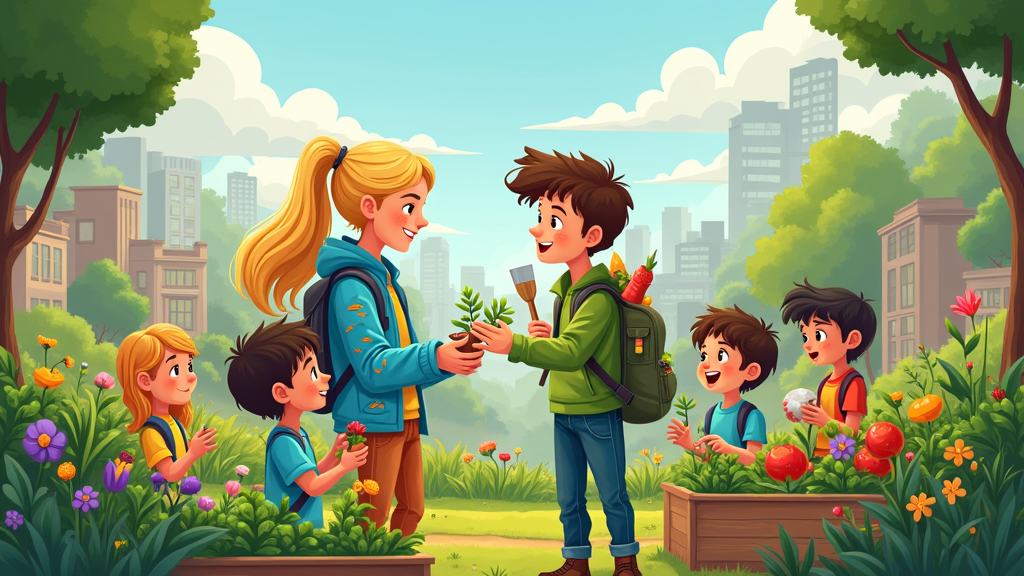
The Community Garden and Urban Farming
What are the benefits of urban farming?
The Discovery of the Community Garden
After learning how to reduce waste at school, Karim and Laetitia go to a community garden with their loyal dog, a border collie named Max. They show the children how to grow fruits and vegetables in the city, while explaining the importance of urban farming. Karim, with his green shirt with tree and leaf badges (1), and Laetitia, with her blue jacket with wave and fish patterns, are ready to share their knowledge. They start by explaining that urban farming helps grow fresh food in the city, reducing carbon emissions. The children, curious and excited, listen carefully.
Karim, with a big smile, starts to explain:
« Urban farming lets us grow fruits and vegetables in the city. »
Laetitia, with a bright smile, adds:
« It reduces the carbon emissions from transporting food. »
Karim, with a big smile, starts to explain: « Look, kids. Here are some growing tips like composting (2). »
Laetitia, with a smile, adds:
« And using rainwater. It's very good for the plants. »
The children learn to plant seeds and take care of the young sprouts. Karim shows how to make composters (3) with recycled materials. The children are amazed by the transformation of waste into natural fertilizer (4). Laetitia explains the importance of rainwater for watering the plants, thus reducing the use of drinking water.
They find out the benefits of urban farming and learn to grow their own fresh food.
The Benefits of Urban Farming
The children discover the benefits of urban farming and learn to grow their own fresh food. They watch the plants carefully, noting the signs of growth and health. Karim and Laetitia encourage them to ask questions and share their observations.
Karim, with an encouraging smile, asks:
« What are the signs that plants are healthy? »
Laetitia, with a smile, explains:
« The green and shiny leaves are a good sign. »
Karim, with a smile, adds:
« And the roots? They must be strong and well developed. »
Laetitia, with an encouraging smile, adds:
« Yes, and the plants must grow tall and strong. »
Karim and Laetitia show the children how to water the plants properly. They explain that too much water can drown the roots, while too little water can dry out the plants. The children learn to feel the soil to know when to water.
After learning how to grow fruits and vegetables in the community garden, Karim and Laetitia organize a special party. During the Nature Festival, children learn about protecting biodiversity (5). With the help of a red fox, they explore the wonders of local wildlife and discover how every species, from butterflies to hedgehogs, plays a crucial role in our ecosystem (6). The children are amazed by the diversity of animals and the techniques for protecting biodiversity. They learn that biodiversity is essential for the survival of our planet and that it is important to protect it. The children are shown how to create natural habitats for animals and how to participate in conservation projects. The benefits of plants for local wildlife are also discovered, and they learn to grow plants that attract pollinating (7) insects. It is explained that protecting biodiversity starts with small daily actions, like recycling and reducing waste. The children are inspired by Karim and Laetitia's adventures and decide to become nature guardians. They promise to protect biodiversity and share their knowledge with their friends and family. Karim and Laetitia are proud of the children's progress and get ready for their next adventure, eager to discover new challenges and share their knowledge about protecting the environment.
📺 Watch this article in video format
For an even more immersive experience, watch our video: