
Épisode · Wiki Storia
S1 - E8 | The Art of Connecting Circuits
How can each little part create a big invention?
On the road to knowledge with music for 3 to 6 year olds!
Today, we are going on an adventure to discover electronic circuits.
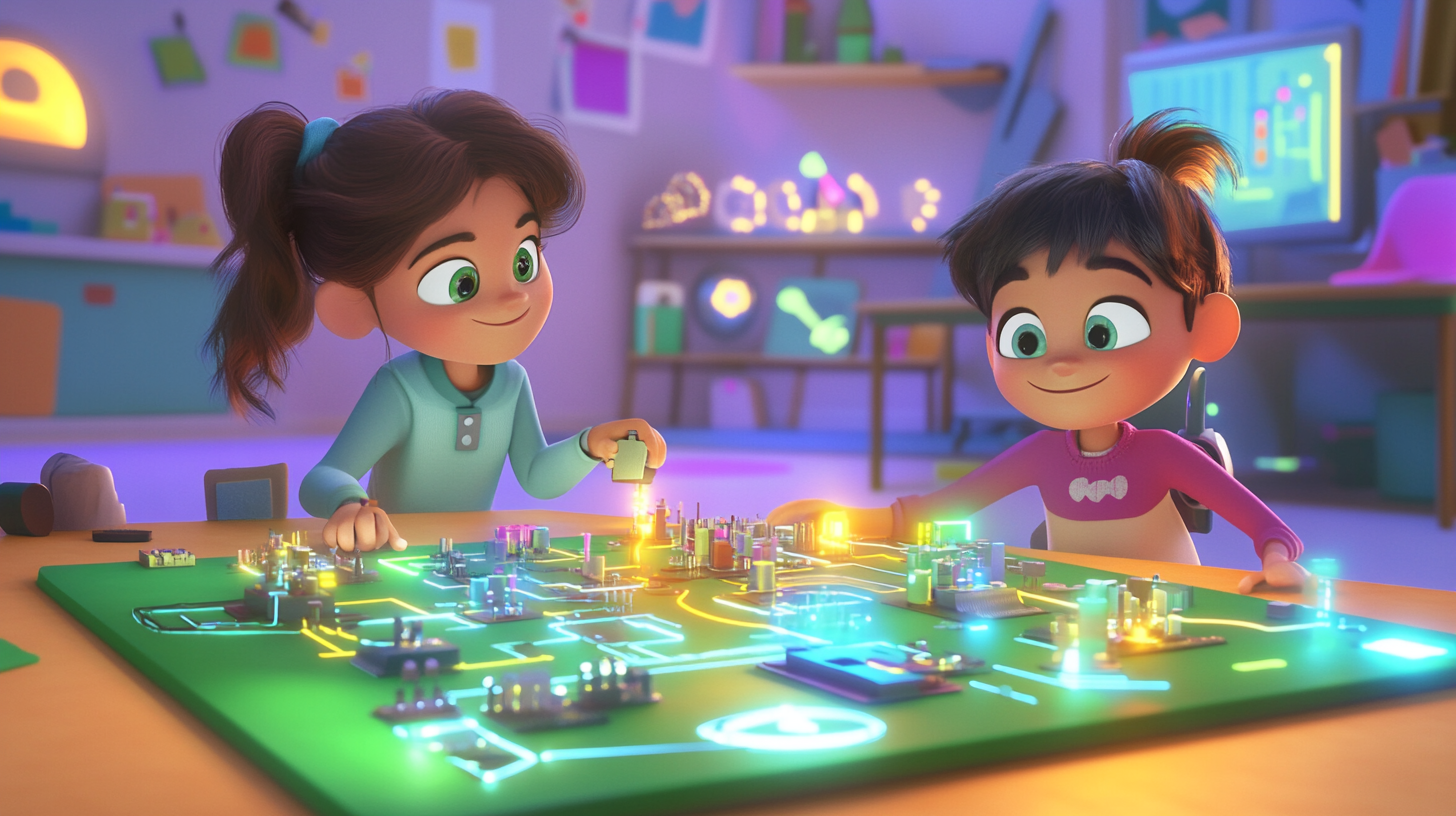
Pictures of our little adventurers in action - can you come and play with them?
🎼 Ready to move, sing and dream?
This first melody will take you on a musical discovery of the world!
🎤 Move, sing, discover!
Let's get adventurous with this second soundtrack. 😀
🎙 Read the lyrics to our music:
The lyrics of the two songs are identical, only the melodies are different.
The adventure begins with a story and discoveries for 6 - 8 year olds!
📻 Listen to this article as a podcast
For an immersive experience, enjoy our article in podcast mode. Click the player below to start listening and let the article carry you away!
📝 Quick summary of key information
How can each little part create a big invention?
An electronic circuit is like a little magic road where parts talk to each other to create amazing inventions. Imagine a little lamp that lights up when you press a button. To make this work, you need to connect small pieces called resistors, LEDs, transistors, and sensors.
Every part has a special job. Resistors control the electric current, LEDs light up, transistors work like switches, and sensors detect changes in the environment. Together, they make a perfect team to run fun gadgets.
To make the circuit work well, you need to connect all the parts properly. It's like building a puzzle where each piece must be in the right place. If a piece is in the wrong spot, the circuit won't work and the magic will disappear.
With circuits, you can make amazing inventions. For example, a little robot that moves or a lamp that changes color. Designing a circuit is important to create useful and fun machines, like toys or high-tech gadgets.
The Art of Connecting Circuits
How can each little part create a big invention?
The Making of a Magic Circuit
After leaving the Sensor Garden, amazed (1) by the electronic flowers that lit up when touched and the leaves that blinked with the birds' songs, Nino and Luma headed towards the exit of the circuit world. They had seen how every sensor, even the smallest one, could feel and react to the surrounding world, just like a squirrel using its senses to explore its forest. Nino, with his magnifying glasses perched on his nose and his mini tool belt, and Luma, in her glowing pattern dress, were eager to put into practice everything they had learned. They found a large sheet of paper. Nino drew lines on the sheet. Luma chose colors for the wires and components (2).
Nino, with a focused smile, says:
« We start with the resistors. »
Luma, curious, asks:
« What do resistors do? »
Nino, while placing the resistors on the circuit, explains: « They control the flow (3) of electricity. Like a faucet for water. »
Nino and Luma placed the resistors on their plan. They made sure each one had a special spot. Then, they added LEDs (4). These are small lights that turn on with electricity. Luma chose LEDs of different colors. They then placed transistors. These small parts decide if the electricity can go through or not. Finally, they added sensors. These sensors react to light, sound, and heat.
Nino, with a mischievous smile, announces:
« We are going to connect the parts with colorful wires. »
Luma, eyes sparkling, says:
« I'm going to add some colorful touches. »
Once all the parts were connected, they plugged their circuit into a small battery. With a soft sound, the LEDs lit up, the resistors warmed up a little, and the sensors reacted to the light in the room. Their circuit was finally ready. Each piece found its place and, once connected, they all lit up to create a unique invention.
The Magic of Electricity
After checking each connection, they decided to test their circuit. Nino and Luma started by touching the sensors. The LEDs changed color depending on the ambient light.
Nino, amazed, says:
« Look, the LEDs are changing color! »
Luma, amazed, says:
« It's magical! »
Next, they tested the sound sensors. The LEDs blinked to the rhythm of their voices. The children also found out that the resistors heated up more or less depending on the power they used (5), which depended on the amount of current that went through them.
Nino, touching the resistors, says:
« The resistors are hot! »
Luma, eyes shining, adds:
« And the transistors control the flow of electricity. »
Now that their circuit was finished, Nino and Luma were amazed by what they had accomplished. Each piece found its place and, once connected, all lit up to create a unique invention. The sound sensors were tested one last time, and the LEDs blinked to the rhythm of their voices. The resistors heated up more or less depending on the power they released, and the transistors controlled the flow of electricity. The children then discovered that they could use their circuit to create light and sound shows. To celebrate their journey, they attended a big party organized (6) by the circuits they had created. The resistors produced melodies, and the transistors danced to the music. The LEDs shone like fireflies, creating a light show. The children discovered that electricity could make music and light. They danced, laughed, and marveled at the wonders of electricity. The party ended with an explosion of colors and sounds, leaving Nino and Luma amazed. They knew that their adventure in the world of circuits was not over. They still had so much to discover and learn. Maybe one day, they would create an even more magical invention, one that could change the world. But for now, they enjoyed this moment of pure joy and discovery, ready for new adventures.
📺 Watch this article in video format
For an even more immersive experience, watch our video: