
Épisode · Wiki Storia
S1 - E2 | Meeting IAlexandra
What if a machine could explain things... with jokes?
On the road to knowledge with music for 3 to 6 year olds!
Today, we are going on an adventure to discover machines that tell jokes!
Pictures of our little adventurers in action - can you come and play with them?
🎼 Ready to move, sing and dream?
This first melody will take you on a musical discovery of the world!
🎤 Move, sing, discover!
Let's get adventurous with this second soundtrack. 😀
🎙 Read the lyrics to our music:
The lyrics of the two songs are identical, only the melodies are different.
The adventure begins with a story and discoveries for 6 - 8 year olds!
📻 Listen to this article as a podcast
For an immersive experience, enjoy our article in podcast mode. Click the player below to start listening and let the article carry you away!
📝 Quick summary of key information
What if a machine could explain things... with jokes?
Imagine a machine that can talk to you and tell you jokes! This is what we call artificial intelligence, or AI. An AI is like an electronic brain that can learn and answer questions.
An AI can talk to people by asking questions, giving answers, and even telling jokes. For example, it can ask you what your favorite animal is and tell a joke about it.
To learn, an AI uses a method called machine learning. This means it looks at lots of examples to understand and get better. The more it learns, the smarter it gets.
Why does an AI tell jokes? To make learning more fun! For example, it could say: Why do computers go to school? To increase their megabytes!
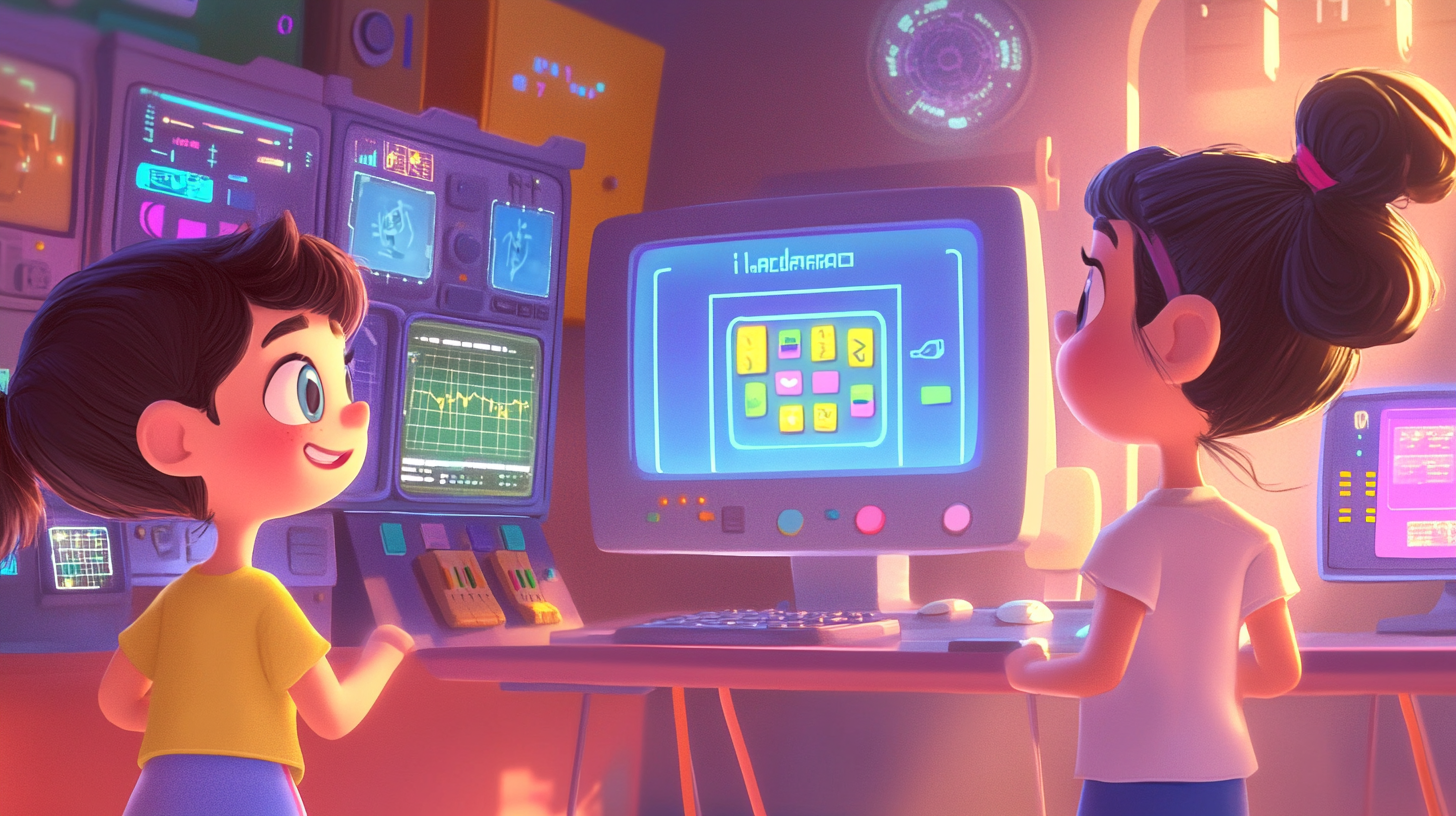
Meeting IAlexandra
What if a machine could explain things... with jokes?
The Discovery of IAlexandra
After finding out how a machine (1) can learn on its own, Noa and Mila, a girl full of imagination who loves to create drawings, stories, and songs with the help of AI, are curious to see what smart machines have in store for them. As they play in a futuristic room, they hear about a machine that learns like a magical brain. Excited, they head to a room full of screens where they meet IAlexandra, an AI that smiles, blinks, and says: 'I am here to learn... and have fun!
Noa, intrigued by the blinking screens, asks:
« What is machine learning? »
Mila, curious, says:
« Yes, explain to us! »
IAlexandra, with a bright smile, starts to explain:
« It's a way to learn by watching lots of examples. »
After explaining this, IAlexandra starts by showing pictures of cats and dogs on the screens. Noa and Mila laugh at seeing cats with glasses or dogs with hats. They are amazed by how quickly IAlexandra recognizes the animals.
Noa, curious about how fast IAlexandra learns, asks:
« How do you learn so fast? »
Mila, amazed, exclaims:
« It's incredible how you can learn so fast! It's almost magical! »
IAlexandra, with a pixelated smile, explains:
« I look at lots of pictures and remember the details. »
Not long after, animal drawings appear on a tablet. IAlexandra is then asked to add colors and details. Mila draws a Persian cat, and IAlexandra adds colorful patterns to make it even more beautiful. Noa draws a dog with glasses, and IAlexandra adds speech bubbles to show that it is talking. The children laugh as they see their drawings come to life on the screen. IAlexandra then suggests a series of games to understand how machines can learn by themselves.
The Learning Games
After drawing animals, IAlexandra suggests a recognition game. Now, they will play a game to recognize shapes and colors. IAlexandra shows geometric shapes on the screens. The children have to name them. Noa and Mila have fun naming circles, squares, and triangles. IAlexandra explains that each shape has a different color. The AI has to learn to recognize them. The children laugh as they see shapes changing color.
IAlexandra, with a bright smile, says:
« Look, I am going to learn to recognize these shapes. »
Noa, excited, says:
« It's easy! In a room full of screens, Noa and Mila meet IAlexandra, an artificial intelligence that smiles, blinks, and says: I'm here to learn... and have fun! She offers them a series of games to understand how machines can learn on their own. »
Mila, happily, shouts:
« Yes, it’s fun! »
IAlexandra, with a pixelated smile, says:
« Now, I am going to show pictures of fruits and vegetables. »
IAlexandra shows pictures of apples, bananas, and carrots. The kids laugh when they see apples with eyes or bananas with smiles. IAlexandra explains that deep learning is a method that helps AI learn to recognize more complex things. Noa and Mila are amazed by how quickly IAlexandra recognizes the foods. They then play a game where they draw fruits and vegetables on the tablet. IAlexandra helps them by adding colors and details. Mila draws a red apple, and IAlexandra adds seeds to make it even prettier. Noa draws an orange carrot, and IAlexandra adds green leaves to make it more realistic. The kids laugh as they see their drawings come to life on the screen.
After drawing fruits and vegetables with IAlexandra, Noa and Mila are invited on a new adventure. In the Dome of Machine Learning, they discover how a machine learns to recognize a Persian cat. Hundreds of images are projected on the walls of the Dome by IAlexandra: cats, dogs, bikes, trees... Noa and Mila are eager to see what the AI will learn next. They know that every image, every shape, every color is a new lesson for the AI. And they are ready to join in this learning adventure. Next time, they will explore the Deep Learning Cave, where each layer of rock is a step the AI takes to learn even more complicated things. They will discover how the AI can recognize faces, voices, and even emotions. But for now, they continue to play with IAlexandra, laughing and learning together.
📺 Watch this article in video format
For an even more immersive experience, watch our video: