
Épisode · Wiki Storia
S1 - E4 | The Deep Learning Cave
What is hidden in the deep layers of the AI?
On the road to knowledge with music for 3 to 6 year olds!
Today, we are going on a journey to discover Deep Learning.
Pictures of our little adventurers in action - can you come and play with them?
🎼 Ready to move, sing and dream?
This first melody will take you on a musical discovery of the world!
🎤 Move, sing, discover!
Let's get adventurous with this second soundtrack. 😀
🎙 Read the lyrics to our music:
The lyrics of the two songs are identical, only the melodies are different.
The adventure begins with a story and discoveries for 6 - 8 year olds!
📻 Listen to this article as a podcast
For an immersive experience, enjoy our article in podcast mode. Click the player below to start listening and let the article carry you away!
📝 Quick summary of key information
What is hidden in the deep layers of the AI?
Deep learning is a way for computers to learn how to recognize complex things, like faces or objects. Imagine you are learning to draw: you start with simple shapes, then you add details to make your drawing more precise. Deep learning works a bit like that!
To learn, machines go through different levels or 'layers'. Each layer helps to recognize more and more complex things. For example, the first layer can recognize simple lines and shapes, while the next layers can identify colors and objects.
Every layer has an important job. The first layer finds basic shapes, like lines and circles. The next layers add details, like colors and textures. Finally, the last layers recognize whole objects, like faces or animals.
A clear example of deep learning is face recognition. Machines can learn to spot people by looking at pictures. They start by recognizing the shape of the face, then details like the eyes and mouth, and finally they can identify the person. This is very useful for unlocking phones or finding family photos.
The Deep Learning Cave
What's hidden in the deep layers of AI?
The Levels of Thinking
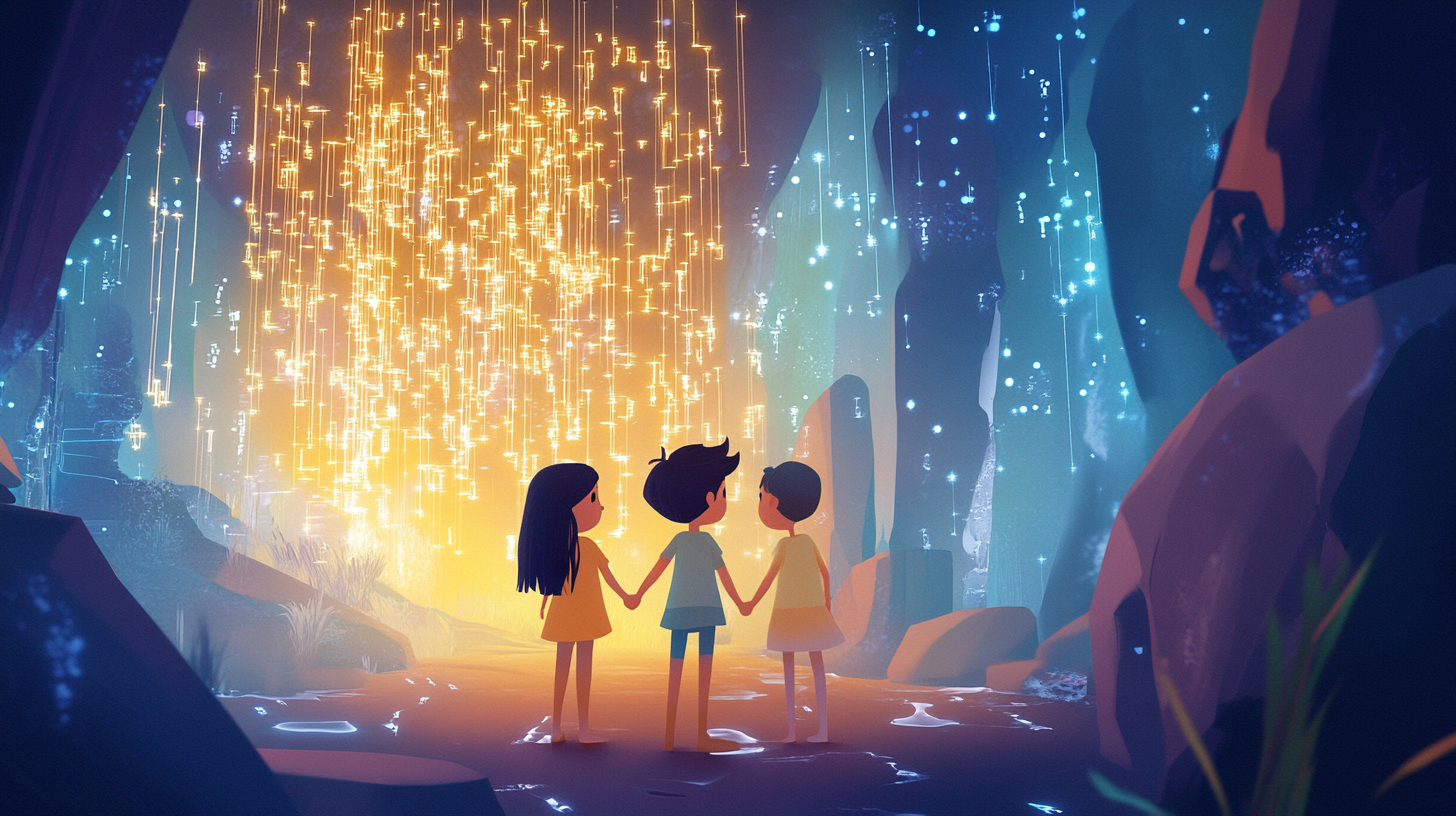
After learning to tell Siamese cats apart from other animals using pictures projected on the walls of the Dome, Noa and Mila discovered how a machine can learn to recognize shapes and objects. IAlexandra explained that each image seen helps the AI (1) improve (2) its recognition skills, turning pixels (3) into real identifications. Soon after, IAlexandra takes them to an even more mysterious place: the Deep Learning Cave. Noa, with his keyboard-shaped jacket, and Mila, with her pink headphones, are eager to find out what lies deep inside this glowing cave.
Noa, curious, asks:
« What is the cave of deep learning? »
IAlexandra, with a smile made of pixels, begins to explain:
« It's a magical place where the AI learns to see complex things. »
Mila, amazed, says: « In a cave with glowing walls, each level shows a step of thinking: first lines, then faces, then feelings (4). Noa and Mila go up the levels with IAlexandra, learning how the artificial intelligence gets better at understanding on each level. »
IAlexandra, with a pixel smile, explains:
« Artificial intelligence goes through many levels. Each level helps to understand pictures better. »
At every level, screens are shown with pictures that get more and more detailed. Noa is amused by the recognition of simple shapes and then familiar objects. Mila, on the other hand, is amazed by the faces that appear gradually. It is explained that each layer of the AI helps to better understand the things seen.
The children are fascinated by this progress (5) and start to understand how the AI can learn to recognize more and more complex things. They keep exploring, curious to find out what else the AI can learn.
The Layers of the AI
As they go up the levels, more and more detailed pictures appear. Noa recognizes simple shapes and familiar objects and has fun identifying each one. Mila, on the other hand, is amazed by the faces that slowly appear, showing the more complex emotions that IAlexandra starts to understand.
IAlexandra, with a pixelated smile, explains:
« Each layer of the artificial intelligence helps to better understand the things we see. »
Noa, amazed, shouts:
« Wow! The AI is getting smarter and smarter. »
Mila, eyes sparkling, exclaims:
« I want to see landscapes! »
IAlexandra, with a pixelated smile, says:
« Let's go deeper. The artificial intelligence now recognizes emotions on faces. »
The children are amazed. They see pictures of landscapes and even moving scenes. Suddenly, a screen shows a blurry image. IAlexandra cannot recognize it. Noa and Mila need to help IAlexandra.
With each level they pass, Noa and Mila understand better how the AI can learn and create. But the adventure doesn't stop there. Now, they will discover a workshop where imagination meets technology. Imagine a magic screen where ideas come to life instantly. With IAlexandra, they will explore the Artificial Imagination Workshop, where children can draw enchanting landscapes and compose songs without even touching a pencil. Get ready to see floating islands and dancing robots appear like magic!
📺 Watch this article in video format
For an even more immersive experience, watch our video: