
Épisode · Wiki Storia
S1 - E2 | The Secrets of the Observatory
How does a telescope work?
On the road to knowledge with music for 3 to 6 year olds!
Today, we are going on a journey to discover the telescope.
Pictures of our little adventurers in action - can you come and play with them?
🎼 Ready to move, sing and dream?
This first melody will take you on a musical discovery of the world!
🎤 Move, sing, discover!
Let's get adventurous with this second soundtrack. 😀
🎙 Read the lyrics to our music:
The lyrics of the two songs are identical, only the melodies are different.
The adventure begins with a story and discoveries for 6 - 8 year olds!
📻 Listen to this article as a podcast
For an immersive experience, enjoy our article in podcast mode. Click the player below to start listening and let the article carry you away!
📝 Quick summary of key information
How does a telescope work?
A telescope is a magical tool that helps you see things very far away in the sky, like stars and planets. It's like a giant pair of binoculars to explore the universe.
To make things look bigger, the telescope uses lenses. These lenses catch the light from stars and planets and make them look bigger and easier to see with our eyes.
Telescopes are very useful for watching stars and planets that are very far away from us. They help us see things we cannot see with just our eyes.
There are two main types of telescopes: refracting telescopes, which use lenses, and reflecting telescopes, which use mirrors. Each has its own advantages for exploring the sky.
Secrets of the Observatory
How does a telescope work?
The Discovery of the Telescope
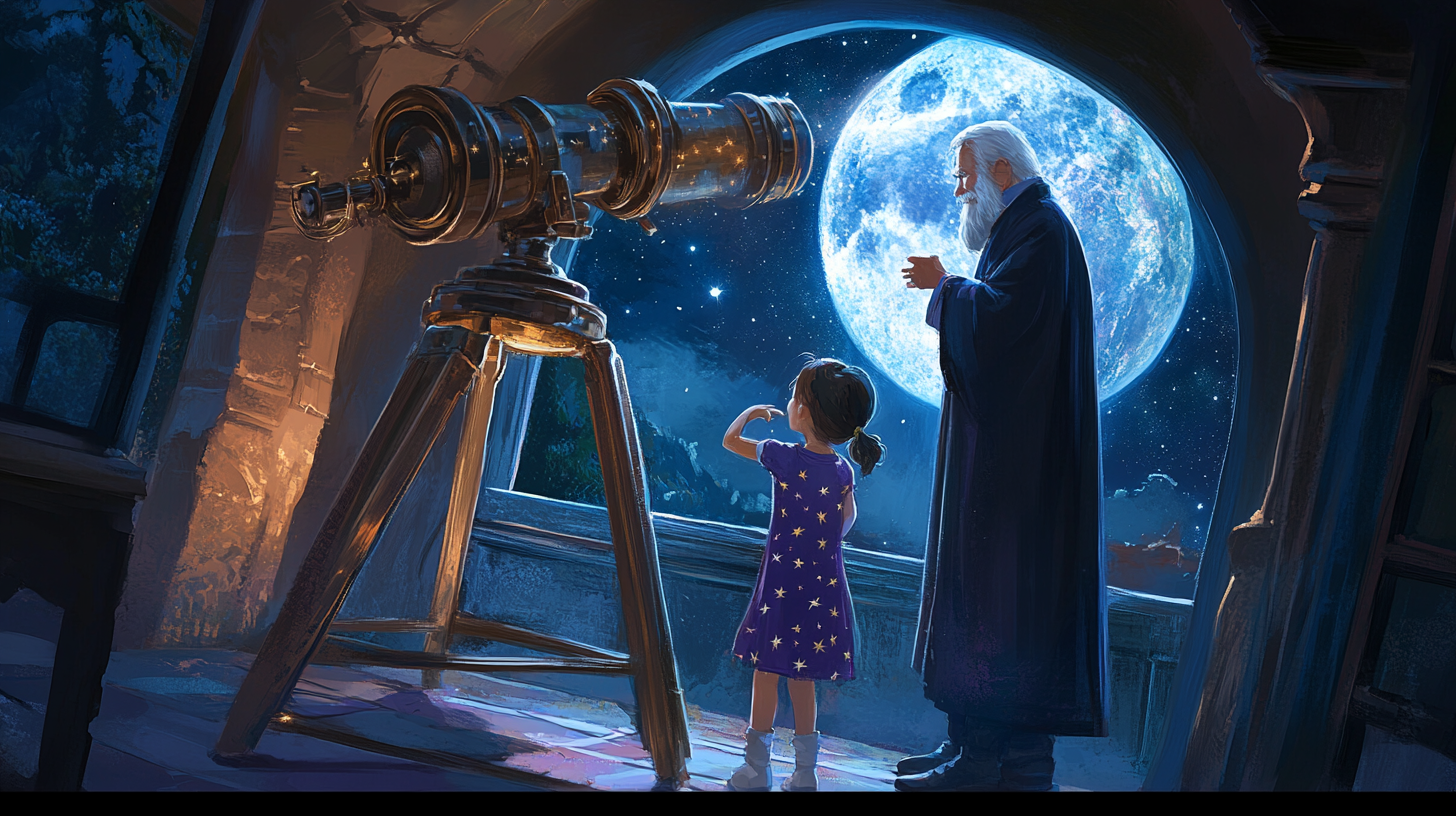
Leo and Luna, two curious kids, explore the night sky with Galileo. He shows them how to use a telescope to see the stars and planets. Galileo explains that the telescope makes things bigger with its lenses (1). Now, the kids are ready to discover the secrets of the observatory (2) (3) and learn how a telescope works.
Galileo, with a mysterious smile, begins to explain:
« You see this big tube? It's a telescope. »
Luna, amazed, asks:
« It is very big. What is it for? »
Galileo, with a kind smile, adds:
« It lets you see stars and planets that are very far away. »
Leo, curious, asks:
« How does it work? »
Galileo, with a smile lit up by curiosity, explains:
« The telescope uses lenses. They make the stars and planets bigger. »
Luna, with sparkling eyes, says:
« I want to draw the stars. They are beautiful. »
Galileo explains that the telescope makes stars and planets look bigger with its lenses, making them easier to see. Leo, always curious, asks questions about how the lenses work. Galileo patiently shows them how to adjust the lenses to see more details. Luna, meanwhile, draws the constellations (4) she sees, amazed by the beauty of the night sky. They discover that the telescope lets them see things in space from very far away, sometimes millions of kilometers. Soon after, they spot a shooting star streaking across the sky. Galileo explains that things in space can be seen from very far away, sometimes millions of kilometers. Leo and Luna are amazed by this discovery. They keep watching the sky, fascinated by the mysteries of the universe.
Different Types of Telescopes
After watching the stars and planets, Galileo explains that telescopes can be of different types. He shows them a refracting (5) telescope that uses lenses to magnify the images. Then, he shows them a reflecting (6) telescope that uses mirrors to capture the light from the stars.
Leo, curious, asks:
« Why are there different types of telescopes? »
Galileo, with a wise smile, begins to explain:
« Each type has its advantages. Refractor telescopes are often more compact. »
Galileo, with a smile lit up by curiosity, explains:
« Reflecting telescopes can catch more light and see objects that are farther away. »
Luna, eyes sparkling with excitement, says:
« I want to draw the different kinds of telescopes. »
Luna, fascinated, draws different types of telescopes in her notebook, adding notes about their uses. They realize that telescopes are powerful tools for exploring the universe.
With stars still in their eyes, Leo and Luna leave Galileo's observatory. They are now heading to the Star Tower, where they will discover constellations and their legends. As they climb the stone steps, they learn that each group of stars tells a fascinating story, often inspired by mythical animals like the Lion or the Big Dipper. They can't wait to find out the mysteries that the Star Tower has in store for them.
📺 Watch this article in video format
For an even more immersive experience, watch our video: