
Épisode · Wiki Storia
S1 - E3 | The Star Tower
What is a constellation?
On the road to knowledge with music for 3 to 6 year olds!
Today, we are going on a journey to discover the constellations.
Pictures of our little adventurers in action - can you come and play with them?
🎼 Ready to move, sing and dream?
This first melody will take you on a musical discovery of the world!
🎤 Move, sing, discover!
Let's get adventurous with this second soundtrack. 😀
🎙 Read the lyrics to our music:
The lyrics of the two songs are identical, only the melodies are different.
The adventure begins with a story and discoveries for 6 - 8 year olds!
📻 Listen to this article as a podcast
For an immersive experience, enjoy our article in podcast mode. Click the player below to start listening and let the article carry you away!
📝 Quick summary of key information
What is a constellation?
Constellations are groups of stars that make imaginary shapes in the sky. They are often named after mythical characters or animals. For example, the Big Dipper looks like a pot or a wagon.
Constellations help astronomers recognize stars and understand the structure of the universe. They also help children discover the night sky and have fun finding shapes in the stars.
Constellations are like maps of the sky. They show where the stars are and help you navigate in space. Old sailors used constellations to guide them on their sea voyages.
There are many famous constellations, like Orion, the hunter, or Cassiopeia, the queen. Each constellation has a fascinating story to tell. By looking at the sky, you can discover these wonders and let your imagination travel among the stars.
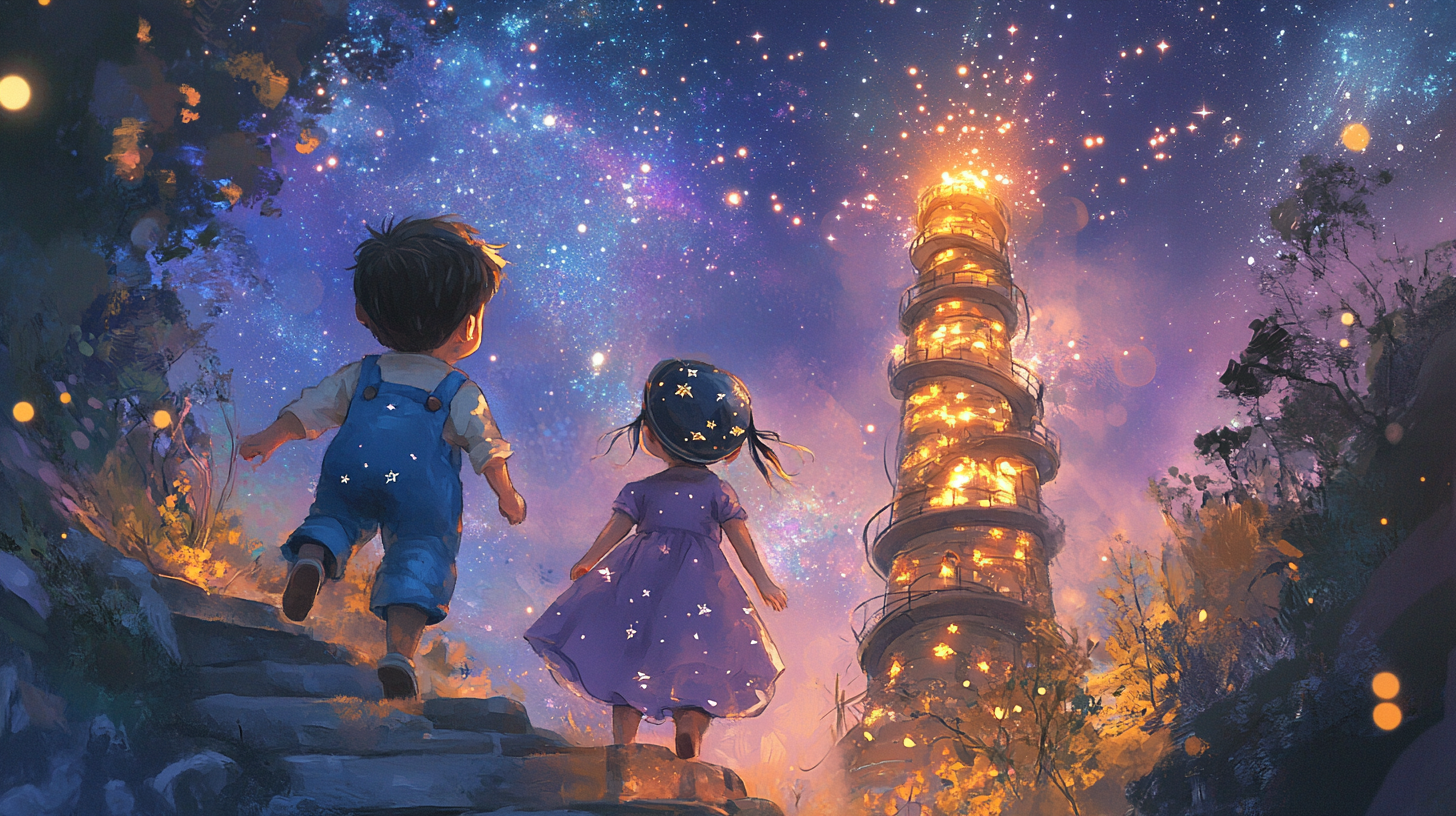
The Star Tower
What is a constellation?
Climbing to the stars
After moving the heavy lenses (1) and adjusting the screws (2) on the copper telescope, Leo, a curious and adventurous boy wearing a blue overalls with stars and a mini astronaut (3) helmet, and Luna, a dreamy girl who loves stars wearing a purple dress with planet patterns, watch the first twinkling stars in the starry sky. Galileo explains how each star is a distant sun, lighting up the vastness of the universe. The children, amazed, wonder how these shiny points can form shapes in the sky. Galileo then suggests they climb the Star Tower to discover the secrets of the constellations.
The kids, excited, start their climb to the top. The spiral stairs take them higher and higher, through fluffy clouds and gentle winds. Galileo, always by their side, tells them that constellations are groups of stars.
Galileo, with a mysterious smile, starts to explain:
« They make imaginary shapes in the sky. »
Galileo, with a mysterious smile, adds: « They are often named after mythological (4) characters or animals. »
Luna, amazed, asks:
« Galileo, the wise owl, just told us that constellations are groups of stars that make shapes in the sky. Is that true? »
Galileo, with a mysterious smile, starts to tell a story:
« Yes, many constellations have a fascinating story. »
Not long after, they discover a breathtaking view of the starry sky. A wise old owl points to a constellation shaped like a hunter, Orion. The children, amazed, listen carefully to the legends associated with each group of stars. Leo, always curious, asks how astronomers (5) can recognize the stars. Galileo explains that constellations help to find the stars and better understand the structure of the universe. Luna, daydreaming, draws the constellations in her notebook, adding colorful details for each legend.
They learn that constellations are groups of stars that form imaginary shapes and that they often have fascinating stories.
The mysteries of the constellations
After learning that constellations are groups of stars that form imaginary shapes and often have fascinating stories, they keep watching the starry sky. The owl Galileo shows them a new constellation.
Galileo, with a mysterious smile, says:
« Here is Cassiopeia. »
Luna, amazed, shouts:
« It looks like a double V. »
Galileo, with a kind smile, confirms:
« That's right, Luna. It's easy to spot. »
Leo, curious about the mysteries of the sky, asks:
« Why do the stars shine? »
Galileo, with a kind smile, explains:
« Stars shine because they are very hot. »
After learning why stars shine, Leo and Luna's curiosity is sparked. Galileo then suggests they discover another fascinating celestial phenomenon (6). In the Comet Garden, the movements and composition of comets are observed. Galileo explains why these bright stars have a glowing tail and why they cross the sky. The children, eager, are already getting ready for their next adventure, ready to discover even more mysteries of the universe.
📺 Watch this article in video format
For an even more immersive experience, watch our video: