
Épisode · Wiki Storia
S1 - E4 | The Comet Garden
What is a comet and why does it have a tail?
On the road to knowledge with music for 3 to 6 year olds!
Today, we are going on a journey to Discover Comets.
Pictures of our little adventurers in action - can you come and play with them?
🎼 Ready to move, sing and dream?
This first melody will take you on a musical discovery of the world!
🎤 Move, sing, discover!
Let's get adventurous with this second soundtrack. 😀
🎙 Read the lyrics to our music:
The lyrics of the two songs are identical, only the melodies are different.
The adventure begins with a story and discoveries for 6 - 8 year olds!
📻 Listen to this article as a podcast
For an immersive experience, enjoy our article in podcast mode. Click the player below to start listening and let the article carry you away!
📝 Quick summary of key information
What is a comet and why does it have a tail?
Comets are big balls of ice and dust that travel through space. They are often called shooting stars by astronomers. They can be very small, sometimes smaller than a house, or huge, bigger than a city.
When a comet gets close to the Sun, it changes. It grows a beautiful, shiny tail made of gas and dust. This tail can stretch for millions of kilometers, like a long ribbon in the sky.
Comets have tails because of something called sublimation. The Sun's heat melts the comet's ice, turning it from solid to gas, creating the tail.
When a comet comes close to the Sun, its tail becomes more visible. It shines brightly, offering a wonderful show for those who watch it from Earth. It's a special moment when the comet shows all its beauty.
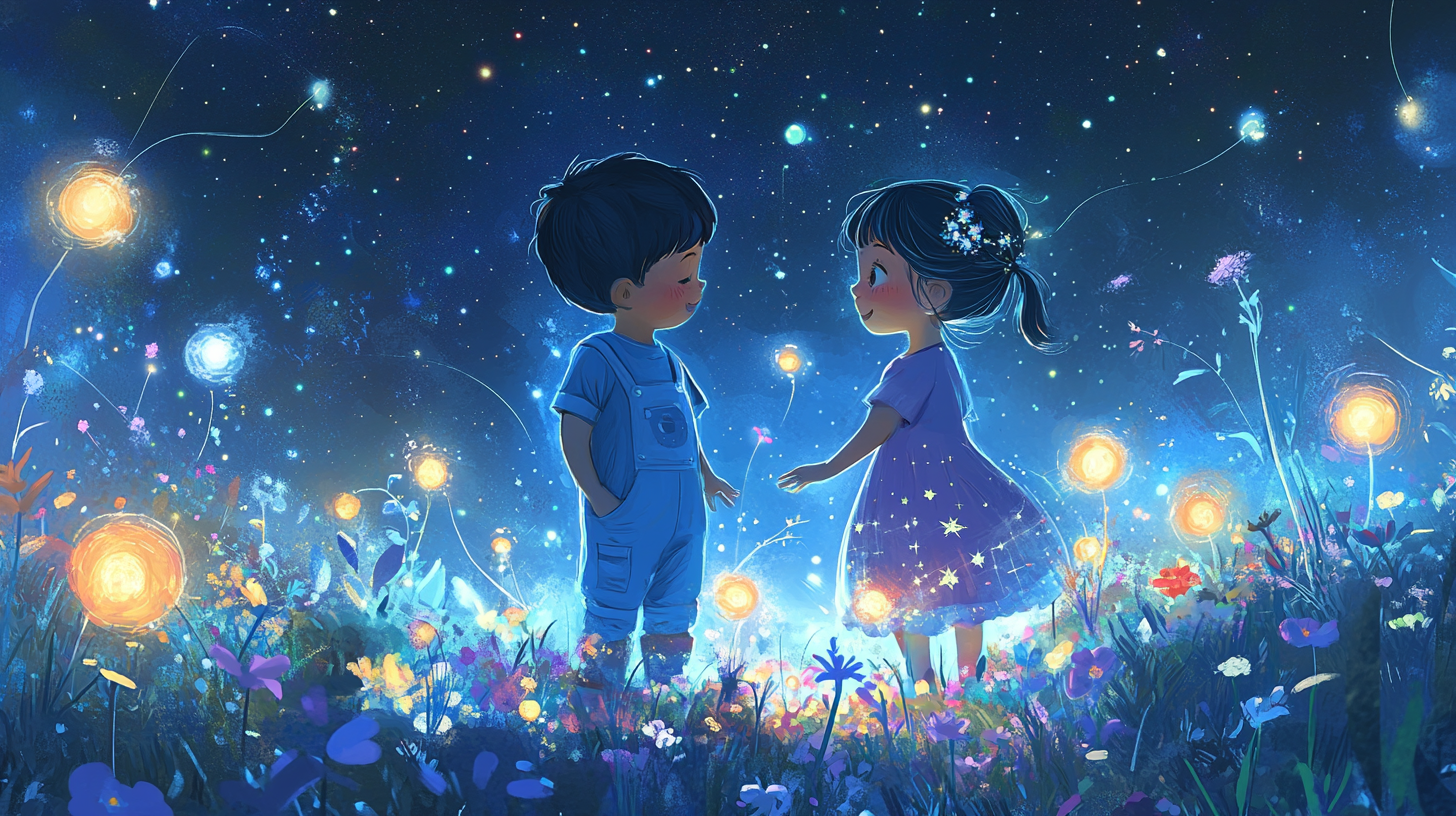
The Comet Garden
What is a comet and why does it have a tail?
Comet Watching
After climbing the Star Tower and discovering the constellations (1) with a kind owl, Leo and Luna find themselves surrounded by the stories of Greek heroes and goddesses (2). They feel ready to explore more mysteries (3) of the sky. Galileo, seeing them so excited, decides to take them to an even more magical place: the Comet Garden. Leo and Luna, their eyes shining with excitement, follow Galileo along a glowing path (4) that leads them to an enchanted garden where comets shine like glowing flowers.
Leo, amazed, shouts:
« It's wonderful! »
Luna, amazed, says:
« Look, they are wonderful! What are they exactly? »
Galileo, with a mysterious smile, starts to explain:
« They are comets. They come from far away. »
Luna, curious, asks:
« Why do they have a tail? »
Galileo, with his wise and knowledgeable voice, explains: « Comets are balls of ice and dust. They form a tail of gas and dust when they get close to the Sun. This is called sublimation (5). The ice and dust turn into gas. »
Comets continue to fascinate Leo and Luna as they watch them in the night sky. Their bright trails are visible behind them. The children are amazed by this rare and wonderful sight. Leo, always curious, asks questions about the path and origin of the comets. A wise and knowledgeable astronomer, always ready to share his knowledge about stars and planets, then explains that comets come from the farthest parts of the solar system. He wears a long black robe, a white beard, and a pointy astronomer's hat.
The Comet's Tail
Galileo wants to show Leo and Luna up close how the tails of comets form. He tells them that the tails appear when the ice and dust turn into gas, because the comet gets close to the Sun. The children are amazed by this explanation and watch the comets very carefully.
Luna, curious, asks:
« Why do some comets have longer tails? »
Galileo, with a smile lit up by curiosity, explains:
« The length of the tail depends on the comet's makeup and its speed. »
Leo, curious, asks:
« Can comets change direction? »
Galileo, with a calm and steady voice, explains: « Comets follow elliptical paths (6) around the Sun. Gravitational (7) forces can pull them off course. »
The children are amazed by these explanations and keep watching the comets, wondering what other surprises the Comet Garden has in store for them. They find out that comets are balls of ice and dust and that their tail forms when they get close to the Sun.
After admiring the comets in the Comet Garden, the kids are amazed by the astronomer's explanations about their orbits and composition. Their curiosity is sparked, and they wonder what other wonders the Comet Garden might reveal. That's when the astronomer takes them to his lab, where, through fun experiments, he explains why things fall to the ground. They even meet a curious cat who helps them with their experiments. With their new knowledge about comets, Leo and Luna are eager to learn about the laws of gravity and understand why things always fall down. Their adventure continues, filled with discoveries and wonders.
📺 Watch this article in video format
For an even more immersive experience, watch our video: