
Épisode · Wiki Storia
S1 - E5 | The Lab of Laws
Why do things fall to the ground?
On the road to knowledge with music for 3 to 6 year olds!
Today, we go on a journey to discover Gravity.
Pictures of our little adventurers in action - can you come and play with them?
🎼 Ready to move, sing and dream?
This first melody will take you on a musical discovery of the world!
🎤 Move, sing, discover!
Let's get adventurous with this second soundtrack. 😀
🎙 Read the lyrics to our music:
The lyrics of the two songs are identical, only the melodies are different.
The adventure begins with a story and discoveries for 6 - 8 year olds!
📻 Listen to this article as a podcast
For an immersive experience, enjoy our article in podcast mode. Click the player below to start listening and let the article carry you away!
📝 Quick summary of key information
Why do things fall to the ground?
Gravity is an invisible force that pulls things toward the center of the Earth. Imagine the Earth is a big magnet that pulls everything around it. That's why, when you drop a ball, it falls to the ground.
Things fall to the ground because gravity pulls them down. The heavier an object is, the more it is pulled by the Earth. For example, an elephant falls faster than a feather, but they both fall down.
When things fall, they go in a straight line. This path is predictable, which means you can know where a thing will land if you drop it from a certain height.
To show what gravity is, think of an apple falling from a tree. The apple goes straight down until it hits the ground. Gravity makes it fall this way, always toward the center of the Earth.
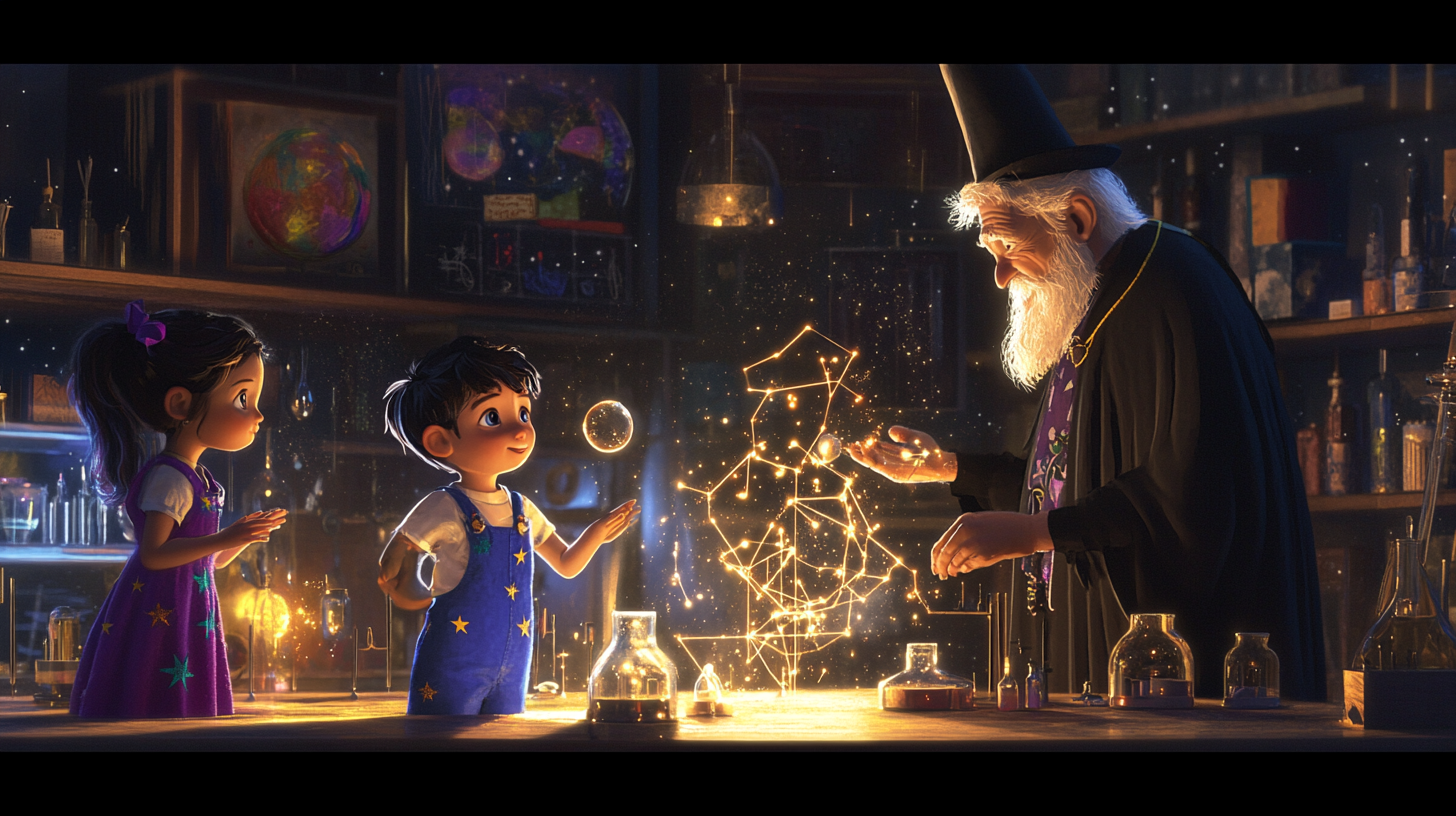
The Laws Lab
Why do things fall to the ground?
The Discovery of Gravity
After discovering the secrets of comets and watching their celestial dances in the Comet Garden, Leo and Luna, along with their faithful cat Merlin, are suddenly wrapped in a dazzling light. When the glow fades, they find themselves in a distant time, ready to meet a great scientist. Galileo, with his curly brown hair, sparkling eyes of curiosity, and blue overalls, warmly welcomes them. He leads them to a laboratory filled with mysterious instruments and old books. Together, they prepare to explore the mysteries (1) of gravity (2).
Galileo, with a mysterious smile, begins to explain:
« Gravity is a force that pulls objects toward the center of the Earth. »
Leo, intrigued by Galileo's explanations, asks:
« Galileo just talked about gravity and explained it. Leo, curious, asks: 'What is gravity? »
Galileo, with a mischievous smile, starts to explain:
« This is what makes objects fall to the ground. »
Luna, her eyes sparkling with curiosity, then asks:
« Show us an experiment. »
Galileo takes an apple and lets it drop. Leo and Luna watch the apple fall to the ground carefully. Galileo then shows them an experiment with an inclined ramp. He rolls a small metal ball down the ramp and watches its path (3). The children discover that the ball follows a straight path before falling to the ground.
Galileo, pointing at the path of the ball, explains:
« This curve is caused by gravity, which pulls the ball down after it leaves the ramp. »
Galileo, with a smile lit up by curiosity, says:
« Now, to better understand these observations, I will take notes and draw the paths we just saw. This will help us visualize how gravity affects the fall of objects. »
It is then explained to Leo and Luna that gravity pulls objects toward the center of the Earth. Galileo shows them that objects fall at a constant acceleration (4), not at a constant speed. The children carefully observe the notes and drawings that Galileo makes to illustrate these concepts. While they are focused on their observations, a bright light suddenly shines in the laboratory.
The Laws of Falling Things
Light comes in from an open window showing the starry sky. Leo and Luna look outside, amazed by the twinkling stars. Galileo, the young inventor who loves stars and the mysteries of the universe, decides to use this moment to show another principle of gravity. He takes two balls of different sizes and shows them to his young students. He explains that, even though they are different sizes, they will fall at the same speed if dropped at the same time in a vacuum. But in the air (5), air resistance (6) can affect how they fall.
Galileo, with a mysterious smile, speaks to his young apprentices:
« Watch carefully. »
Galileo, with a mischievous smile, says:
« I am going to drop them at the same time. »
Galileo drops the two balls. Leo and Luna watch carefully. The two balls hit the ground at the same time, even though they are different sizes.
Galileo, with a mysterious smile, is about to explain:
« This is the law of falling things. »
Luna, with her eyes wide open, asks:
« But then, even if they are different sizes, they fall at the same time in the air? »
After watching the balls fall and understanding the law of falling bodies, Leo and Luna are intrigued by the mysteries of the universe. Galileo, always passionate about stars and the mysteries of the universe, suggests a new experiment. They are taken to an even more fascinating laboratory, where they discover incredible scientific instruments. Galileo explains that every object, no matter its size or shape, is pulled by Earth's gravity and falls at the same speed in a vacuum. The children, curious and excited, get ready to explore more laws of physics (7) with their mentor.
📺 Watch this article in video format
For an even more immersive experience, watch our video: