
Épisode · Wiki Storia
S1 - E6 | The Valley of the Planets
What are the planets in our solar system?
On the road to knowledge with music for 3 to 6 year olds!
Today, we are going on a journey to explore the Solar System.
Pictures of our little adventurers in action - can you come and play with them?
🎼 Ready to move, sing and dream?
This first melody will take you on a musical discovery of the world!
🎤 Move, sing, discover!
Let's get adventurous with this second soundtrack. 😀
🎙 Read the lyrics to our music:
The lyrics of the two songs are identical, only the melodies are different.
The adventure begins with a story and discoveries for 6 - 8 year olds!
📻 Listen to this article as a podcast
For an immersive experience, enjoy our article in podcast mode. Click the player below to start listening and let the article carry you away!
📝 Quick summary of key information
What are the planets in our solar system?
Our solar system has eight planets that go around the Sun. It's like a big family where each member has its own special features.
The planets are Mercury, Venus, Earth, Mars, Jupiter, Saturn, Uranus, and Neptune. Each one has a different size, color, and distance from the Sun.
For example, Mercury is the smallest and closest to the Sun, while Jupiter is the biggest. Saturn is famous for its shiny rings that make it special.
Knowing the planets is important because they help us understand the universe. Each planet has mysteries to discover, like the storms on Neptune or the volcanoes on Mars.
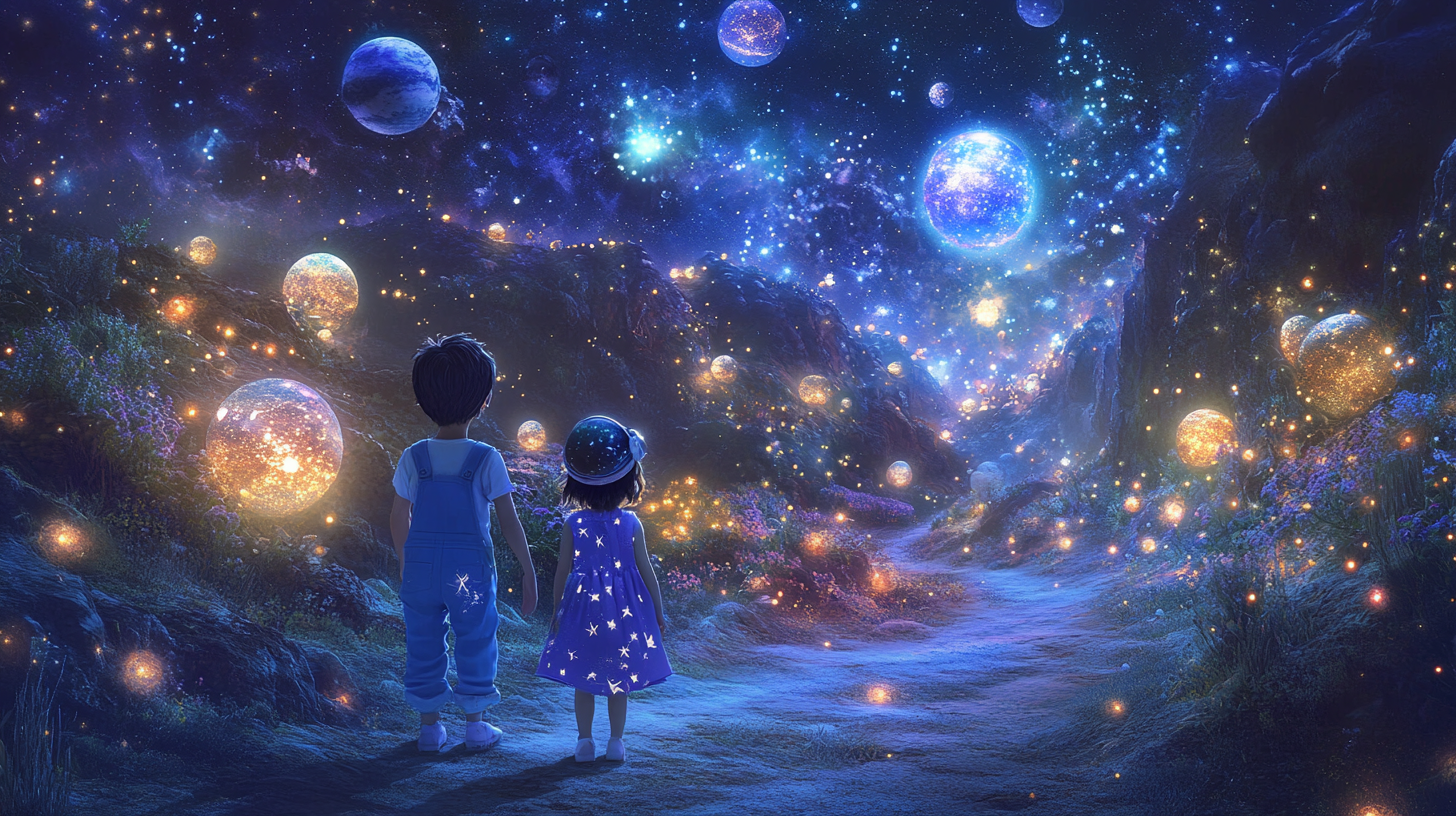
Planet Valley
What are the planets in our solar system?
The Valley of the Planets
After exploring the unique features of each planet, the children are invited to follow Galileo into his lab (1). After watching balls of different sizes fall to the ground, they learn about the laws (2) of falling objects through fun experiments. Galileo uses objects of different sizes to show the force of gravity (3). Leo and Luna are amazed by the scientific discoveries and the mysteries of the world around them. But when Galileo shows them the stars through his telescope (4), the children are even more captivated. They see bright spots in the sky and wonder what they are. Galileo then explains that these are planets and invites them to discover them up close in the Valley of the Planets.
Not long after, Leo and Luna find themselves in the Valley of Planets, a magical place where each planet in our solar system is represented by a glowing ball. A wise and knowledgeable astronomer (5) explains to them that our solar system includes eight planets.
Galileo, with a mysterious smile, starts to list:
« Here they are: Mercury, Venus, Earth, Mars, Jupiter, Saturn, Uranus, and Neptune. »
Luna, amazed, shouts:
« Wow, they are all different! »
Leo, amazed, adds:
« Yes, they have different colors and sizes. »
Galileo, with a smile lit up by curiosity, begins to explain:
« Let's start with Mercury, the smallest and closest to the Sun. »
They learn that each planet in our solar system has unique features and that they orbit (6) (7) around the Sun.
The Mysteries of the Giants
After learning about the unique features of each planet, they head to Jupiter, the biggest planet in the solar system.
Galileo, with a dazzling smile, announces:
« Here is Jupiter, it is very big. »
Luna, amazed, says:
« It is huge! »
Leo, curious about what he sees, asks:
« What is the Great Red Spot? »
Galileo, with a smile lit up by curiosity, explains:
« It's a giant storm that has lasted for centuries. »
Next, they head to Saturn, famous for its beautiful rings. A wise old owl explains that these rings are made of ice and dust.
After exploring the mysteries of the night sky and watching the distant planets, it's time for Leo and Luna to discover another fascinating celestial phenomenon. They are then guided to a clearing lit by the soft light of the Moon. An astronomer, with his wisdom and telescope, explains the different phases of the Moon and how they occur. The children are amazed by the astronomer's explanations and wonder what other wonders they can discover in the universe. They are then reminded that they still have so much to learn and are eager to continue their adventure with the astronomer.
📺 Watch this article in video format
For an even more immersive experience, watch our video: