
Épisode · Wiki Storia
S1 - E7 | The Moon and Its Phases
Why does the Moon change shape in the sky?
On the road to knowledge with music for 3 to 6 year olds!
Today, we are going on a journey to the Moon.
Pictures of our little adventurers in action - can you come and play with them?
🎼 Ready to move, sing and dream?
This first melody will take you on a musical discovery of the world!
🎤 Move, sing, discover!
Let's get adventurous with this second soundtrack. 😀
🎙 Read the lyrics to our music:
The lyrics of the two songs are identical, only the melodies are different.
The adventure begins with a story and discoveries for 6 - 8 year olds!
📻 Listen to this article as a podcast
For an immersive experience, enjoy our article in podcast mode. Click the player below to start listening and let the article carry you away!
📝 Quick summary of key information
Why does the Moon change shape in the sky?
The Moon is a big rock that goes around the Earth. It is like a shiny friend who visits us every night. Sometimes, it is big and bright, other times, it is barely visible.
The Moon doesn't really change shape. It's the angle between the Earth, the Moon, and the Sun that changes. Imagine the Moon is a coin that you spin between your fingers: it seems to change shape, but it stays the same.
The Moon phases are like chapters in a story. There is the new moon, where the Moon is almost invisible. Then comes the first quarter, where half of the Moon is lit up. Next, the full moon, where it is round and bright. Finally, the last quarter, where the other half is lit up.
The Moon goes through these phases in about 29 days. It's like a big journey she takes around the Earth. Knowing the phases of the Moon helps to understand time and follow natural cycles, like tides and seasons.
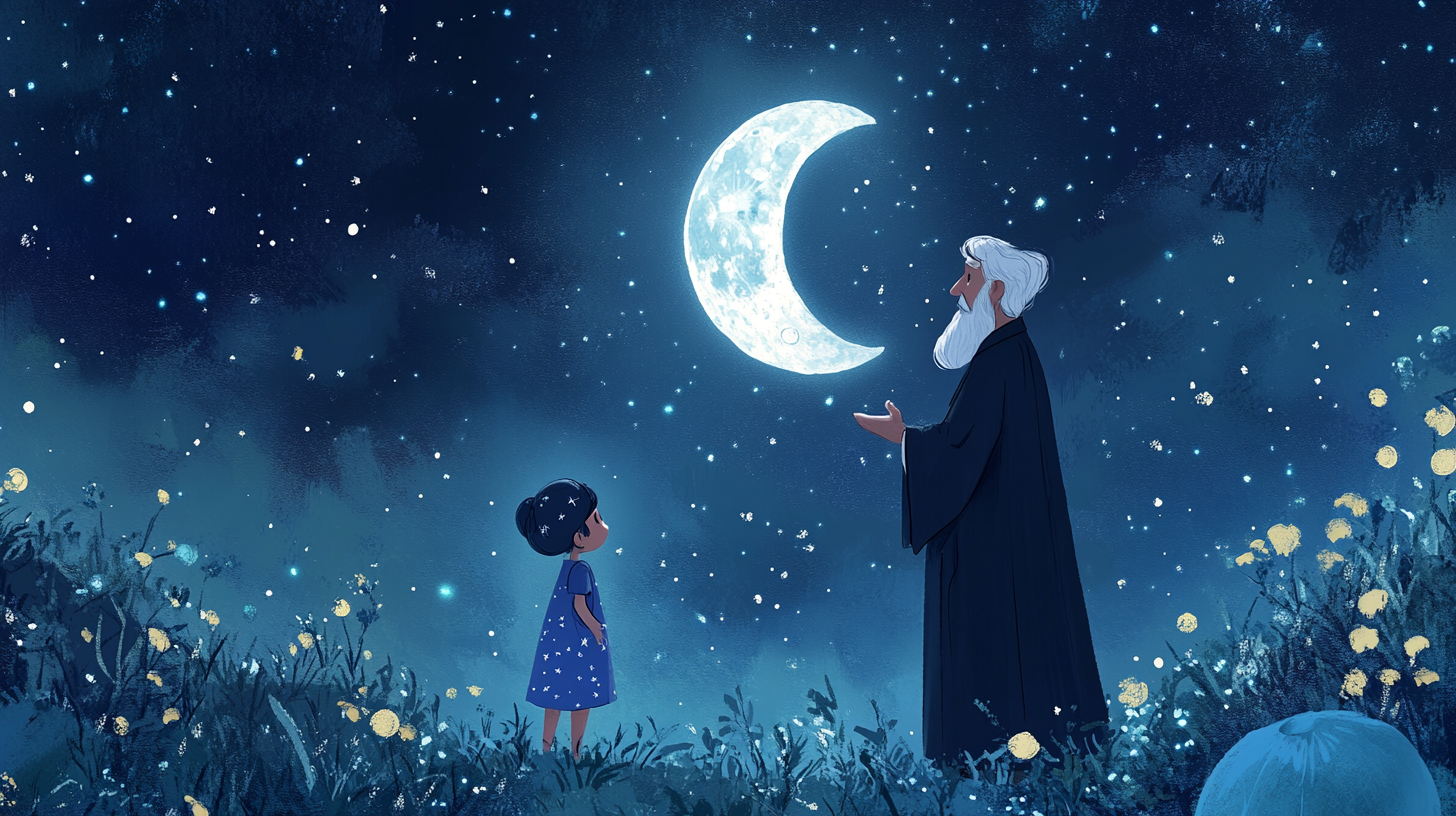
The Moon and Its Phases
Why does the Moon change shape in the sky?
The Mysteries of the Moon
After exploring the Valley of Planets and meeting fascinating extraterrestrial creatures like green Martians and iridescent (1)-winged Saturnians, Leo, dressed in his blue overalls with star embroidery and a miniature astronaut (2) helmet, and Luna, a girl with long black hair in a ponytail wearing a purple dress with planet patterns, returned to Galileo's Observatory (3). In the Valley of Planets, they learned that Mercury is the planet closest to the Sun and that Neptune is the farthest away. They also discovered that Jupiter, the largest, is known for its Great Red Spot. Back at the observatory, they are eager to share their discoveries with the young inventor (4). Galileo, always ready to share his knowledge, greets them with a kind smile. Galileo, a young inventor passionate about stars and the mysteries of the universe, wears overalls filled with pockets for his tools and inventions. He always has a sketchbook in hand to draw his ideas. He has messy hair and sparkling eyes full of curiosity.
Galileo, with a kind smile, asks:
« Have you seen many interesting things? »
Leo, eyes shining with excitement, exclaims:
« Yes, we saw planets and incredible creatures! »
Luna, eyes sparkling, exclaims:
« It was magical! »
Galileo, excited, says:
« It's wonderful! Now, look at the Moon through my telescope. »
Leo and Luna walk up to the telescope. They look at the Moon. Galileo tells them that the Moon does not shine by itself. It reflects the light from the Sun. Galileo shows them the different phases (5) of the Moon. He talks about the new moon, the first quarter, the full moon, and the last quarter. The children listen carefully.
Leo and Luna find out that the phases of the Moon are caused by the changing angle between the Earth, the Moon, and the Sun.
The Moon's Phases
After learning that the phases of the Moon are caused by the changing angle between the Earth, the Moon, and the Sun, Leo and Luna are eager to follow the Moon's phases for several days. They decide to climb the Star Tower to observe the Moon up close.
Luna, with a determined smile, suggests:
« We need to write down the changes every night. »
Leo, excited, adds:
« Yes, and draw what we see. »
Galileo, with a kind smile, turns to the children and says:
« I will show you how to use a moon calendar. »
Galileo shows them a moon calendar. They discover that the Moon goes through phases like the crescent and the gibbous. Every evening, they watch and draw the changes. They are amazed by the beauty of the constellations around the Moon.
Galileo, with a mysterious smile, starts to explain:
« Look at these constellations. They have stories. »
After learning about the phases of the Moon and admiring the wonders of the sky, Leo and Luna, along with their inventor friend, get cozy to watch the stars. As they gaze at the constellations, shooting stars streak across the night sky, leaving glowing trails behind them. The kids learn that these shooting stars are not stars, but small pieces of rock or metal that enter Earth's atmosphere at high speed. Their inventor friend then explains that these events are called meteors (6) and that some of them can even reach Earth's surface as meteorites (7). Leo and Luna are fascinated by these discoveries and decide to keep watching the sky every night. Their inventor friend, inspired by their observations, starts sketching new inventions to explore the mysteries of the universe even more. The night is magical, and the kids know they have so much more to discover. They promise to return to the Observatory for new adventures, ready to explore the secrets of the universe with their friends.
📺 Watch this article in video format
For an even more immersive experience, watch our video: