
Épisode · Wiki Storia
S1 - E5 | The Mysteries of Motion
Why does a moving object keep going all by itself?
On the road to knowledge with music for 3 to 6 year olds!
Today, we are going to discover things that keep moving all by themselves.
Pictures of our little adventurers in action - can you come and play with them?
🎼 Ready to move, sing and dream?
This first melody will take you on a musical discovery of the world!
🎤 Move, sing, discover!
Let's get adventurous with this second soundtrack. 😀
🎙 Read the lyrics to our music:
The lyrics of the two songs are identical, only the melodies are different.
The adventure begins with a story and discoveries for 6 - 8 year olds!
📻 Listen to this article as a podcast
For an immersive experience, enjoy our article in podcast mode. Click the player below to start listening and let the article carry you away!
📝 Quick summary of key information
Why does a moving object keep going all by itself?
Have you ever pushed a ball and seen it keep rolling even when you weren't touching it anymore? Or maybe you've seen a small car move after being pushed? This is what we call an object that moves by itself.
Why does an object that has been pushed or thrown keep moving even when you're not touching it anymore? It's because of a force called inertia. When an object is moving, it tends to keep moving because it has energy. It's like the object wants to keep playing!
In everyday life, there are lots of examples of things that keep moving. Think about toys, balloons, and small cars. When you push a ball, it rolls away. When you throw a small car, it moves on its own for a while.
It is important to understand why things keep moving. This helps us understand how things work and to be more careful. If you push a ball, it can roll far away and you need to be careful not to bump into something or knock something over.
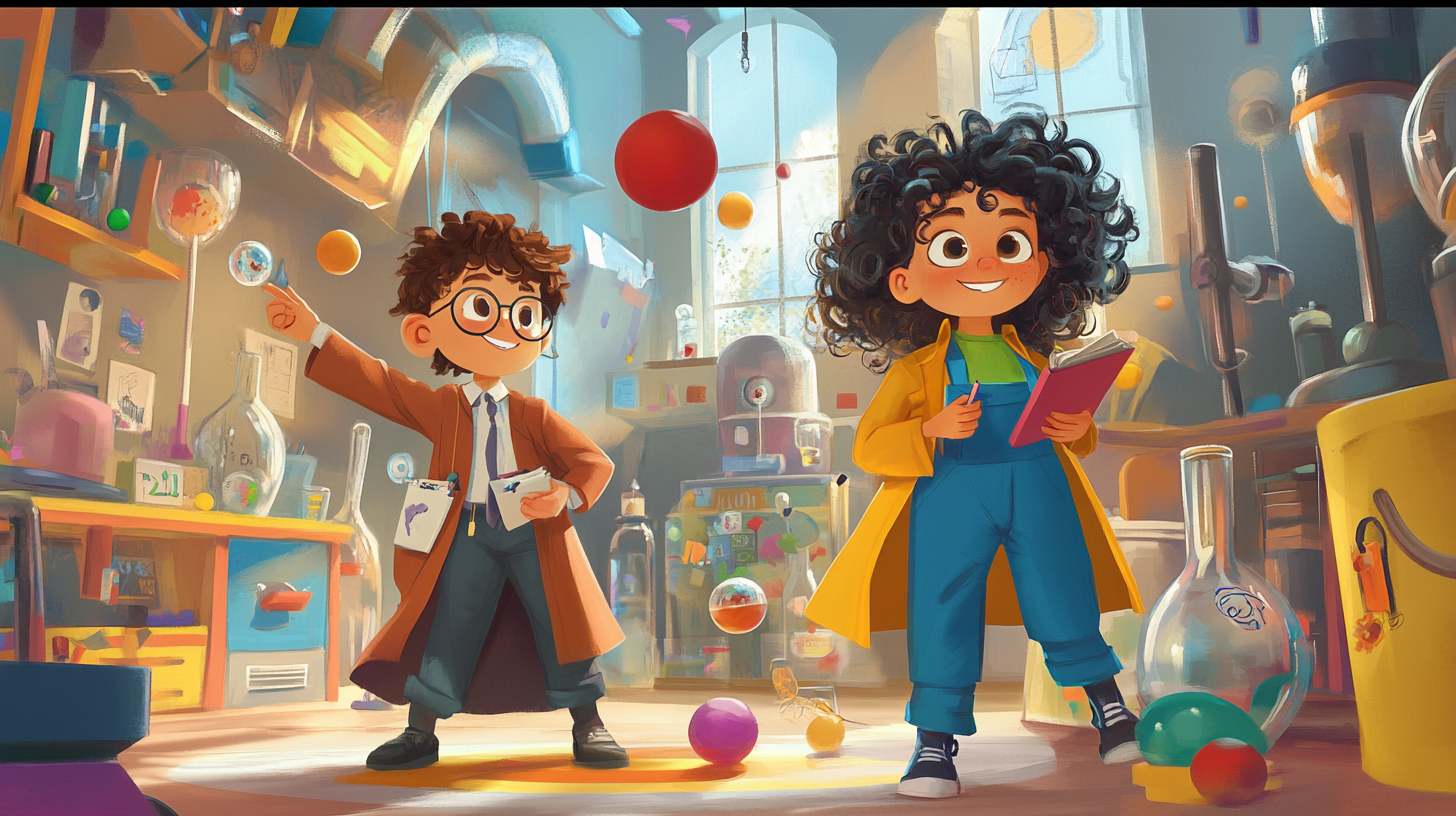
The Mysteries of Movement
Why does a moving object keep going on its own?
The Magic Ramp Room
After watching an apple and a feather fall in the air, Nina and Noa, along with a scientist (1), go to a big colorful room filled with ramps and balls. The children, always curious, hurry to explore this new space. The scientist, with his kind smile, tells them that this room is perfect (2) for understanding how things move.
Noa, curious, asks:
« What are these balls? »
Nina, curious, asks:
« Can we roll them down the ramps? »
Noa, with his usual energy, runs from one ramp to another. He watches each ball carefully. Nina, on the other hand, draws the paths (3) of the balls in her notebook. She notes the differences in speed and distance. Some balls stop quickly, while others keep rolling for a long time.
Noa, curious, asks:
« Why do some balls roll further? »
Nina, curious, asks:
« And why do some stop quickly? »
Isaac Newton (4), always ready to explain, shows them that the surface of the ramps and the shape of the balls affect their movement. He talks about friction, this invisible force that slows down objects.
By understanding this rule, Nina notices a hidden carving (5) on the wall: an arrow pointing to the next magical place to explore.
Newton's First Law
Nina shows the carving to Noa. The arrow shines brighter and brighter, catching their attention. The children look at each other, excited by this new discovery.
Noa, curious, asks:
« What is this drawing? »
Nina, eyes sparkling, explains:
« It’s a magic arrow. It shows us the way. »
Noa, excited by the discovery, suggests:
« Let's see where it leads. »
The children follow the magic arrow that leads them to Newton's garden. A white rabbit greets them and shows them wooden bikes. Noa and Nina realize that the bike doesn't move without them. Curious, they start pedaling, discovering the mysteries of motion and force. They understand that their legs provide the energy needed to move forward, just like Newton's first law explains. As they pedal, they feel the power of their movements and the resistance (6) of the air. Newton, proud of their discoveries, encourages them to keep exploring and asking questions. The children, excited, promise to come back for more scientific adventures.
📺 Watch this article in video format
For an even more immersive experience, watch our video: