
Épisode · Wiki Storia
S1 - E6 | The Bike Adventure
Why do we have to pedal to go forward and brake to stop?
On the road to knowledge with music for 3 to 6 year olds!
Why do we pedal to go forward and brake to stop?
Pictures of our little adventurers in action - can you come and play with them?
🎼 Ready to move, sing and dream?
This first melody will take you on a musical discovery of the world!
🎤 Move, sing, discover!
Let's get adventurous with this second soundtrack. 😀
🎙 Read the lyrics to our music:
The lyrics of the two songs are identical, only the melodies are different.
The adventure begins with a story and discoveries for 6 - 8 year olds!
📻 Listen to this article as a podcast
For an immersive experience, enjoy our article in podcast mode. Click the player below to start listening and let the article carry you away!
📝 Quick summary of key information
Why do we have to pedal to go forward and brake to stop?
To move a bike, you need to pedal. The pedals are connected to a chain that turns the wheels. Imagine the chain is like a magic rope that sends the power from your legs to the wheels. When you push the pedals, the chain turns the wheels, and the bike moves forward.
To stop, you need to use the brakes. There are two types of brakes: hand brakes and foot brakes. When you pull the hand brake or press the foot brake, small pads stick to the wheels and slow them down. It's like putting anti-slip shoes on the wheels to stop them from turning.
Knowing how to pedal and brake is very important. It lets you move around safely and have fun with your friends. Imagine you are a superhero who can control your bike like magic! You can go where you want and stop when you want.
Riding a bike has lots of benefits. It's good for your health because it makes you move and breathe fresh air. It's also good for the planet because it doesn't pollute. Plus, it's fun! You can explore your neighborhood, go to school, or take rides with your family.
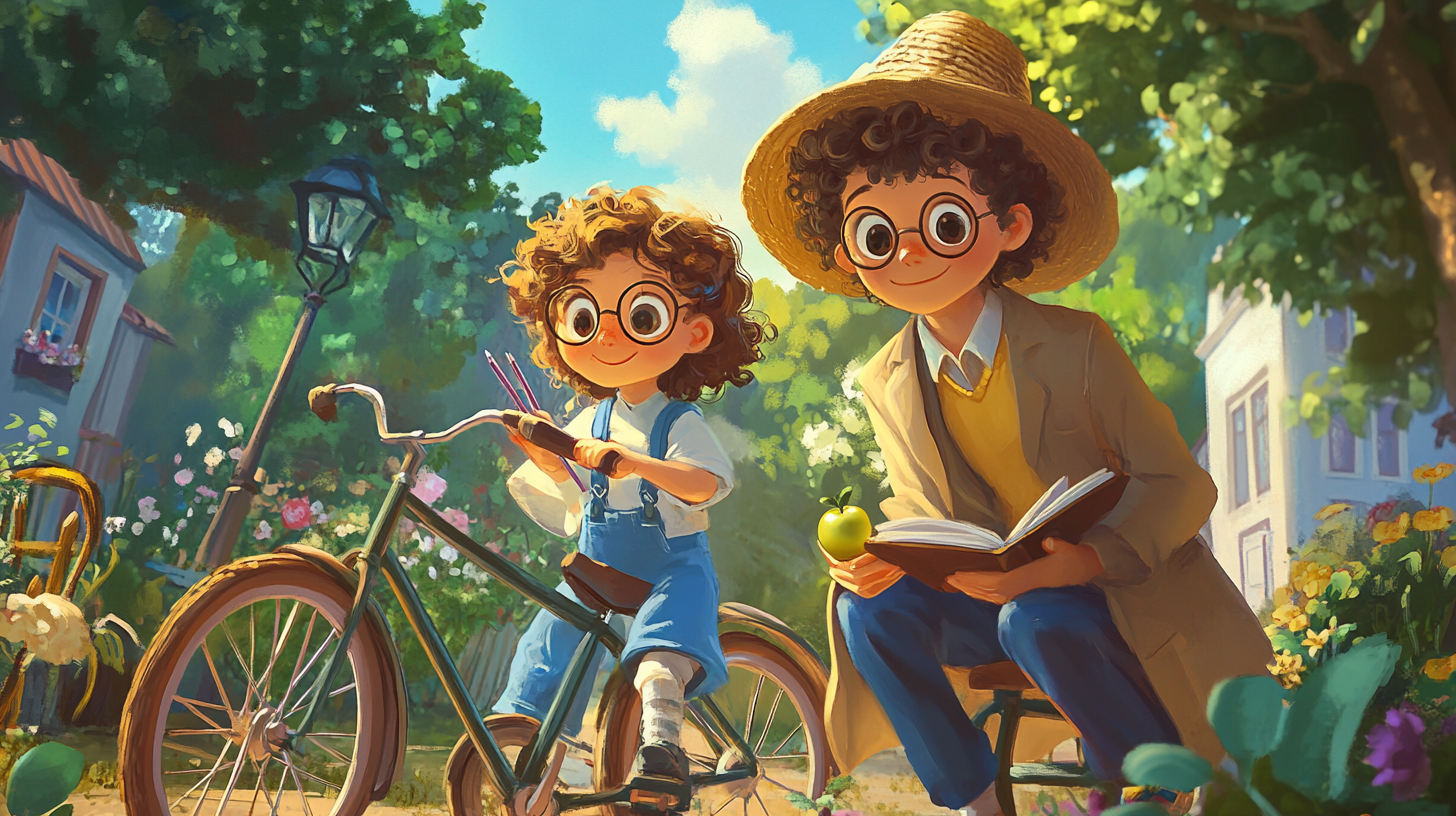
The Bike Adventure
Why do we pedal to go forward and brake to stop?
The Discovery of the Bicycle
In the colorful room, Noa and Nina learned why some balls keep rolling after being thrown, thanks to Isaac Newton's explanations. They even saw a curious cat watching the balls with interest. The children understood that any moving object stays in motion, unless it is stopped by a force. After observing carefully, they decided to take a break in the garden to relax. Once settled on the green grass, Noa and Nina spotted an old, rusty bike. Curious, they decided to take a closer look.
Noa, curious, says:
« Look, Nina, this bike is really old. »
Nina, curious, then suggests:
« Yes, let's try to make it move. »
After pushing the bike, Noa and Nina notice that it doesn't move. They decide to sit on it and think about this mystery. That's when Isaac Newton, who has been watching them from a bench, waves for them to come over. He explains that the bike is a great example of inertia (1), the first law of motion described by him, which states (2) that any object at rest stays at rest and any object in motion stays in motion at a constant speed, unless acted upon by an external force.
Isaac Newton, with a kind smile, then explains:
« To move forward, you need to pedal. Without force, the bike stops. »
Noa, curious, asks:
« Why? »
Nina, curious, asks:
« Yes, why? »
Isaac Newton, with a kind smile, explains:
« The bike does not move without force. By pedaling, you create a force. Without this force, it stays still. »
The children are told that to move forward, they must pedal. Their curiosity piqued, they try to pedal faster and faster, feeling the speed carry them away. That's when Isaac Newton points out that an old handlebar is shining in the sun. By touching it, a light appears, revealing the next page of the magic book.
The Mysteries of Motion
Noa and Nina then discover a new page in the magic book. This page shows a picture of a moving bike. Isaac Newton reminds them that to move forward, they need to apply force by pedaling. So, without this force, the bike stays still.
Isaac Newton, with a kind smile, begins to explain:
« You see, that's exactly what you just did! You applied a force by pedaling, and that's what made your bike move. The second law of motion, which I discovered, talks about this relationship between force, mass, and acceleration. It's thanks to this law that you were able to move forward. »
Noa, curious about the light, then asks:
« How does it work? »
Isaac Newton, with a mischievous smile, speaks to the children:
« When you brake, you create a force that slows down the bike. Try it. »
Nina, with a mischievous smile, suggests:
« Let's try. »
The children, fascinated, are encouraged to brake gently, then harder and harder. They feel the bike slow down and then stop. Then, Isaac Newton explains the third law of motion. It states that for every action, there is an equal and opposite reaction (3).
Isaac Newton, with a bright smile, explains:
« Pedaling is an action that pushes the bike forward, and braking is an action that slows it down. »
The light from the handlebar guides them to a glowing tunnel. In the magical Rainbow of Light tunnel, Noa and Nina watch a ray of light turn into a colorful arc. A butterfly with shimmering (4) wings joins them, explaining the mysteries of colors. They learn how white light breaks (5) into seven different colors using a prism (6). Isaac Newton shows them how each color has a different wavelength and how they mix to create white light. The children, amazed, watch the colors dance and mix. They understand that each color has a purpose in nature, like the butterfly's wings that help it hide or attract mates. Isaac Newton explains that light and colors are all around us, and they play a crucial role in our daily lives. The children, enchanted by this new discovery, promise to keep exploring the mysteries of light and colors in their next adventure.
📺 Watch this article in video format
For an even more immersive experience, watch our video: