
Épisode · Wiki Storia
S1 - E1 | The Lesson of Long Life from the Giant Turtles
How can giant turtles live so long?
On the road to knowledge with music for 3 to 6 year olds!
Today, we are going on a journey to discover Giant Turtles.
Pictures of our little adventurers in action - can you come and play with them?
🎼 Ready to move, sing and dream?
This first melody will take you on a musical discovery of the world!
🎤 Move, sing, discover!
Let's get adventurous with this second soundtrack. 😀
🎙 Read the lyrics to our music:
The lyrics of the two songs are identical, only the melodies are different.
The adventure begins with a story and discoveries for 6 - 8 year olds!
📻 Listen to this article as a podcast
For an immersive experience, enjoy our article in podcast mode. Click the player below to start listening and let the article carry you away!
📝 Quick summary of key information
How can giant turtles live so long?
Giant tortoises are amazing animals that can live for a very long time. Some live over 100 years, and some even up to 200 years! Imagine, they could see many generations of tortoises being born and growing up.
Why do they live so long? They have a slow metabolism, which means they grow and age very slowly. They eat little and move slowly, which helps them save energy.
Giant turtles play an important role in their environment. They help spread seeds from the plants they eat, which helps new plants grow. They are also important for the ecosystem of the islands where they live.
Giant tortoises eat plants, fruits, leaves, and sometimes small rocks to help digest their food. You can find them mostly on certain islands, like the Galápagos Islands and Mauritius. They love warm and humid places.
The Long Life Lesson of Giant Turtles
How can giant turtles live so long?
The Giant Turtle Island
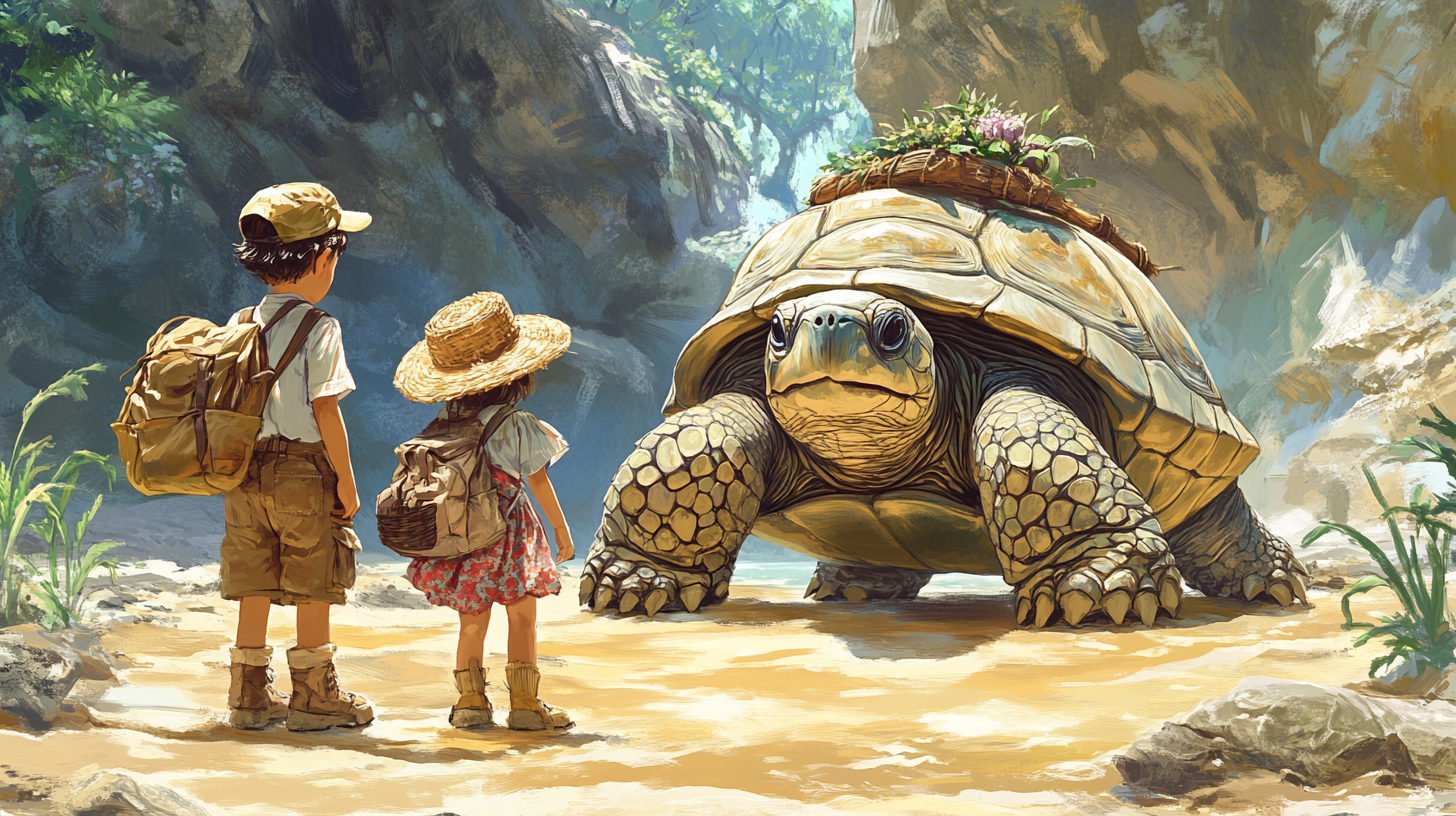
After discovering the wonders of the birds of the Galápagos Islands, Mila and Max are back on board their flying boat. At the end of their previous adventure, they learned that every species (1) adapts to its environment (2). They saw finches with different beaks, warblers (3) with unique songs, and marine iguanas with shiny scales (4). The children are eager to discover new islands and meet other fascinating animals. As the boat flies over a rocky and warm island, Mila and Max spot slow and majestic shapes: giant turtles.
Max, eyes wide open, exclaims:
« Look, Mila! Giant turtles! »
Mila, amazed, shouts:
« They are huge! »
Not long after, the boat gently lands on the island. Mila and Max get off and walk towards the turtles. An old turtle named Tama slowly comes near. She has a green shell with golden patterns and shiny eyes. Tama carries a small bag over her shoulder (5) where she keeps her treasures and favorite things.
Max, with a big smile, says:
« Hello, Tama the Turtle! »
Mila, with a curious smile, says:
« We want to know more about you. »
Tama the Turtle, with a mysterious smile, says:
« Welcome to Giant Turtle Island. You are lucky, I will show you a secret. »
Tama the Turtle shows them an old stone with a symbol carved on it: it's the first clue to a forgotten natural treasure, hidden for a long time on the islands.
The Natural Treasure
The kids follow Tama the Turtle. She shows them rare plants and colorful flowers. She explains how they adapt to the environment.
Tama the Turtle, with a calm and steady voice, explains:
« Giant turtles have a very slow metabolism. They use little energy. »
Max, curious, asks:
« Why do they live so long? »
Tama the Turtle, with a soft and reassuring voice, explains:
« They eat plants and fruits. This makes them strong and healthy. »
Mila, amazed, says:
« Wow! They really live for a long time, don't they? And they are so wise! »
After exploring the island, they find a hidden cave. Inside, they discover fossils (6) and old objects. These treasures tell the story of the giant turtles.
After listening to Tama the Turtle's wise advice and discovering the natural treasure, Mila and Max fly away on their magic boat. Their next stop is the Island of Singing Finches. There, they will find out why these little birds, the finches, have such different beaks. They will listen to their songs and watch how each beak helps them eat in unique ways. With hearts full of new knowledge and natural wonders, the children can't wait to continue their adventure.
📺 Watch this article in video format
For an even more immersive experience, watch our video: