
Épisode · Wiki Storia
S1 - E5 | The Traces of the Past in Darwin's Notebook
How did Darwin understand the secrets of nature?
On the road to knowledge with music for 3 to 6 year olds!
Today, we are going on a journey to discover Charles Darwin.
Pictures of our little adventurers in action - can you come and play with them?
🎼 Ready to move, sing and dream?
This first melody will take you on a musical discovery of the world!
🎤 Move, sing, discover!
Let's get adventurous with this second soundtrack. 😀
🎙 Read the lyrics to our music:
The lyrics of the two songs are identical, only the melodies are different.
The adventure begins with a story and discoveries for 6 - 8 year olds!
📻 Listen to this article as a podcast
For an immersive experience, enjoy our article in podcast mode. Click the player below to start listening and let the article carry you away!
📝 Quick summary of key information
How did Darwin understand the secrets of nature?
Charles Darwin was a British naturalist, born in 1809. He is famous for his travels and observations of animals and plants. He spent five years exploring the world on a ship called the Beagle.
Darwin watched how animals and plants live in their environment. For example, he saw that penguins have wings for swimming and not for flying. Cacti, on the other hand, have spines to protect themselves in the desert.
He found out that animals and plants change over time to survive better. For example, giraffes have long necks to reach the leaves on trees. Lizards have sticky feet to climb on walls.
Darwin wrote a famous book called 'The Origin of Species' where he explains his discoveries. This book changed the way we understand nature and how living things evolve.
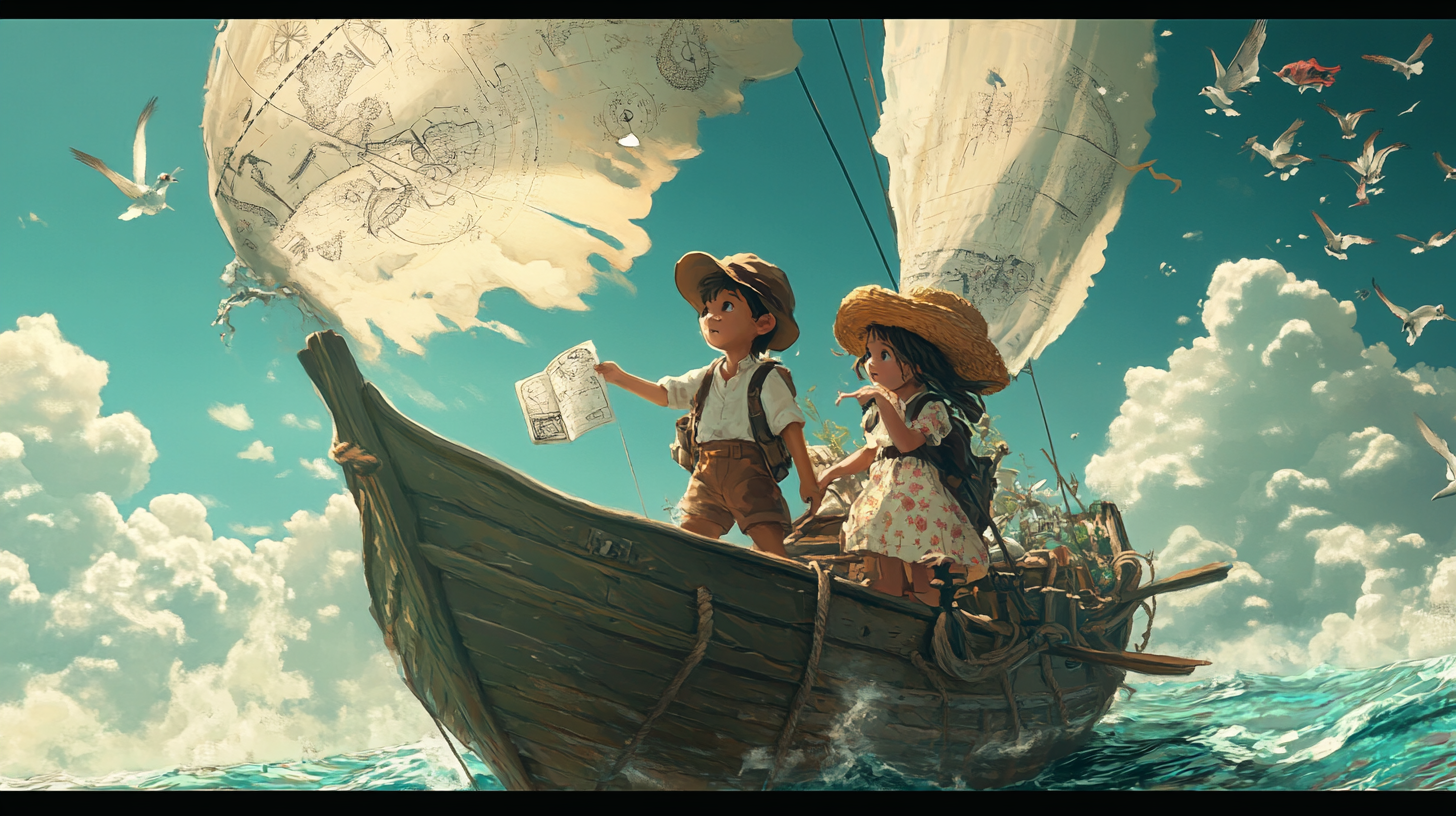
The Past Traces in Darwin's Notebook
How did Darwin understand the secrets of nature?
The Flying Nature Museum
On the Island of Climbing Plants, Mila and Max walk through a lush (1) jungle where everything seems to reach for the sky. They watch vines wrap around trees and climbing ferns reach the highest branches. An orchid, hanging from a branch, catches their eye with its beauty. The children understand that climbing plants use trees to reach the sunlight. They know that Darwin observed animals and plants to understand how they adapt to their environment. By opening a new page in Darwin's notebook, full of sketches and questions, they discover that each encounter brings them closer to a forgotten secret of nature.
Max, pointing at a page in the notebook, says:
« Look, Mila, Darwin drew giant tortoises! »
Mila, with a curious smile, adds: « Yes, they live on the Galápagos Islands. They have a very strong (2) shell. »
Max, curious, asks:
« Why do turtles have strong shells? »
Mila, after looking at the drawings, explains to Max: « To protect themselves from predators, the giant tortoises of the Galápagos have a very strong shell. They live for a long time because of their slow metabolism (3). »
After watching the turtles, they remember the finches with different beaks. They understand that each beak is perfect for the food they find. This helps them eat well. They also remember the quick lizards with their bright colors. These colors help them hide or attract friends (4). They realize that every animal has unique tricks (5) to survive and thrive (6).
By putting together a map with the island clues (7), they find out that every meeting brings them closer to a forgotten nature secret.
Nature's Secrets
After putting the map together with the island clues, they find a new drawing. It's an island with climbing plants. They decide to go and find it.
Max, curious, suggests:
« Mila, let's look in the notebook. What does it say about climbing plants? »
After flipping through the notebook, Mila says:
« Climbing plants use trees to reach the sunlight. »
Max, curious, asks:
« Why do they climb? »
Mila, who loves the secrets of plants, explains:
« To grow and develop, they need light to live. »
Once they arrive on the island, they watch the climbing plants. They see how they wrap around the trees. They understand that this helps them grow towards the sky.
After putting the map together with the island clues, Mila and Max can't wait to discover nature's secrets. They go back to the islands they visited to see the giant tortoises of the Galápagos, the finches with different beaks, the agile lizards, and the climbing plants. Each meeting shows them how animals adapt to their environment, teaching them unique tricks for surviving and thriving. They realize that Darwin observed these adaptations and wrote them in his notebook, helping them understand nature better today. They see that nature is full of secrets, and each encounter with an animal or plant reveals a bit more of these secrets. They can't wait to find out what the next island has in store and to continue their adventure with Darwin's notebook.
📺 Watch this article in video format
For an even more immersive experience, watch our video: