
Épisode · Wiki Storia
S1 - E6 | The Adventure of Amazing Species
Why does every species have its own tricks to live in nature?
On the road to knowledge with music for 3 to 6 year olds!
Today, we are going on a journey to discover animal tricks.
Pictures of our little adventurers in action - can you come and play with them?
🎼 Ready to move, sing and dream?
This first melody will take you on a musical discovery of the world!
🎤 Move, sing, discover!
Let's get adventurous with this second soundtrack. 😀
🎙 Read the lyrics to our music:
The lyrics of the two songs are identical, only the melodies are different.
The adventure begins with a story and discoveries for 6 - 8 year olds!
📻 Listen to this article as a podcast
For an immersive experience, enjoy our article in podcast mode. Click the player below to start listening and let the article carry you away!
📝 Quick summary of key information
Why does every species have its own tricks to live in nature?
Animals have special tricks to survive in nature. These tricks are adaptations that help them fit into their environment. For example, the chameleon changes color to hide and avoid predators.
Some animals use camouflage to blend into their surroundings. A camel, for example, can move quickly in the desert thanks to its wide feet that keep it from sinking into the sand.
Birds use their beaks to catch insects or seeds. For example, a toucan's beak is perfect for catching fruits. Other animals, like bears, hibernate during the winter to save energy.
Animals protect themselves from predators in different ways. Some hide, others run fast, and some live in groups for more safety. Each trick is a clever way to survive in nature.
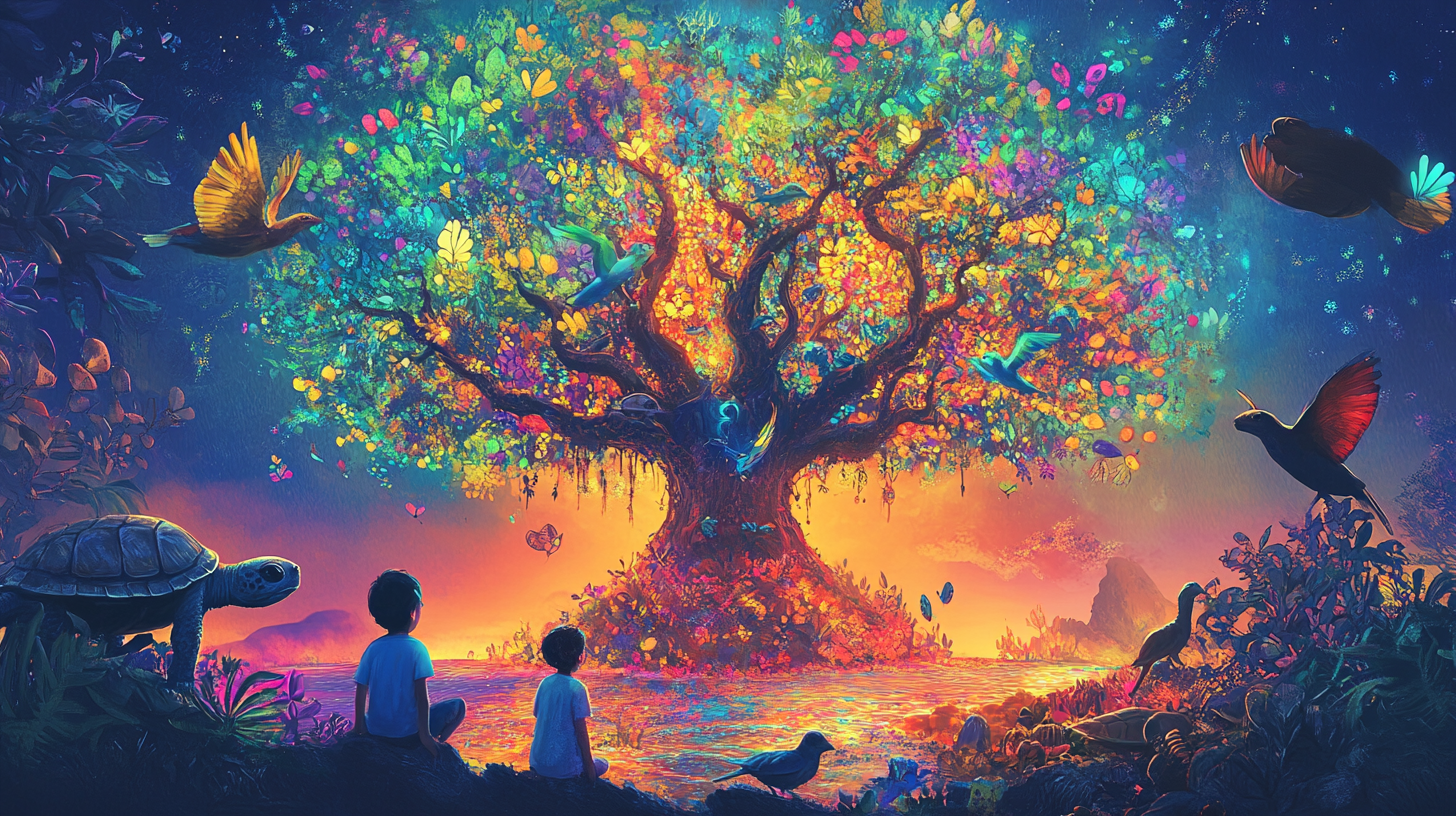
The Amazing Species Adventure
Why does each species have its own tricks to live in nature?
The Secrets of the Giant Turtles
In the Flying Natural Museum, Mila and Max open a new page in Darwin's notebook, full of sketches (1) and questions. They discover detailed drawings of the Galápagos finches, those little birds with different beaks. Darwin had noted how each beak adapted to the available food, revealing the secrets of evolution (2). The children wonder what other mysteries await them on the next islands. After admiring the drawings, Max and Mila decide to return to the islands they have already visited to learn more about the adaptations (3) of animals and plants.
After leaving the Flying Natural History Museum, Mila and Max find themselves on Giant Turtle Island. They watch the peaceful turtles slowly move across the rocky ground.
Max, eyes wide open, shouts: « Look, Mila! The turtles have very strong (4) shells. »
Mila, while watching the turtles, says: « Yes, they protect themselves from predators (5) with their shells. »
Max, after reading in his notebook, says:
« They live for a very long time, more than one hundred years. »
After watching the turtles, Mila explains to Max:
« That's right. They eat very little and move slowly. »
Max, after watching the turtles, explains to Mila:
« Maybe they eat little because they move slowly. They don't need much energy. »
After thinking, Mila tells Max:
« To save their energy. »
Next, they go to the Island of Singing Finches, where they learn how the birds' beaks are adapted to their food.
The Singing Finches and Their Magic Beaks
Not long after, Mila and Max find themselves back on the Island of Singing Finches. The varied melodies of the birds catch their attention, and they spot finches with different beaks, each adapted to their food.
Max, looking carefully at the finches, says:
« Look Mila, some finches have short, thick beaks. »
After watching the beaks of the finches, Mila explains to Max:
« Yes, they are perfect for cracking seeds. »
Max, after watching carefully, says:
« And some finches have long and thin beaks. »
After watching the finches, Mila tells Max: « They eat nectar (6) (7) with these beaks. »
Max, fascinated by the finches, explains:
« In addition to adapting to their food, their beaks also help them produce varied songs. Some finches have very melodious songs, while others have simpler songs. »
Mila, fascinated by the birds, says:
« Yes, they attract partners with their songs. »
After admiring the tree of life, Mila and Max get ready for a new adventure. They will discover how animals and plants adapt to their environment. With the help of their binoculars, they observe surprising details: a flower that holds water, an insect that mimics a leaf, or a lizard that changes color to camouflage. Once Mila and Max have observed these adaptations well, they say that each species has its own tricks to live in nature. They promise to keep exploring and discovering the wonders of nature, always guided by Darwin's teachings.
📺 Watch this article in video format
For an even more immersive experience, watch our video: