
Épisode · Wiki Storia
S1 - E7 | The Mysteries of Adaptation
How do animals and plants adapt to their world?
On the road to knowledge with music for 3 to 6 year olds!
Today, we are going on a journey to discover how animals and plants adapt.
Pictures of our little adventurers in action - can you come and play with them?
🎼 Ready to move, sing and dream?
This first melody will take you on a musical discovery of the world!
🎤 Move, sing, discover!
Let's get adventurous with this second soundtrack. 😀
🎙 Read the lyrics to our music:
The lyrics of the two songs are identical, only the melodies are different.
The adventure begins with a story and discoveries for 6 - 8 year olds!
📻 Listen to this article as a podcast
For an immersive experience, enjoy our article in podcast mode. Click the player below to start listening and let the article carry you away!
📝 Quick summary of key information
How do animals and plants adapt to their world?
Animals and plants adapt to their environment in different ways. Animals use their bodies and behaviors to survive. For example, some hide to escape predators, others hibernate to save energy in the winter, and some migrate to find food and a better climate. Plants, on the other hand, produce oxygen, provide food, and offer a habitat to other living beings.
Plants also adapt to specific conditions. For example, cacti live in the desert and store water in their stems to survive in very dry places. Mosses, on the other hand, grow in wet forests and absorb water directly from the air. Animals, too, have different ways of living depending on their habitat. In the forest, monkeys climb trees to eat and stay safe. In the savanna, giraffes use their long necks to reach the leaves of trees.
Adapting is important for animals and plants to live and for nature to stay balanced. Animals and plants need to change to fit their environment to find food, avoid dangers, and have babies. For example, fish like salmon swim long distances to have babies in special rivers. Flowers attract bugs for pollination, helping them have babies too.
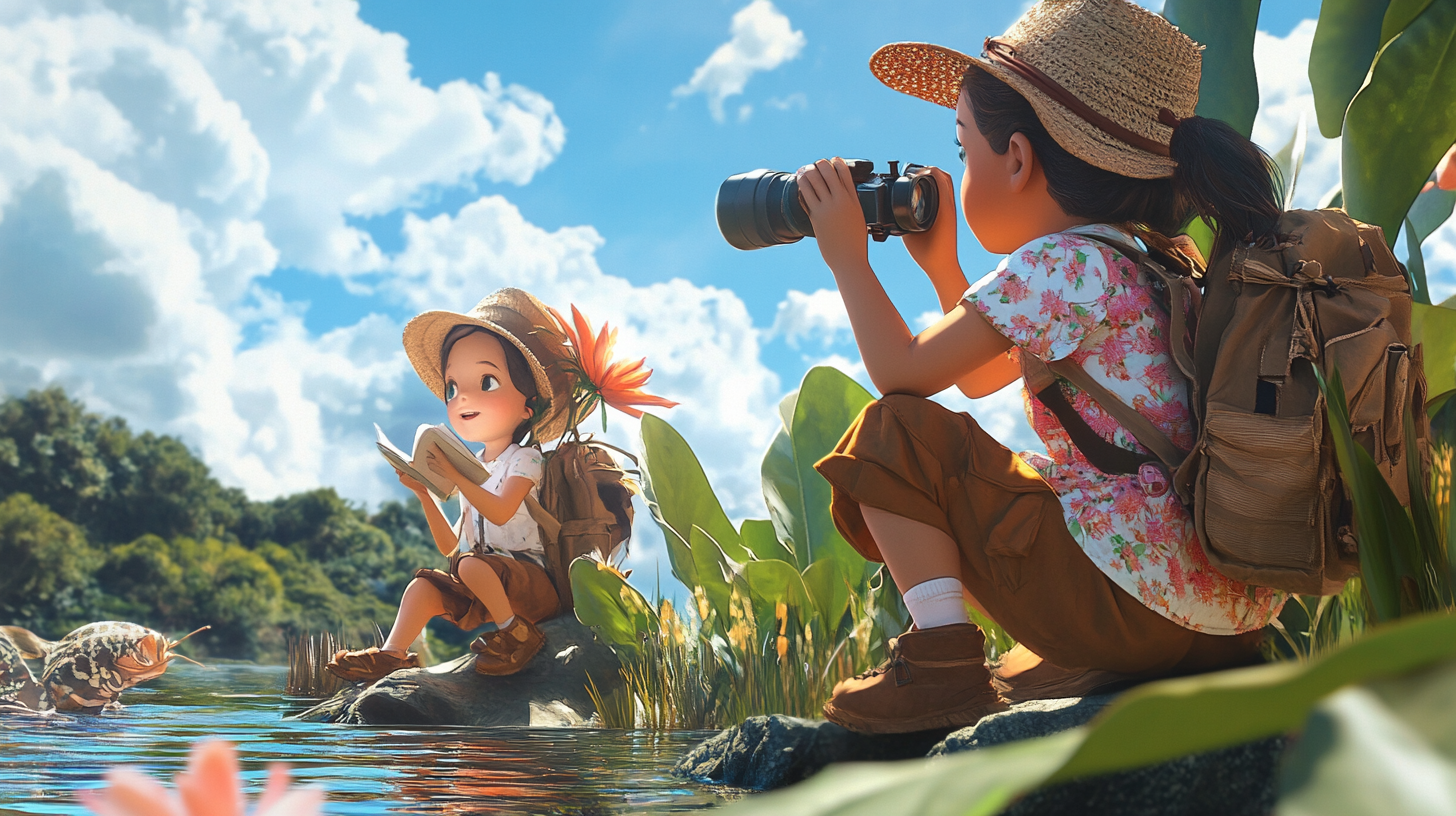
The Mysteries of Adaptation
How do animals and plants adapt to their world?
Surprising Observations
After being amazed by the secrets of the giant tortoises of the Galápagos, who live more than 100 years, and the finches with different beaks, each one adapted to their favorite food, Mila and Max were eager to discover more wonders (1) of nature. Lizards that change color to hide and climbing plants that hold onto trees to reach the sunlight had already helped them understand adaptation (2) in nature. Their endless curiosity (3) pushed them to explore more.
Max, amazed, says:
« Look, Mila! This flower holds water. »
Mila, amazed, says:
« And this insect looks like a leaf. »
Max, amazed, says:
« Wow! We should write it all down in our notebook. »
Not long after, they find a hidden word in Darwin's drawings: 'adaptation,' the key to surviving in nature. They decide to go on a journey to discover the secrets of adaptation.
Mila, her eyes shining with excitement, says:
« Let's explore new horizons. »
Max, excited, shouts:
« Yes, let's go on an adventure. »
Their flying boat takes them to a mysterious island where the plants seem to defy gravity. When they arrive, they discover trees with aerial roots that stretch out like arms to find water and nutrients (4).
The Secrets of Adaptation
Mila and Max walk under the giant trees. They touch the aerial roots. They are rough and strong. The children look at the plants around them. They see colorful flowers that attract insects.
Max, amazed, says:
« These flowers are pretty. They attract bees. »
After watching the bees, Mila tells Max:
« Yes, and bees help flowers make seeds. »
Max, curious, points his finger: « Look, this plant has thorns (5). It protects its leaves. »
After looking at the plant more closely, Mila explains to Max:
« The thorns stop animals from eating its leaves. »
After finding the word 'adaptation' in Darwin's drawings, Mila and Max decided to use their new knowledge. By watching the thorns on plants and the bees that help flowers, they understood that every part of nature has a purpose. So, they planned their own expedition (6) to a clearing on the island, equipped with magnifying glasses and notebooks, ready to observe the secrets of spiders, ants, and dragonflies (7). They now know that all you need to do is watch carefully to understand nature's mysteries. Their adventure has turned them into real explorers, always ready to discover new wonders. Who knows what other secrets they will find on their next adventure?
📺 Watch this article in video format
For an even more immersive experience, watch our video: