
Épisode · Wiki Storia
S1 - E7 | The Riddle of Paradoxes
Can you grow old slower than your twin?
On the road to knowledge with music for 3 to 6 year olds!
Today, we are going to explore the twin paradox.
Pictures of our little adventurers in action - can you come and play with them?
🎼 Ready to move, sing and dream?
This first melody will take you on a musical discovery of the world!
🎤 Move, sing, discover!
Let's get adventurous with this second soundtrack. 😀
🎙 Read the lyrics to our music:
The lyrics of the two songs are identical, only the melodies are different.
The adventure begins with a story and discoveries for 6 - 8 year olds!
📻 Listen to this article as a podcast
For an immersive experience, enjoy our article in podcast mode. Click the player below to start listening and let the article carry you away!
📝 Quick summary of key information
Can you grow old slower than your twin?
The twin paradox is a fun idea. It shows that time does not pass the same way for everyone. If one twin travels very fast in space, they will age more slowly than their brother who stayed on Earth.
Imagine you have a twin. If you go on a very fast rocket, you will come back younger than your brother who stayed at home. Isn't that surprising?
This is because of a theory called relativity. It says that time and space change depending on how fast you are moving. The faster you go, the slower time passes for you.
So, yes, you can really age slower than your twin! It's like time slows down for the one who travels fast. It's a fascinating idea that shows how mysterious the universe is.
The Paradox Riddle
Can you grow old slower than your twin?
The Puzzle Room
After watching faraway galaxies and discovering livable planets, the magic train leaves the tracks and flies into space, taking Léo, Léa, and Albert Einstein through an endless starry sky. Earth is now just a blue dot in the vastness of the cosmos. The children observe colorful nebulae (1) and shooting stars, guided by the explanations of the famous physicist (2). Albert Einstein talks to them about the mysteries of time and space, sparking their curiosity about the paradoxes of relativity. Léo and Léa, fascinated, ask endless questions, trying to understand how time can change with speed.
Léo, eyes sparkling with stars, asks:
« Can time really change? »
Léa, curious, asks:
« How does it work? »
Albert Einstein, with a mischievous smile, explains:
« It's the theory of relativity. Time can slow down if you go very fast. »
Not long after, the magic train enters a bright tunnel. It takes them straight to the Puzzle Room. Here, the walls are covered with math formulas (3) and complex diagrams. Albert Einstein suggests a role-play game for the kids. Léo and Léa must imagine they are twins. One stays on Earth, while the other travels on a spaceship at a speed close to the speed of light.
Albert Einstein, with a mischievous smile, announces: « Léo, you are going to be the time-traveling (4) twin. Léa, you come with me in time. »
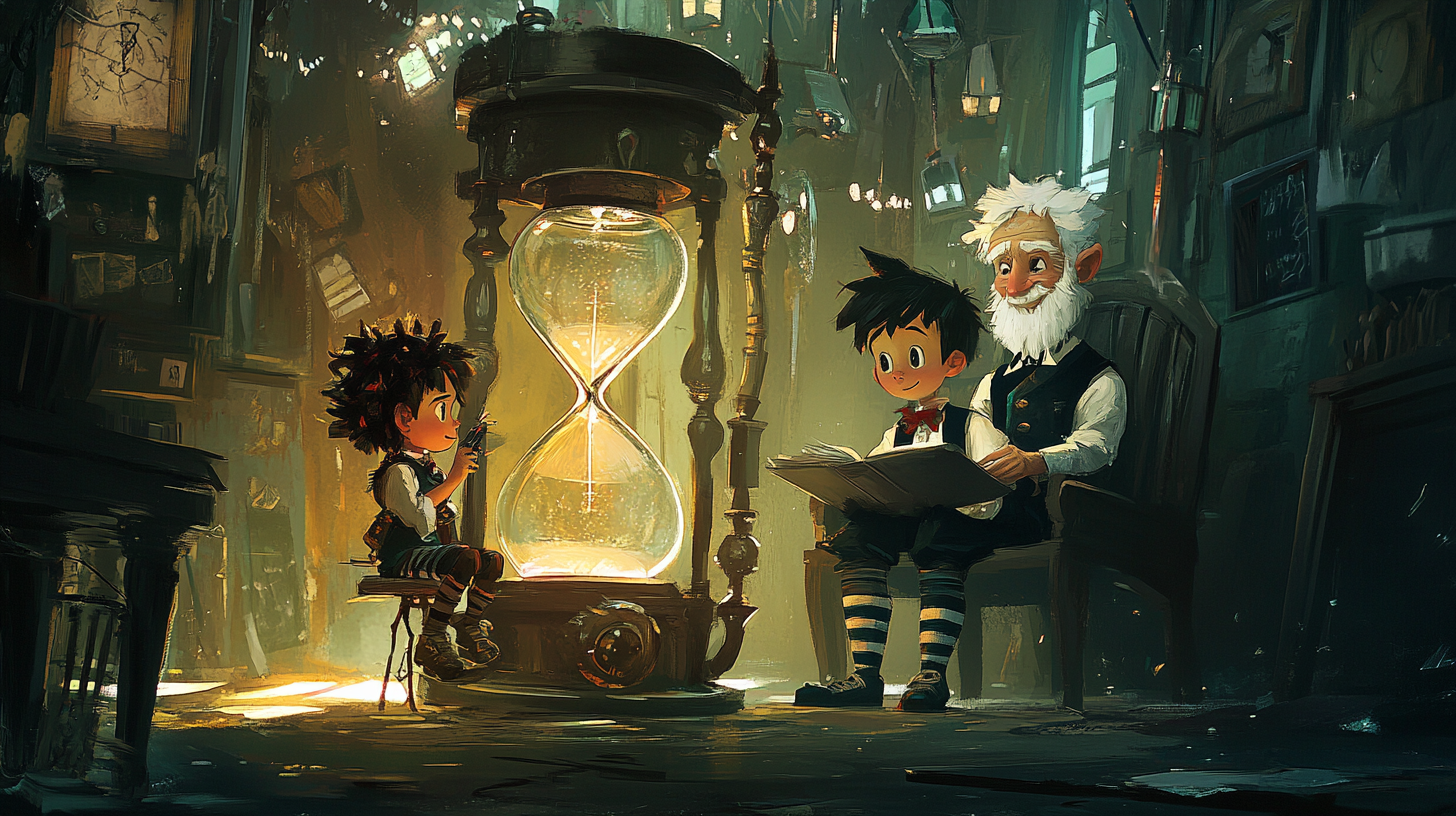
The children, curious, start the adventure. Léo, the dreamy boy who loves the stars, runs very fast through the room, while Léa carefully watches every detail. Albert Einstein uses a special hourglass to show that time really flows more slowly for Léo. The children discover that time is not a constant (5) thing everywhere, but it can change depending on how fast you go.
By solving the puzzle, they find a backwards hourglass that shows them a new piece of the Magic Map.
The Twins Paradox
Léo and Léa observe the inverted hourglass, amazed by the sight. Time seems to be going backward, showing them that, according to the twin paradox (6) (7) theory, time can indeed slow down for a traveler moving at high speed.
Léo, amazed, shouts:
« This is amazing! »
Léa, with her eyes wide open, asks:
« Can time really slow down? »
Albert Einstein, with a mischievous smile, explains:
« Yes, it's relativity. Speed changes time. »
Albert Einstein shows them another hourglass. This hourglass is normal. He explains that time passes more slowly for someone who travels very fast. Léo and Léa understand the twin paradox better.
Léo, with wide eyes, asks:
« Can we really age slower? »
Albert Einstein, with a big smile, explains:
« Yes, by traveling very fast. Time slows down. »
After solving the riddle of the upside-down hourglass, the kids head to a carriage full of shiny puzzles. In this carriage, they need to match symbols to activate the train's secret mechanisms. Léo and Léa discover that letters and numbers can explain the universe, with the help of Albert Einstein. The kids, amazed, continue their journey through time and space, ready to discover new scientific wonders. Their endless curiosity drives them to explore the mysteries of the universe even further, always with their friend Albert Einstein by their side.
📺 Watch this article in video format
For an even more immersive experience, watch our video: