
Épisode · Wiki Storia
S1 - E3 | The Book of Wonderful Elements
How can we remember all the amazing things we discover?
On the road to knowledge with music for 3 to 6 year olds!
Today, we are going to explore notebooks.
Pictures of our little adventurers in action - can you come and play with them?
🎼 Ready to move, sing and dream?
This first melody will take you on a musical discovery of the world!
🎤 Move, sing, discover!
Let's get adventurous with this second soundtrack. 😀
🎙 Read the lyrics to our music:
The lyrics of the two songs are identical, only the melodies are different.
The adventure begins with a story and discoveries for 6 - 8 year olds!
📻 Listen to this article as a podcast
For an immersive experience, enjoy our article in podcast mode. Click the player below to start listening and let the article carry you away!
📝 Quick summary of key information
How can we remember all the amazing things we discover?
A notebook is a magic tool for drawing, writing, and remembering all the amazing things you discover. It's like a treasure where you can keep your ideas and adventures.
Scientists use notebooks to write what they see and draw what they observe. For example, they can draw stars, plants, or even tiny pieces of stuff called chemical elements.
Chemical elements are like invisible building blocks that make up everything around us. They are everywhere, in the air, in the water, and even in the toys you play with.
Remembering the things you discover is very important. It helps you learn and become more curious. The more you know, the more you can explore and understand the world around you.
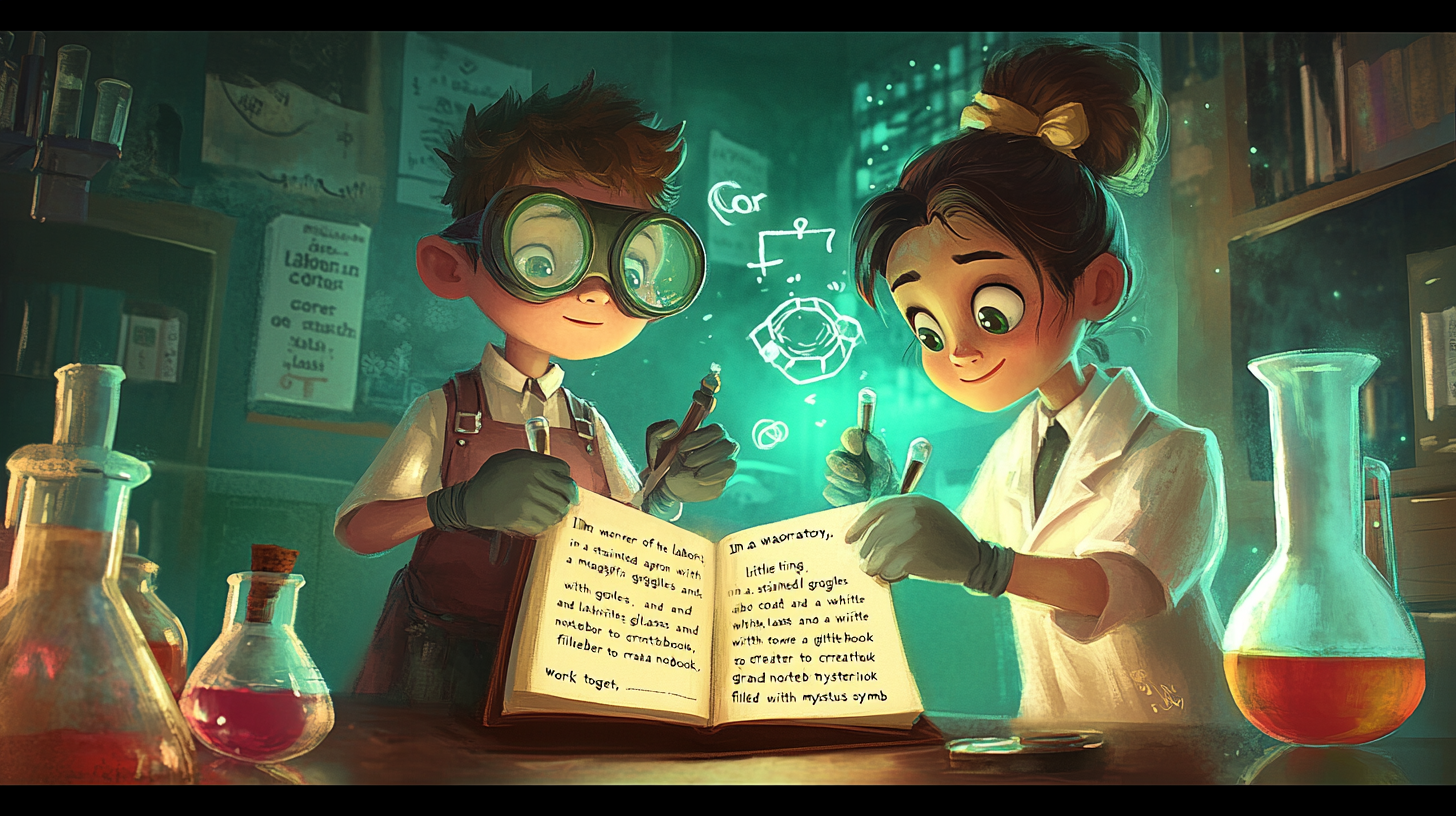
The Wondrous Elements Notebook
How can we remember all the amazing elements we discover?
The Creation of the Elements Notebook
In the Radiation Room, Zoé and Tom observe glowing powders under the watchful eye of Marie Curie. They discover that these shiny powders, though invisible to the naked eye, reveal the presence of radioactivity (1). Marie Curie, with patience, explains to them how these invisible particles (2) can be detected and measured. The children are amazed by the sparks that dance in the darkness. Tom, with his methodical mind, tries to follow each movement of the particles, while Zoé, always curious, asks questions about how these powders can be so bright.
Tom, amazed, whispers:
« These powders shine really bright. »
Zoé, curious about this phenomenon, asks:
« Why do they shine like that? »
Marie Curie, with a smile lit up by curiosity, explains:
« This is radioactivity. It is invisible, but it makes the powders glow. »
After watching the glowing powders, Zoé and Tom decide to write down every detail. Zoé starts drawing everything she sees: vials, powders, sparks… Tom invents symbols for each substance (3) they observe.
Tom, after thinking for a moment, says:
« I am going to draw stars for the powders. »
Zoé, always so excited, says:
« And I will draw arrows for the sparks. »
Marie Curie, smiling, says:
« That's a great idea. You can also write down what you see. »
Marie Curie gives them a big empty notebook. Together, they create the “Element Notebook,” which will guide them in their exploration of the invisible world.
The Element Adventure
With their notebook, Zoé and Tom start exploring the laboratory (4). Zoé draws every detail and Tom writes down everything they discover.
Tom, all excited, shows Zoé:
« Look, Zoé, this metal shines. »
Zoé, after looking carefully, says:
« It's copper. It's very pretty. »
Tom, pointing at a flask, explains:
« You see, Zoé, this gas is transparent, like the air we breathe. It is invisible, but it is right here, all around us. »
Zoé, after looking carefully, says: « It's oxygen (5). It's everywhere. »
Marie Curie, with an encouraging smile, says:
« You are right. Elements are everywhere. »
With the Elements Notebook full, Zoé, a lively and precise girl with a too-long white coat, lab gloves, and an always-open notebook, and Tom, a curious and methodical boy with a slightly stained apron, too-big safety glasses, and a magnifying glass always in hand, are ready to explore the invisible world of elements more deeply. Marie Curie explains that each element has a story to tell and they are ready to discover all the wonders the invisible world has to offer. She shows them how to observe and study the properties (6) of each element. This fascinating and complex process (7) promises new discoveries and adventures. The children, with their notebook in hand, are eager to continue their exploration. They now know that each element has a story to tell and they are ready to discover all the wonders the invisible world has to offer.
📺 Watch this article in video format
For an even more immersive experience, watch our video: