
Épisode · Wiki Storia
S1 - E4 | The Mysterious Extraction of Radium
Why is radium so hard to find?
On the road to knowledge with music for 3 to 6 year olds!
Today, we are going on a journey to discover radium.
Pictures of our little adventurers in action - can you come and play with them?
🎼 Ready to move, sing and dream?
This first melody will take you on a musical discovery of the world!
🎤 Move, sing, discover!
Let's get adventurous with this second soundtrack. 😀
🎙 Read the lyrics to our music:
The lyrics of the two songs are identical, only the melodies are different.
The adventure begins with a story and discoveries for 6 - 8 year olds!
📻 Listen to this article as a podcast
For an immersive experience, enjoy our article in podcast mode. Click the player below to start listening and let the article carry you away!
📝 Quick summary of key information
Why is radium so hard to find?
Radium is a very rare element. It is so special that you can only find it in a mineral called pitchblende.
Finding radium is a real challenge. It takes a lot of patience and experiments to get just a tiny bit.
To get radium, scientists have to do lots of experiments. It's like finding a needle in a haystack.
Radium is very important for some science and medicine research. That is why it is crucial to know where to find it.
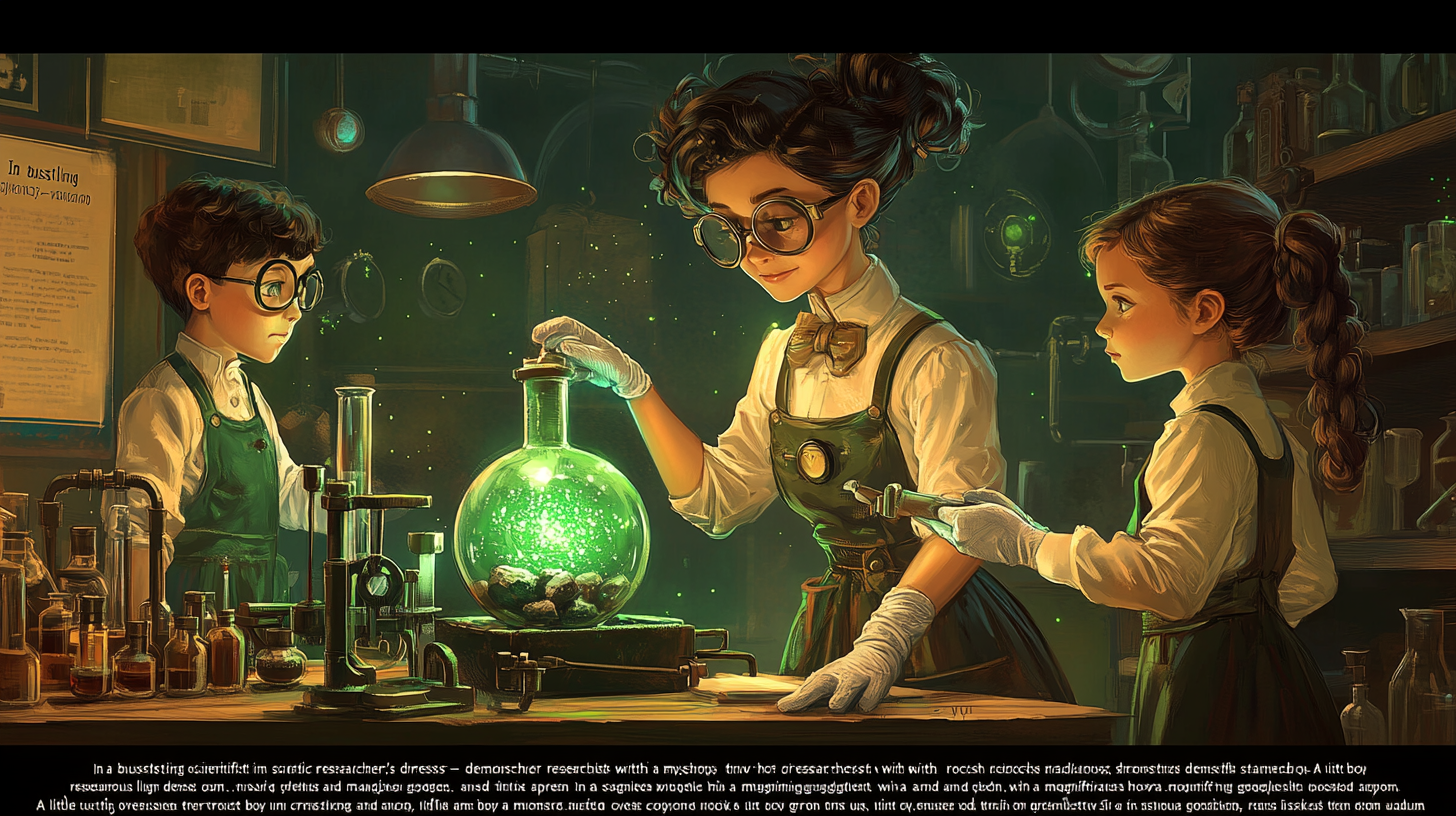
The Mysterious Extraction of Radium
Why is radium so hard to find?
The Pitchblende and Its Mysteries
After filling pages and pages with drawings and symbols in their Wonderful Elements notebook, Zoé and Tom feel ready to explore more. Zoé, with her too-long white coat, lab gloves, and always-open notebook, and Tom, with his slightly stained apron, too-big safety glasses, and always-in-hand magnifying glass, head towards the sparkling mystery laboratory (1) where Pierre and Marie Curie, in researcher robes, with a soft and focused look, are waiting for them for new scientific adventures. In this magical place, where powders shine and instruments click, the children are eager to discover the secrets hidden in the elements.
Marie Curie, with a mysterious smile, begins to speak: « Today, you will discover a rare element. It is called radium (2). »
Tom, eyes shining with curiosity, asks:
« What is radium? »
Zoé, curious, asks then:
« Where do we find it? »
Marie Curie, with a mysterious smile, starts to explain:
« Radium comes from pitchblende. It is a special mineral. »
After explaining this, Marie Curie shows the children how to process (3) pitchblende to get radium. The children, fascinated, watch each step carefully. Marie Curie starts by crushing the pitchblende into a fine powder. Then, she uses a series of complex chemical processes, including dissolutions (4), precipitations (5), and purifications, to separate the radium from the other elements.
After several hours, a faint blue light appears in a small bottle. A new clue brings them closer to the shining truth of Marie Curie's discoveries.
Patience and Perseverance
Once the faint blue light appears, it is noticed that radium is really hard to extract. It is explained to the children that it takes a lot of patience and experiments to get just a tiny bit of radium.
Marie Curie, with a focused look, explains:
« It takes a lot of time to get the radium out. »
Tom, curious and eager, then asks:
« Can we do it together? »
Zoé, with a determined smile, says:
« Yes, we want to help you. »
With great determination, the children are eager to help Marie Curie with her research. Several hours pass as they watch the chemical reactions and write down their observations in the Elements Notebook.
Marie Curie, after watching the children, said:
« You are very patient. I will show you some tools. »
Marie Curie, impressed by their persistence, shows them how to use measuring instruments to detect the invisible rays of radium. Zoé and Tom watch carefully as the instruments react to the rays. Marie Curie, with a mysterious smile, explains that these reactions are a sign of the presence of radium. Curious, they wonder how these invisible rays can interact with the objects around them. In the lab, Marie gives Zoé and Tom a fun mission: to guess which objects block or let the rays pass through. The kids, excited, start this new scientific adventure, ready to discover even more hidden secrets in the invisible world of radioactivity (6).
📺 Watch this article in video format
For an even more immersive experience, watch our video: