
Épisode · Wiki Storia
S1 - E9 | The Triumph of the Second Nobel and the Legacy of Science
Why is Marie Curie the only person to have won two Nobel Prizes in different sciences?
On the road to knowledge with music for 3 to 6 year olds!
Today, we are going to learn about Marie Curie.
Pictures of our little adventurers in action - can you come and play with them?
🎼 Ready to move, sing and dream?
This first melody will take you on a musical discovery of the world!
🎤 Move, sing, discover!
Let's get adventurous with this second soundtrack. 😀
🎙 Read the lyrics to our music:
The lyrics of the two songs are identical, only the melodies are different.
The adventure begins with a story and discoveries for 6 - 8 year olds!
📻 Listen to this article as a podcast
For an immersive experience, enjoy our article in podcast mode. Click the player below to start listening and let the article carry you away!
📝 Quick summary of key information
Why is Marie Curie the only person to have won two Nobel Prizes in different sciences?
Marie Curie is a famous scientist. She is known for her discoveries in physics and chemistry. She won two Nobel Prizes, which is very rare!
Marie Curie first won a Nobel Prize in physics for her work on radioactivity. Then, she won another Nobel Prize, this time in chemistry.
She discovered two special chemicals: radium and polonium. These chemicals are very special because they give off invisible energy called radioactivity.
Marie Curie is a unique example in the history of science. She shows that science is a journey without end, where each discovery leads to another.
The Triumph of the Second Nobel Prize and the Legacy of Science
Why is Marie Curie the only person to have received two Nobel Prizes in different sciences?
The Big Ceremony
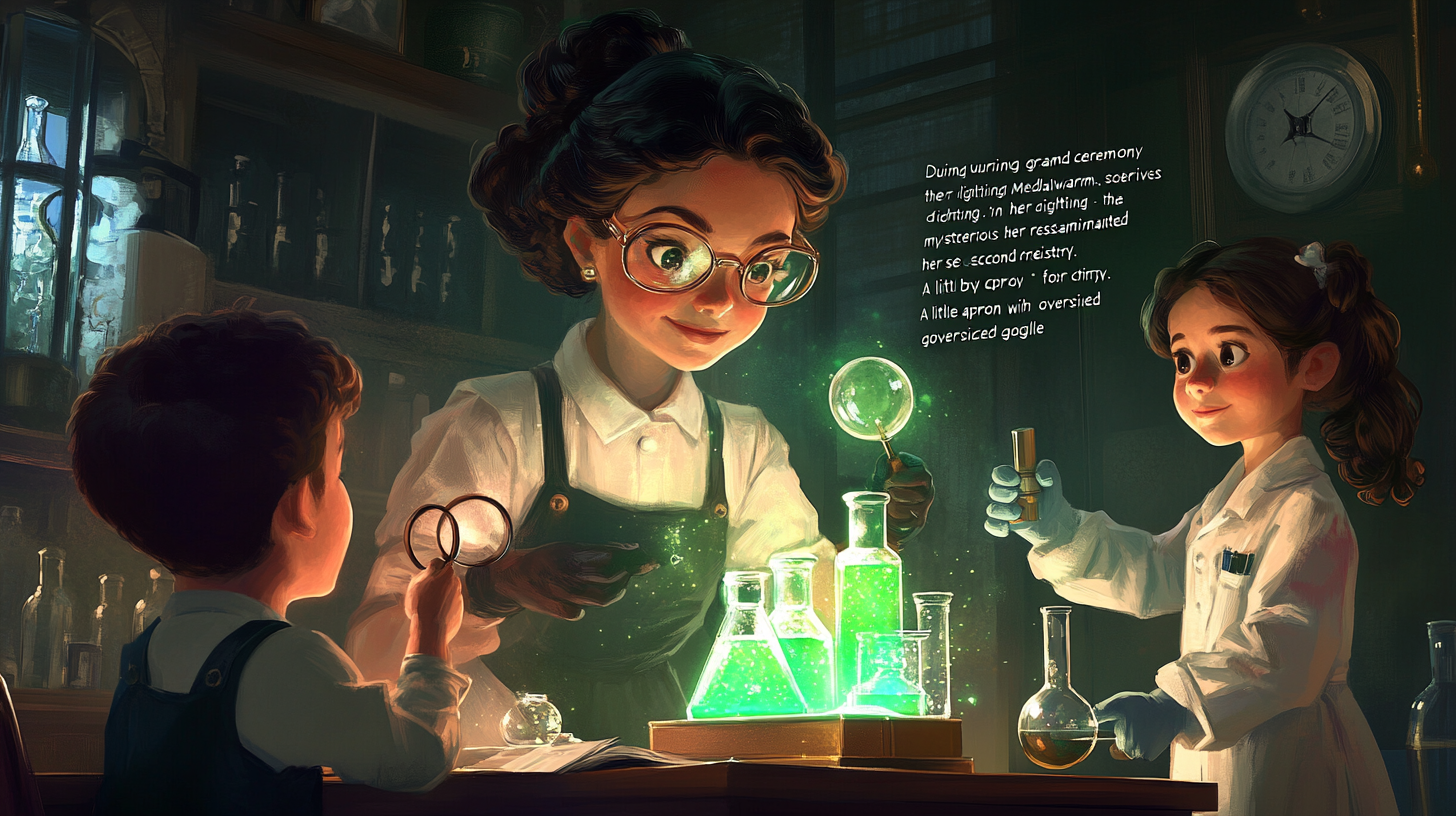
After being introduced into the Medal Room, Zoé and Tom are invited to discover a golden box containing a beautiful medal. This medal is the second Nobel Prize, the one for physics, received by Marie Curie for her discoveries about radioactivity, an invisible but powerful world. The scientist tells them how, with Pierre, she discovered mysterious elements (1) like polonium and radium. Zoé, with her too-long white coat, lab gloves, and always-open notebook, takes notes on every detail, while Tom, with his magnifying glass and too-big safety goggles, observes every corner of the medal, amazed by the engravings.
Marie Curie, with a kind smile, says:
« You are among the first children to see this medal. »
Tom, amazed, shouts:
« Wow, it's so beautiful! »
Zoé, curious about Marie's explanations, asks:
« Why can't we see radioactivity? »
Marie Curie, with a soft and focused gaze, explains:
« It is an invisible world. We cannot see it, but we can feel it. »
Not long after, Marie Curie tells Zoé and Tom some exciting news. She has been invited to a special (2) ceremony. She will receive a special prize for her work in chemistry (3). Zoé and Tom are invited to go with her. The ceremony takes place in a big auditorium (4) filled with scientists and curious people. Marie Curie goes on stage, wearing her researcher (5)'s dress, and receives the medal. Zoé and Tom, sitting in the front row, watch with admiration. Marie gives them a final message: science belongs to everyone who wants to understand and change the world with kindness.
The Legacy of Science
After the ceremony ended, Marie Curie took Zoé and Tom to the Noble Ideas Garden. She showed them the flowers and plants that grow there. Each flower represents a discovery. Marie Curie explained that each discovery is like a seed. Once planted, it can grow into new ideas and inventions.
Marie Curie, with a soft and focused look, begins to explain: « Look around you. Every flower you see here stands for a scientific discovery. Each discovery is like a seed. Once planted, it can grow and give birth to new ideas and inventions. This is how science moves forward, thanks to the curiosity (6) and kindness of those who want to understand the world. »
Zoé, amazed, whispers:
« It's like a magical garden. »
Tom, amazed, says:
« The flowers are beautiful. They shine. »
Marie Curie, with a kind smile, says:
« You are right, Tom. Some scientific discoveries can seem magical, like these glowing flowers. But really, they are the result of lots of hard work and curiosity. Science, like these flowers, can shine and light our way to new understandings of the world. »
Marie Curie tells how her work inspired other scientists to explore the world of radioactivity even more. Zoé and Tom listen carefully, understanding that science is a never-ending journey where each discovery leads to another. Marie talks to them about the importance of patience and perseverance (7), qualities that are essential for every scientist.
Marie Curie, with a gentle and focused look, starts to speak:
« Patience and perseverance are important. »
With stars in their eyes and hearts full of dreams, Zoé, a little girl with a white lab coat that's too long, lab gloves, and a notebook always open, and Tom leave Marie Curie's laboratory. Marie Curie, dressed in a researcher's gown, with a soft and focused gaze, often lit up by a mysterious green light, is ready to share their discoveries. A final sign of encouragement is given, knowing that the future of science is in good hands. Patience and perseverance, essential qualities for any scientist, are highlighted by Marie Curie. Who knows what new adventures await them, perhaps even a meeting with a curious cat named Schrödinger, or an exploration of the mysteries of the universe?
📺 Watch this article in video format
For an even more immersive experience, watch our video: