
Épisode · Wiki Storia
S1 - E3 | The Magic Automata
How can robots move and do things?
On the road to knowledge with music for 3 to 6 year olds!
Today, we are going on a robot adventure.
Pictures of our little adventurers in action - can you come and play with them?
🎼 Ready to move, sing and dream?
This first melody will take you on a musical discovery of the world!
🎤 Move, sing, discover!
Let's get adventurous with this second soundtrack. 😀
🎙 Read the lyrics to our music:
The lyrics of the two songs are identical, only the melodies are different.
The adventure begins with a story and discoveries for 6 - 8 year olds!
📻 Listen to this article as a podcast
For an immersive experience, enjoy our article in podcast mode. Click the player below to start listening and let the article carry you away!
📝 Quick summary of key information
How can robots move and do things?
Robots move with motors and gears. For example, a robot can have wheels or legs that move with these motors. It's like the robot has magic legs or wheels that let it move everywhere.
Robots do things with computer programs. These programs tell the robot what to do, like pick up an object or move to a special place. It's like the robot is following a recipe to do its jobs.
Leonardo da Vinci made automata, which are machines that copy human movements. These automata worked with complex mechanisms. Imagine a mechanical bird that can fly with gears and springs.
The main parts of a robot are the motors, the gears, the sensors, and the computer programs. The sensors help the robot feel what is around it, like light or obstacles. It is like the robot has eyes and ears to see and hear its surroundings.
Robots are helpful because they can do hard or dangerous tasks for humans. For example, they can explore dangerous places or help build things. It's like having a mechanical superhero that helps us every day.
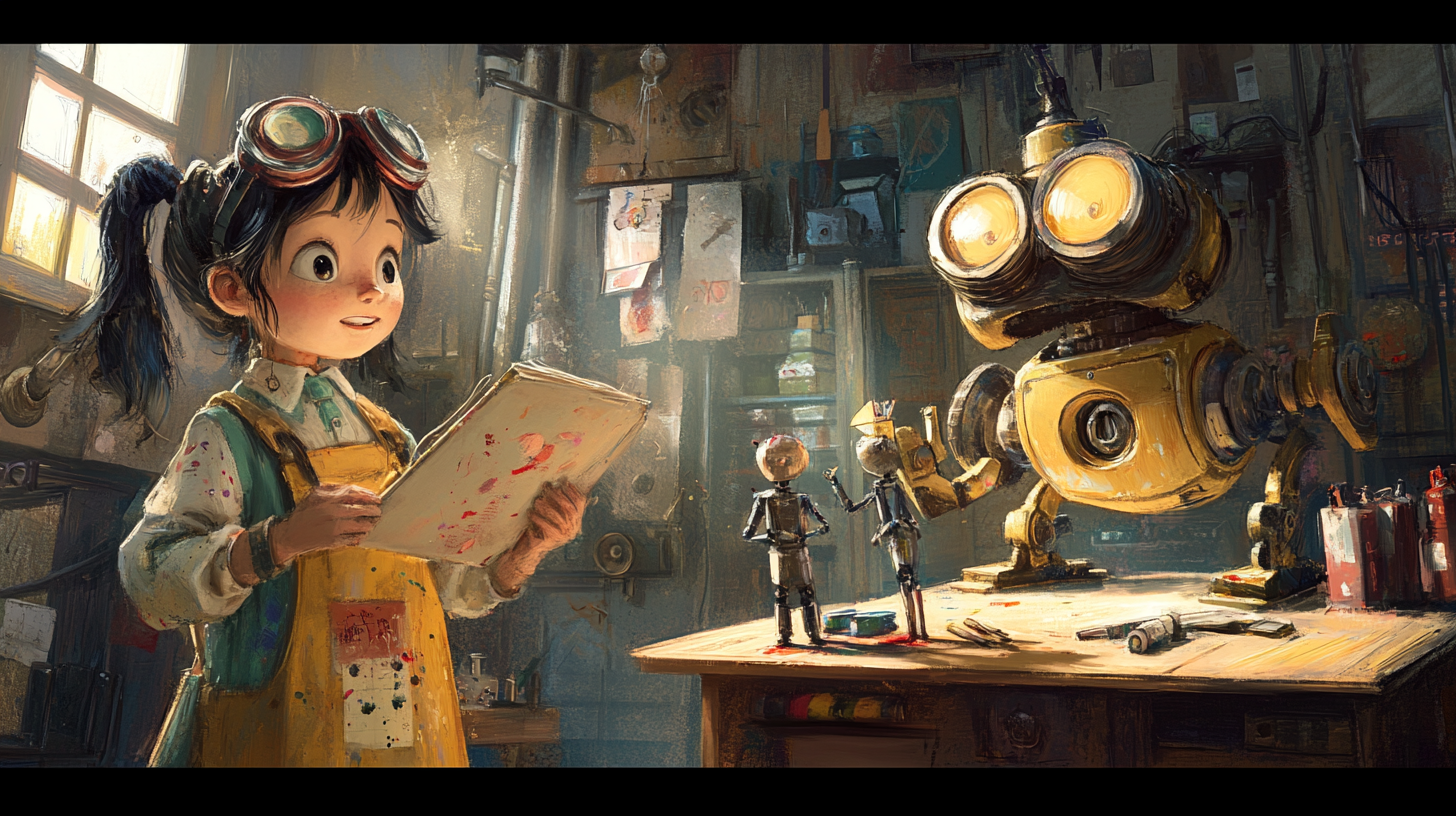
Magical Automata
How can robots move and do things?
The Discovery of the Automata
After exploring Leonardo da Vinci's bridge, Lea and Max are drawn to another wonder in the room. The kids are invited to discover how wooden beams and cables support the weight of a herd of wild horses. The principles of balance (1) and material strength (2) are explained while admiring the master's architectural (3) feats. Their curiosity piqued, they are then guided to the Automata Room, where they hope to find new wonders to explore.
Not long after, they enter the Room of Automata. The room is filled with amazing machines. Automata of all shapes and sizes are lined up on the shelves. Lea and Max have wide eyes of wonder.
Lea, amazed, says:
« Look, Max! The automatons are moving by themselves. »
Max, amazed, shouts:
« It's magic! How do they move? »
Lea, curious about the moving automata, suggests:
« Let's go take a closer look. »
They walk up to a knight-shaped automaton. Its arms move thanks to well-oiled gears (4). Max takes out his sketchbook and notes every detail. Lea, with her safety goggles on her head, examines the gears and cables. They discover that the automatons use weights and springs to make precise movements.
By studying the inner (5) workings, they learn how these machines work and how they were designed. Suddenly, a lion-shaped automaton starts to roar, surprising the two kids. They laugh at this unexpected discovery, realizing that Leonard also had a sense of humor. They decide to keep exploring the other automata.
Experimentation and Innovation
After finding out the secrets of the automata, Lea and Max keep exploring. They go near an automaton shaped like a musician. Its fingers move over invisible keys, playing a gentle melody. The two friends are amazed by the precision of the movements.
Max, amazed, shouts:
« This is amazing! How does it play music? »
Lea, curious about the mechanism, exclaims:
« Look at the gears! They turn and make the fingers move. »
Max, after watching the mechanisms, suggests:
« We should try to do the same with our automaton. »
After looking at the mechanisms, Lea says: « Yes, but we need electric motors (6). Leonard didn't have any. »
Max, full of hope, suggests:
« Let's go to the Invention Garden. Maybe we'll find some ideas. »
After discovering the secrets of the automata, Lea and Max can't wait to put what they've learned into practice. They head to the Invention Garden, where they can test their own creations. Watching a red squirrel jump from branch to branch, they understand the importance of experimenting and innovating to create even more amazing inventions. They promise to come back soon to continue their adventures and discover other hidden wonders in Leonardo da Vinci's workshop.
📺 Watch this article in video format
For an even more immersive experience, watch our video: