
Épisode · Wiki Storia
S1 - E4 | The Invention Garden
Why is it important to test and experiment when you invent something?
On the road to knowledge with music for 3 to 6 year olds!
Today, we are going to learn about the importance of testing and experimenting.
Pictures of our little adventurers in action - can you come and play with them?
🎼 Ready to move, sing and dream?
This first melody will take you on a musical discovery of the world!
🎤 Move, sing, discover!
Let's get adventurous with this second soundtrack. 😀
🎙 Read the lyrics to our music:
The lyrics of the two songs are identical, only the melodies are different.
The adventure begins with a story and discoveries for 6 - 8 year olds!
📻 Listen to this article as a podcast
For an immersive experience, enjoy our article in podcast mode. Click the player below to start listening and let the article carry you away!
📝 Quick summary of key information
Why is it important to test and experiment when you invent something?
Testing and experimenting means trying different things to see what works best. Imagine you want to invent a new toy. If you don't test your idea, you won't know if it's fun or if it works well.
Testing helps to find out what works well and what does not. For example, if you want to invent a new type of remote-controlled car, you need to test it to see if it drives well, if it turns correctly, and if it is strong.
If you don't test enough, your invention might not work as planned. For example, a remote-control car that hasn't been tested might not move or break easily. This could make children sad and unhappy.
Mistakes and failures are important steps in the invention process. They help you learn and improve your invention. For example, Thomas Edison tested more than 1000 times before he found the right light bulb. Without testing, he would never have succeeded!
The Invention Garden
Why is it important to test and experiment when you invent something?
The Discovery of the Invention Garden
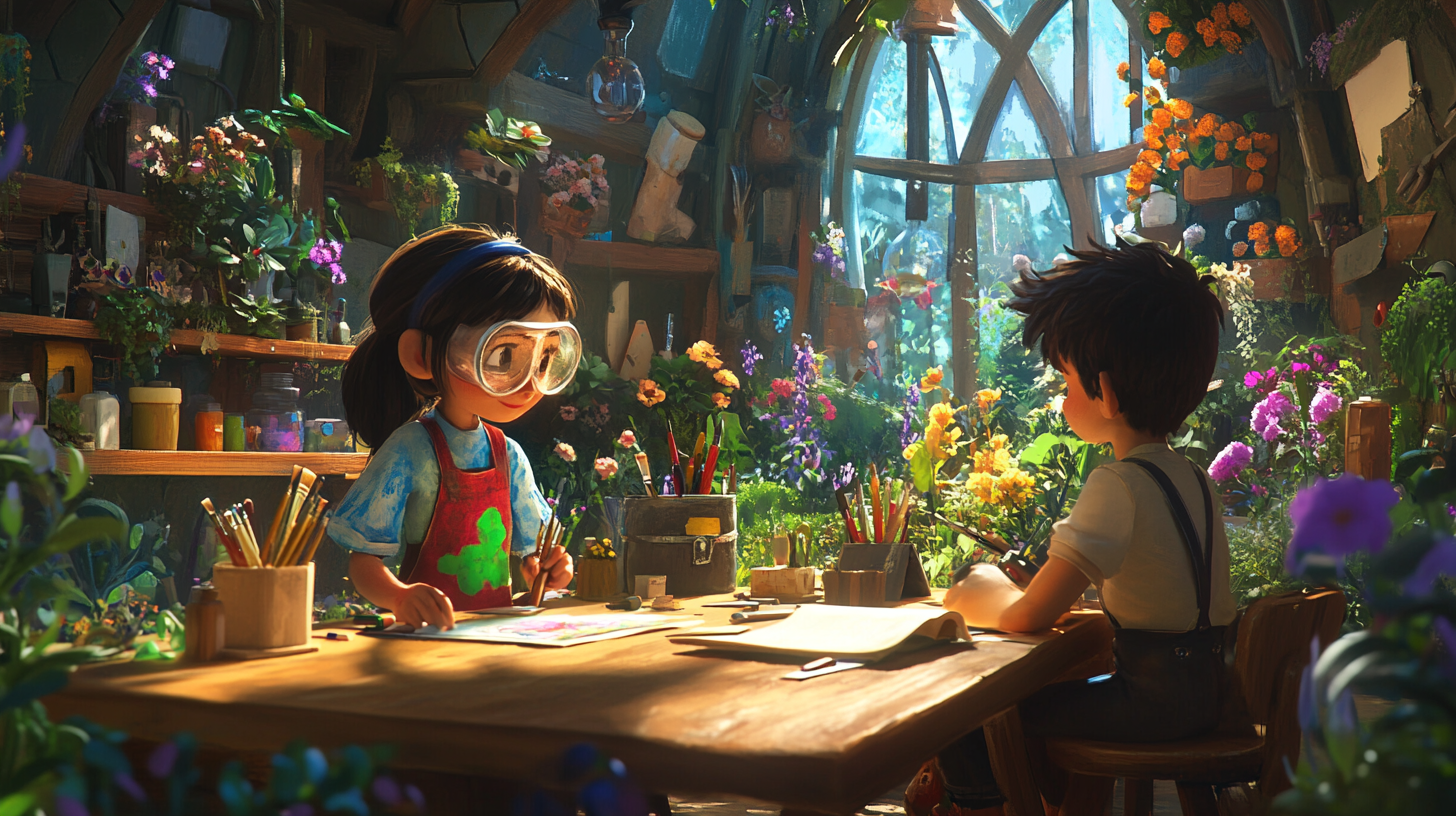
After watching Leonardo da Vinci's automata (1), machines made of wood and metal that moved like living animals, Lea, wearing a painter's smock with paint splatters and safety goggles on her head, and Max, a imaginative boy with a sketchbook always within reach and tools hanging from his belt, understand how simple mechanisms (2) can bring inanimate (3) creations to life. The children, amazed, wonder what other inventions await them. Soon after, they find themselves in the Invention Garden, a green space where plants and flowers grow in harmony with Leonardo's inventions. Here, they can test their own creations and discover the secrets of nature and science.
Lea, amazed, says: « Look Max, colorful butterflies are flying everywhere. It's incredible how nature and inventions live together (4) here. It's like Leonardo da Vinci's inventions inspired nature itself! »
Max, amazed, says:
« That's right! And look, the birds are singing very loudly. It seems like they are happy to see all these inventions around them. Maybe they get inspired by Léonard's creations to build their nests. »
Lea, amazed by the butterflies, explains to Max:
« The colors of the butterflies hide them among the flowers. »
Max, fascinated by the movements of animals, says: « You're right, Lea. Snakes slide silently on the ground, as if their scales (5) were inspired by Leonardo da Vinci's inventions. It seems like they move with the same precision as the mechanisms he drew. »
After watching birds, butterflies, and snakes, the children are inspired by nature and the inventions of Leonardo da Vinci. They decide to create their own inventions. Inspired by the changing colors of butterflies, Lea imagines a robot that can change color. Max, on the other hand, draws a silent vehicle, inspired by the quiet movement of snakes. They start to gather materials in the garden to bring their ideas to life.
After starting to gather materials in the garden, the children get to work. By experimenting and learning from their mistakes, they see how important trying and failing is in the invention process.
The Importance of Trying and Making Mistakes
After trying things out, they see that every mistake brings them closer to success. They decide not to give up and to keep adjusting their inventions.
Lea, thinking about her creation, says: « Max, I am going to add light sensors (6). »
Max, thinking about his next step, says:
« I will use softer materials. »
Lea, after thinking, says:
« The robot must change color with the light. »
Max, after thinking, says:
« The vehicle must be as quiet as cats. »
After many tries, they finally succeed. Their inventions work perfectly. They then understand that testing and experimenting is very important.
After exploring the wonders of the Invention Garden, Lea and Max discover a coded (7) notebook from Leonardo da Vinci, filled with mysterious symbols. Curious, they wonder how this genius protected his revolutionary ideas. A small white owl, perched on a shelf, seems to be watching them with curiosity, as if it holds the keys to this mystery. The children, excited by this new discovery, decide to unravel the secret of the coded notebook. Max, who always has a sketchbook handy, is especially intrigued. They know this adventure will lead them to new inventions and even more fascinating knowledge.
📺 Watch this article in video format
For an even more immersive experience, watch our video: