
Épisode · Wiki Storia
S1 - E7 | Leonardo's Submarine
How can submarines travel underwater?
On the road to knowledge with music for 3 to 6 year olds!
Today, we are going on an adventure to discover submarines.
Pictures of our little adventurers in action - can you come and play with them?
🎼 Ready to move, sing and dream?
This first melody will take you on a musical discovery of the world!
🎤 Move, sing, discover!
Let's get adventurous with this second soundtrack. 😀
🎙 Read the lyrics to our music:
The lyrics of the two songs are identical, only the melodies are different.
The adventure begins with a story and discoveries for 6 - 8 year olds!
📻 Listen to this article as a podcast
For an immersive experience, enjoy our article in podcast mode. Click the player below to start listening and let the article carry you away!
📝 Quick summary of key information
How can submarines travel underwater?
A submarine is a special boat that can dive under water. It is like a fish that swims both on the surface and deep down. Submarines are used to explore the oceans, watch the ocean floor, and even for secret missions.
To stay underwater, submarines use ballast tanks. These are tanks that fill with water. When the ballast tanks are full, the submarine becomes heavier and sinks underwater, like a stone in a pond.
To go up to the surface, submarines push water out of their ballasts. This makes them lighter, and they go up to the surface, like a cork that floats. It's a bit like blowing into a straw to make an object go up in the water.
Submarines move with the help of propellers, just like boats. These propellers are powered by engines that let the submarine move forward, backward, or turn. It's as if the submarine has invisible wheels that push it through the water.
Leonardo's Submarine
How can submarines travel underwater?
The Prototype Exploration
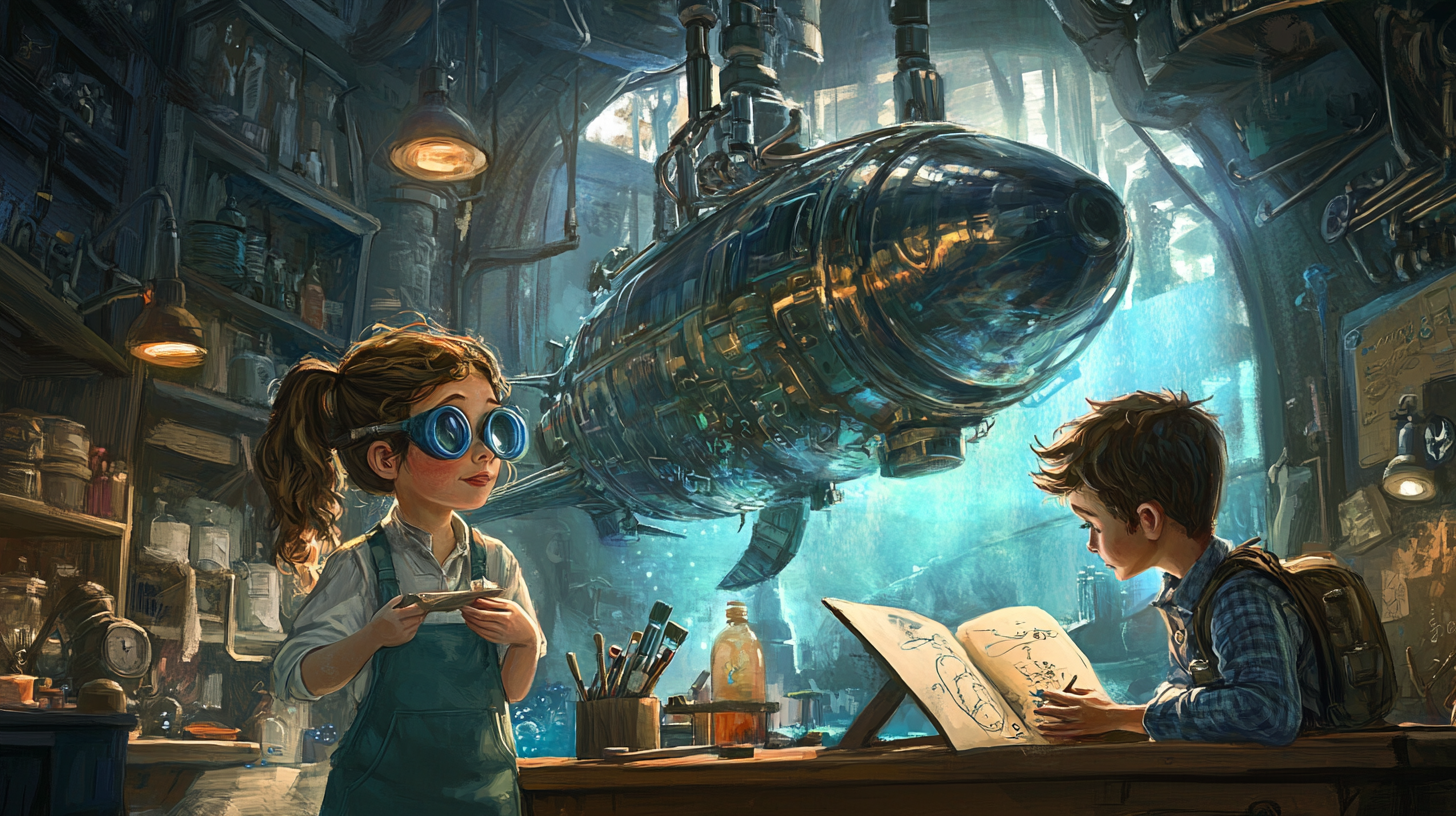
After discovering Léonard de Vinci's war machine and thinking about the importance of finding peaceful solutions to conflicts, Lea and Max head towards another fascinating invention. A little blue bird guides them to a submarine (1) prototype (2), inviting them to explore the mysteries of underwater navigation (3). Lea, with her insatiable curiosity, wears a paint-splattered artist's smock and has safety goggles on her head. She rushes towards the prototype, while Max, always ready to draw, takes out his notebook to sketch the details of this new discovery.
Lea, her eyes shining with excitement, says: « Lea and Max explore a model of a submarine by Leonardo da Vinci, fascinated by its ability to travel underwater. By studying the plans and testing models, they learn the principles (4) (5) of underwater navigation and how submarines work. »
Max, as he looks at the details, starts to explain: « I am going to draw the different parts. The mechanisms (6) are complicated. »
Lea, always eager to learn, explains: « The ballasts (7) are tanks filled with water. They help the submarine dive or rise. »
Max, looking at the details of the submarine, explains:
« The propellers help it move. They push the submarine forward. »
After studying the plans, Lea explains to Max:
« Modern submarines use the same principles. They travel underwater with these systems. »
By studying the plans and testing models, they learn the principles of underwater navigation and how submarines work.
Underwater Travel Secrets
After testing the small models, Lea and Max decide to build a bigger one. They want to check their new knowledge about submarines.
Lea, excited by the discoveries, says:
« Max, we need to build a bigger model. We will use the plans from Leonardo. »
Max, focused, starts to explain:
« Okay, Lea. We need to follow the instructions carefully. The ballasts and the propellers are important. »
Lea, while looking at the plans, explains to Max:
« The ballasts fill with water to dive. The propellers spin fast to move forward. »
Max, after thinking for a moment, adds:
« We also need to use electric motors. They spin the propellers. »
After several tries, they adjust the ballasts and the propellers. The model works well underwater. But suddenly, it starts to sink.
Lea, after checking the ballasts, says:
« Max watches carefully. A ballast is open. It lets water in. »
Max, after looking at the problem, says:
« I will close it. The model comes back up to the surface. »
After adjusting the ballasts and propellers on the submarine model, Lea and Max are invited to explore a new room filled with sketches. Among the drawings, a sketch of a white horse catches their attention. Intrigued, they discover the anatomical (8) drawings of Leonardo da Vinci, fascinated by their precision and detail. With her safety goggles always on her head and her paint-splattered artist's smock, Lea observes the muscles and bones drawn with incredible precision. Max, on the other hand, takes out his sketchbook and starts drawing the anatomical details, noting the proportions and possible movements. They then realize that Leonardo da Vinci was not just an inventor, but also an artist and a scientist. By discovering these drawings, they feel inspired to continue their own explorations and inventions, ready to uncover new mysteries and learn even more.
📺 Watch this article in video format
For an even more immersive experience, watch our video: