
Épisode · Wiki Storia
S1 - E2 | The Harmonics of the World with Pythagoras
How can math make music?
On the road to knowledge with music for 3 to 6 year olds!
Today, we are going on a journey to discover math and music.
Pictures of our little adventurers in action - can you come and play with them?
🎼 Ready to move, sing and dream?
This first melody will take you on a musical discovery of the world!
🎤 Move, sing, discover!
Let's get adventurous with this second soundtrack. 😀
🎙 Read the lyrics to our music:
The lyrics of the two songs are identical, only the melodies are different.
The adventure begins with a story and discoveries for 6 - 8 year olds!
📻 Listen to this article as a podcast
For an immersive experience, enjoy our article in podcast mode. Click the player below to start listening and let the article carry you away!
📝 Quick summary of key information
Pythagoras, a Greek philosopher, found out that sounds can be connected to numbers. While playing with strings, he noticed that different lengths make different notes. It's like numbers and sounds are best friends!
Imagine a guitar string. If you make it shorter, the note becomes higher. If you make it longer, the note becomes lower. Isn't that cool? But really, it's just math!
This discovery shows that the universe is organized. Math is everywhere, even in music. It explains why some notes sound good together and others do not. It is as if nature follows a secret score.
For example, a piano keyboard follows special math rules. The white and black keys are placed to make nice sounds. It's because of math that music sounds so beautiful!
The Harmonics of the World with Pythagoras
How can math make music?
The Room of Musical Numbers
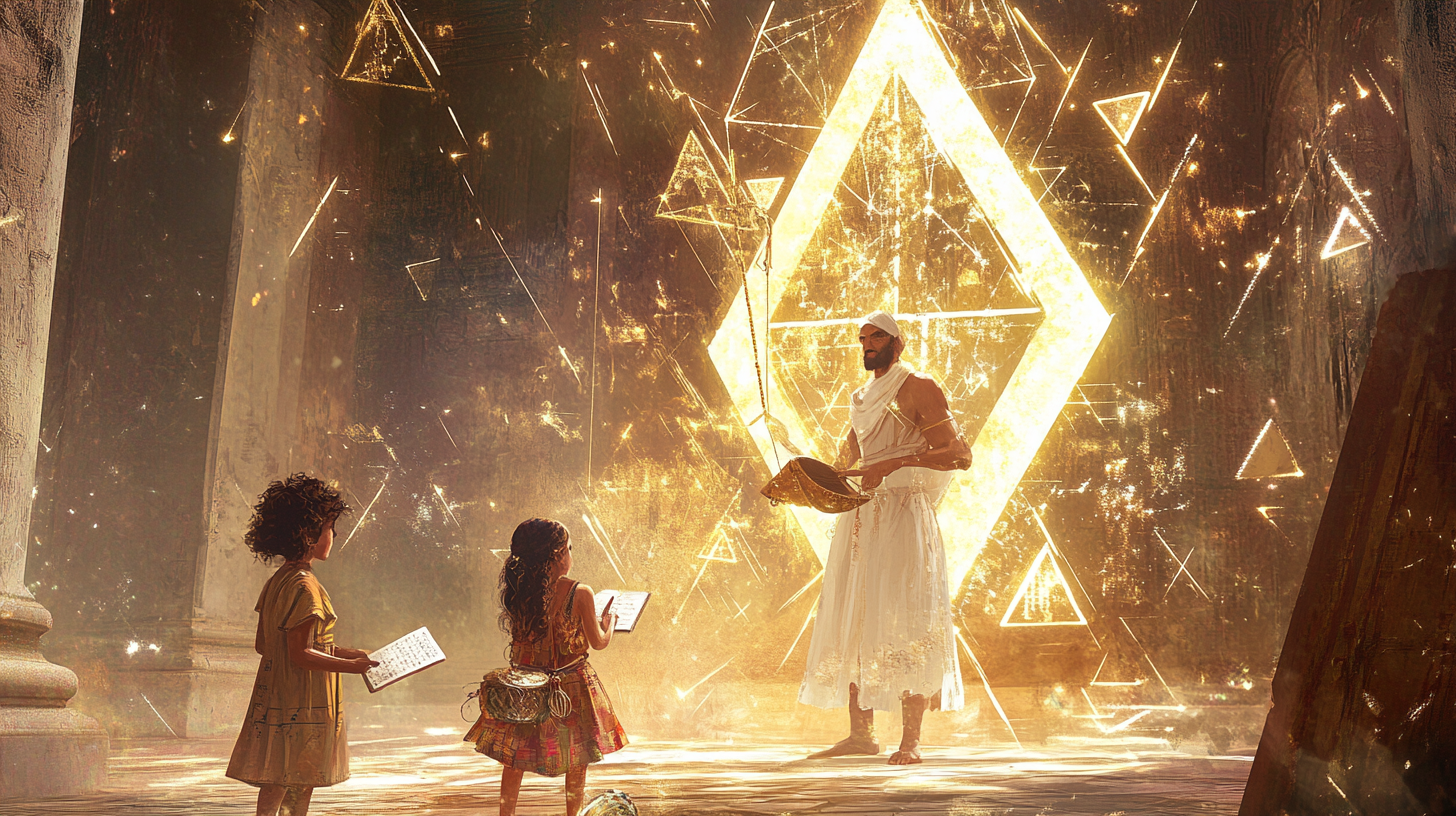
After listening to Thales explain how important water is, Sarah and Sofiane start a new adventure. They follow the river and watch the butterflies and fish that live there. They discover that water is essential for life and for thinking. A butterfly is seen, landing on a leaf, before Thales explains that everything is connected to water. Then, they start another adventure by following the river, which leads them to a new world. When they arrive in a room filled with chimes and glowing triangles, they are amazed by what they find.
Sofiane, amazed, says:
« Wow, this is amazing! »
Sarah, amazed, says:
« Yes, all these sounds are so soft. »
Soon after, a man with messy (1) brown hair and sparkling eyes appears. He plays with golden strings, making harmonious (2) notes. It's Pythagoras. He walks up to the children, smiling.
Pythagoras, curious, then asks:
« Hi! Do you like sounds? »
Sofiane, amazed, says:
« Yes, it's very beautiful! »
Sarah, curious about the golden strings, asks:
« What are you doing with these strings? »
Pythagoras, with a cheeky smile, says:
« I'm playing with sounds. Listen carefully. »
By stretching a golden string, Pythagoras lets them hear a pure (3) note: it reveals a sequence of numbers (4), a new clue for their quest.
The Secrets of the Singing Triangles
After listening to the pure note, Sarah watches carefully while Sofiane is amazed. They look at Pythagoras with sparkling eyes of curiosity. Pythagoras, with his notebook in hand, is already asking questions about sounds and numbers.
Sarah, curious, asks: « How do you make (5) these sounds? »
Sofiane, amazed, exclaims:
« It's incredible how a simple note can reveal numbers! »
Pythagoras, with a mysterious smile, explains:
« Sounds come from strings and triangles. Each length makes a different note. »
Pythagoras shows the children the shiny triangles. They glow in different colors. He explains that each triangle makes a melody depending on its size. Sarah and Sofiane watch carefully.
Sarah, after watching the shiny triangles, says:
« I want to draw these triangles. I am going to write down the measurements. »
Sofiane, curious about the glowing triangles, says: « I am going to calculate the ratios. Math (6) is everywhere! »
After listening to the pure note revealed by Pythagoras' golden string, Sarah and Sofiane are intrigued by the sequence of numbers that appears. They wonder what it means. Suddenly, a golden light appears and guides them to a new room. Upon entering, they discover a strange room filled with chimes and glowing triangles. Once inside, they find a large marble bath where Pythagoras, an ancient Greek philosopher passionate about mathematics and the mysteries of the universe, waits for them with a big smile. He is going to explain why some objects float while others sink. Sarah and Sofiane, curious and enthusiastic, are ready to discover new mysteries and solve new puzzles. Their adventure continues, filled with discoveries and wonders.
📺 Watch this article in video format
For an even more immersive experience, watch our video: