
Épisode · Wiki Storia
S1 - E4 | Aristotle's Natural Inventory
How do we sort all the animals in the world?
On the road to knowledge with music for 3 to 6 year olds!
Today, we are going to discover animals.
Pictures of our little adventurers in action - can you come and play with them?
🎼 Ready to move, sing and dream?
This first melody will take you on a musical discovery of the world!
🎤 Move, sing, discover!
Let's get adventurous with this second soundtrack. 😀
🎙 Read the lyrics to our music:
The lyrics of the two songs are identical, only the melodies are different.
The adventure begins with a story and discoveries for 6 - 8 year olds!
📻 Listen to this article as a podcast
For an immersive experience, enjoy our article in podcast mode. Click the player below to start listening and let the article carry you away!
📝 Quick summary of key information
Once upon a time, there was a wise man named Aristotle. He invented a way to sort animals. He grouped them by their features, like fur, feathers, or fins.
Sorting animals is very important. It helps us understand how they are alike and different. For example, dogs and cats have fur, while birds have feathers.
There are three big groups of animals. Animals with fur, like dogs and cats. Animals with feathers, like birds. And finally, animals with fins, like fish.
This sorting helps children learn. They can recognize and understand the different features of animals, which makes learning more fun and easy.
Aristotle's Natural Inventory
How to sort all the animals in the world?
The Garden of Classifications
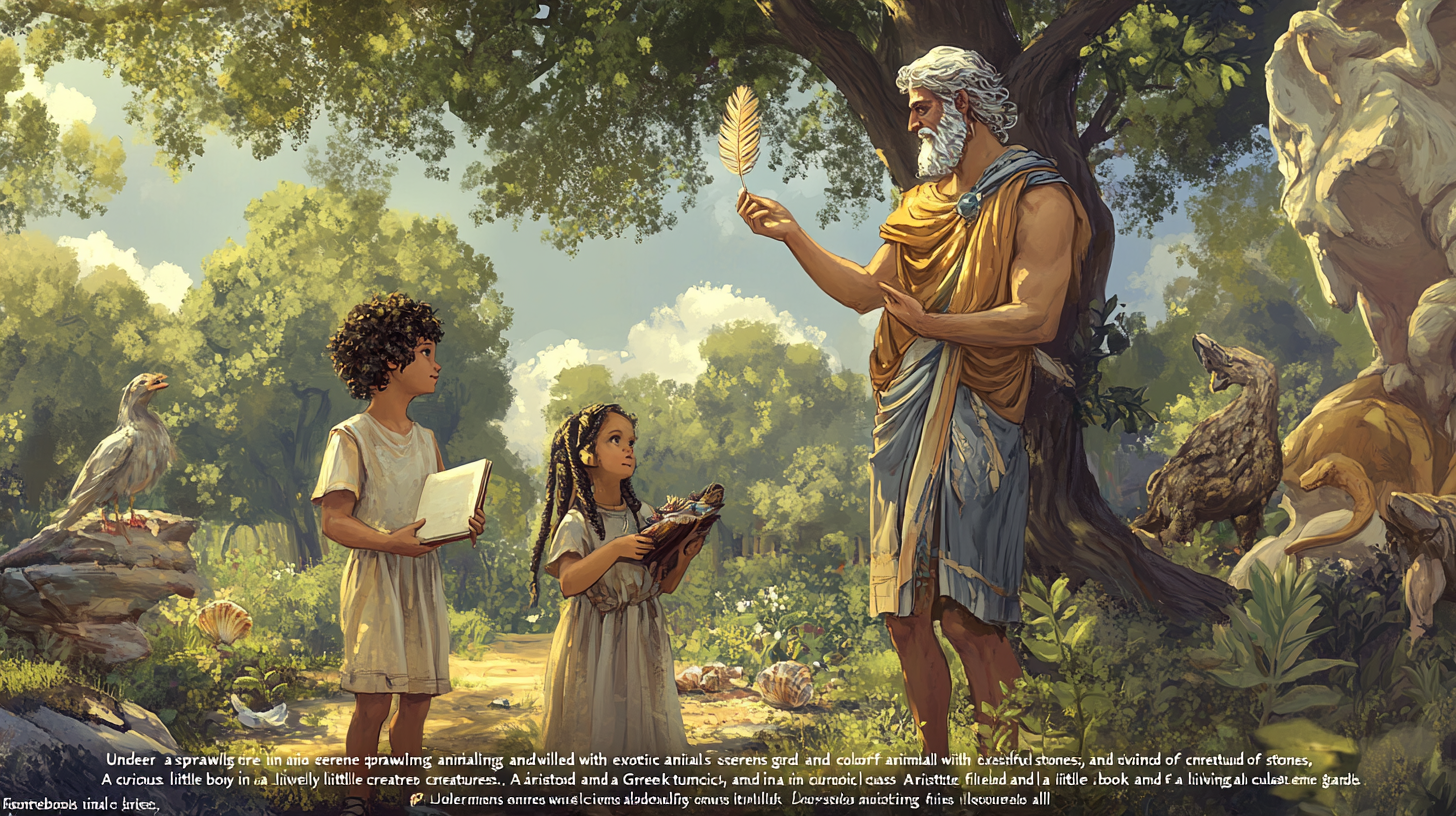
After playing with Archimedes and his pet alligator, the children discover why some things float and others sink. They even saw a piece of metal float thanks to Archimedes' principle (1). Once the water was calm, Sarah and Sofiane suddenly found themselves in a peaceful garden. They spotted a man with curly brown hair and piercing green eyes, wearing a tunic and a cloak. He always has a small notebook in his pocket to write down his observations and ideas. This man is Aristotle, a nature and animal lover. He is surrounded by strange animals and colorful stones, under a big, majestic (2) tree.
Aristotle, with a warm smile, says:
« Hello, I am Aristotle. You are in my garden. »
Sofiane, amazed, says:
« Hello Aristotle, this is a wonderful garden. »
Sarah, amazed by the variety of animals, asks:
« There are so many animals here. How do you sort them? »
Aristotle, with a sly smile, explains:
« I invented a method. Animals have fur, feathers, scales, or fins. That's how I sort them. »
Sofiane, excited, says: « That's a great idea. I will count the kinds (3) of animals. »
Soon after, Aristotle gives a rare feather to Sarah. She looks at it and finds a carved symbol. Sofiane counts the animals. He notices that some, like the butterflies, have bright colors. Aristotle is fascinated and writes everything down in his notebook. Sarah and Sofiane are ready for the next part of their adventure.
The Mysteries of Feathers and Fur
After looking at the feather, Sarah and Sofiane follow Aristotle into the garden. They find a snake sliding between the stones. Aristotle explains that the way the snake moves (4) and the structure of its scales help it to move silently.
Aristotle, fascinated by the snake, explains:
« It is very important for hunting and avoiding dangers. »
Sarah, amazed by the discovery, exclaims:
« It's fascinating! Every detail in nature has a special purpose. »
Aristotle, with a smile lighting up his face, starts to explain: « Exactly. Just like the snake, every animal has unique features (5) that help it survive. For example, furry animals, like lions and bears, have thick fur to keep them warm in the cold. Similarly, feathered animals, like birds, have light feathers that help them fly. »
Sofiane, after listening carefully to Aristotle, says: « That's right, every animal has amazing adaptations (6). I will write down all these features to understand them better later. »
Sarah, her eyes sparkling with curiosity, says:
« I am going to draw the animals in my notebook. »
After discovering the secrets of animals and stones with Aristotle, the young boy with curly brown hair and piercing green eyes, Sarah and Sofiane follow a path of flowers to another garden. They find Hippocrates, surrounded by pots and mortars. A white rooster crows happily, while a black cat watches them curiously. Hippocrates, in a white tunic, mixes herbs and petals, ready to reveal the mysteries of natural remedies. Sarah and Sofiane, armed with their new knowledge, are eager to learn what Hippocrates has to teach them. They now know that every detail in nature is important and that all it takes is good observation to understand the wonders of the world around them.
📺 Watch this article in video format
For an even more immersive experience, watch our video: