
Épisode · Wiki Storia
S1 - E9 | Stars Revealed by Anaxagora
What if the sun and the moon were not gods but things like the Earth?
On the road to knowledge with music for 3 to 6 year olds!
Today, we are going on a journey to discover the Sun and the Moon.
Pictures of our little adventurers in action - can you come and play with them?
🎼 Ready to move, sing and dream?
This first melody will take you on a musical discovery of the world!
🎤 Move, sing, discover!
Let's get adventurous with this second soundtrack. 😀
🎙 Read the lyrics to our music:
The lyrics of the two songs are identical, only the melodies are different.
The adventure begins with a story and discoveries for 6 - 8 year olds!
📻 Listen to this article as a podcast
For an immersive experience, enjoy our article in podcast mode. Click the player below to start listening and let the article carry you away!
📝 Quick summary of key information
A long time ago, a philosopher named Anaxagoras had a big idea. He said the sun and the moon are not gods, but objects like the Earth. Can you imagine that?
Anaxagoras thought that stars, like the sun and the moon, are made of the same stuff as our planet. In other words, they are made of rocks, dirt, and metals. This changed the way people thought about the universe.
To understand this, just look at the sky. When you see the stars, the sun, and the moon, you can tell they are natural things. They are not magical, but real and visible.
So, Anaxagoras showed that everything can be explained by science. The stars are not gods, but objects that we can study and understand. It is thanks to observations and thoughts like those of Anaxagoras that we know so much about the universe today.
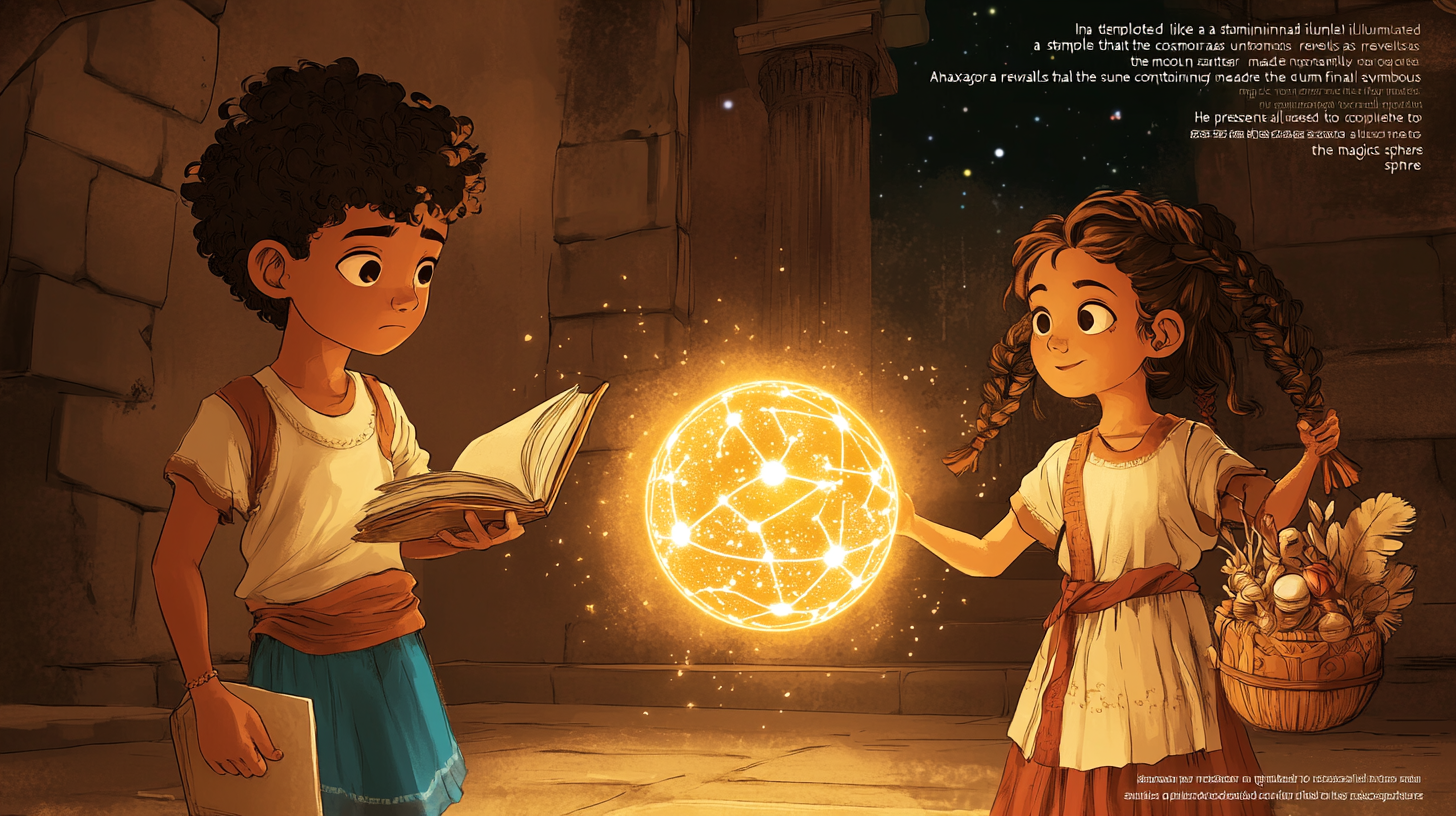
The Stars Revealed by Anaxagora
What if the sun and the moon were not gods but objects like the Earth?
The Star Temple
After watching a show (1) where nature's elements (2) danced before the amazed eyes of an ancient (3) lion, it is revealed to Sarah and Sofiane that air, water, earth, and fire can create wonders together. They leave the ancient theater, still amazed by the show, and head towards a temple shining like the night sky. Anaxagora waits for them there, her eyes lifted towards the twinkling stars. She beckons them to join her, a mysterious smile on her lips. Sofiane, always clever and enthusiastic, is then asked what Anaxagora has to show them next. Sarah, on the other hand, is asked to observe the stars with fascination, wondering what these shiny points could hide.
Sofiane, with his eyes wide open, asks:
« What are these stars? »
Sarah, amazed, whispers:
« They are so pretty. They look like diamonds in the sky. »
Anaxagora, with a mysterious smile, explains:
« The stars are made of the same stuff as the Earth. They are like rocks that shine. »
Sofiane, always curious, asks:
« How do we know what stars are? »
Anaxagora, always curious, explains:
« We watch and use math. We can understand without magic. »
Suddenly, a shooting star streaks across the sky, leaving a glowing trail, as if to show Anaxagora's words. Intrigued by the sight, Sarah turns to her, followed by Sofiane. In a temple as shiny as the night sky, a glowing moonstone is then held out by Anaxagora. It holds the last symbol to place in the magic sphere, allowing Sarah and Sofiane to go home.
The Secrets of the Stars
Anaxagora gives them a glowing moonstone, containing the last symbol to place in the magic sphere to go home. She explains that this stone contains minerals found on the Moon, brought by meteors (4). Sarah and Sofiane, amazed, look at this discovery. Anaxagora then shows them an old telescope, with which they can observe the Moon's craters and sunspots. Sofiane, fascinated, asks how we can measure the distance between Earth and the Moon.
Anaxagora, with a smile lit up by curiosity, explains:
« Scientists use methods like parallax and light echoes to measure these distances. »
Sarah, curious about the stars, asks:
« Why does the Moon change shape every night? »
Anaxagora, with a smile lit up by the starlight, begins to explain:
« The Moon changes shape because of its phases. Sometimes, it is between the Earth and the Sun. Sometimes, it is on the other side. »
Sofiane, curious about the Moon, asks:
« What happens if the Moon disappears? »
Anaxagora, curious about Sofiane's question, thinks for a moment before answering: « Without the Moon, the tides (5) would be smaller and the night would be darker. »
With the moonstone in hand, Sarah and Sofiane are ready to go back home, but they know that more adventures await them. Maybe one day, they will meet other wise people (6), like Hypatia, the Egyptian mathematician, or Al-Khwarizmi, the father of algebra (7). And who knows, maybe they will even meet fantastic animals like dragons or phoenixes! Before leaving, Anaxagora gives them a small telescope so they can keep watching the stars at home. Sarah and Sofiane thank her warmly and promise to come back soon. They go home with their heads full of new knowledge and wonders to share.
📺 Watch this article in video format
For an even more immersive experience, watch our video: